
Corporate Event Livestreaming in Fort Lauderdale: The 2026 Strategic Guide
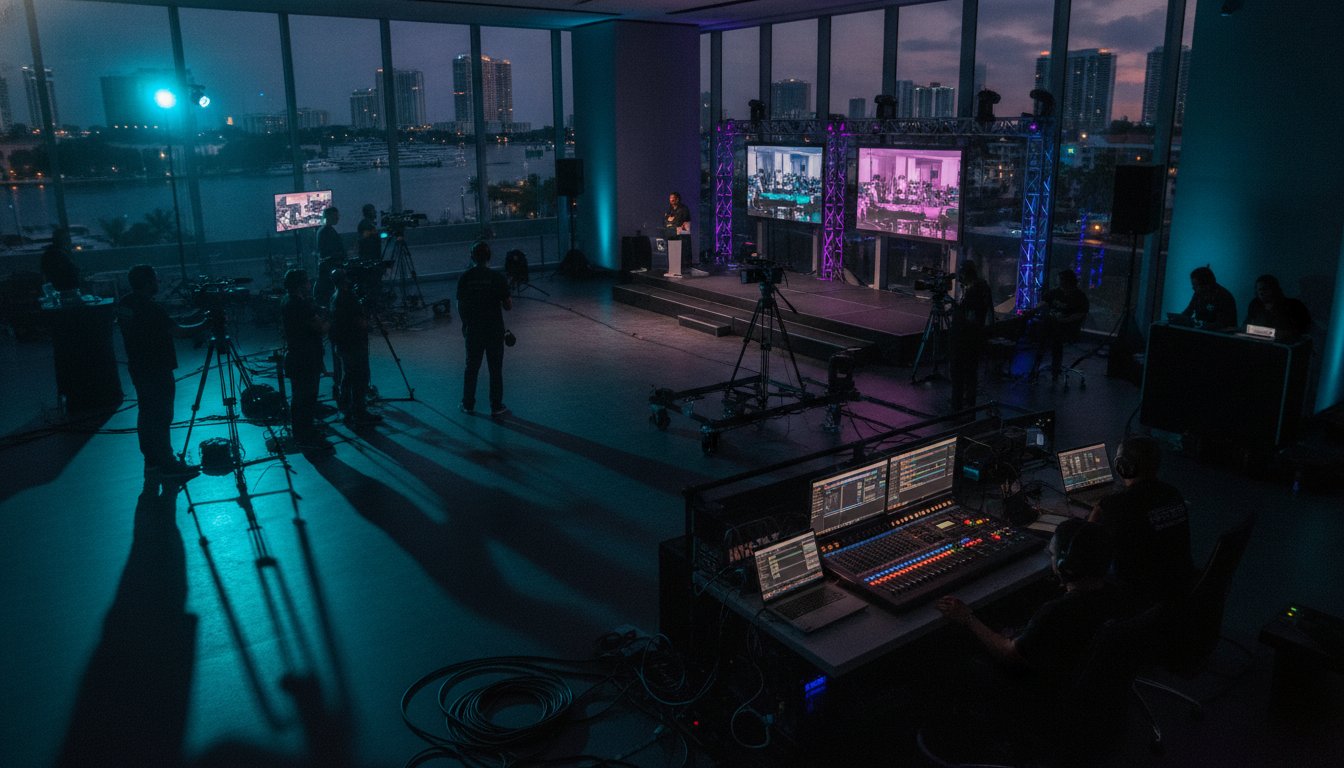
Your corporate livestream is not just a broadcast; it's a direct reflection of your brand's credibility in front of the people who matter most. When the connection drops, the audio cuts out, or the picture quality looks like it was shot on a decade-old webcam, no amount of polished slide decks can recover the impression you've lost. For corporate event livestreaming in Fort Lauderdale, the stakes are simply too high to treat technical execution as an afterthought.
You already know this. That tension you feel in the weeks before a major town hall or conference, the quiet worry about what happens if something goes wrong live, is completely valid. High-stakes events demand a level of broadcast-standard reliability that goes far beyond plugging in a laptop and hoping for the best.
This guide is designed to change how you think about corporate livestreaming, from a technical checkbox into a strategic communication asset. You'll learn exactly what separates a seamless, broadcast-quality production from one that puts your brand at risk, how to manage hybrid audience engagement effectively, and what professional technical direction actually looks like when it's done right.
Key Takeaways
- Broadcast-quality corporate event livestreaming in Fort Lauderdale requires far more than a single camera and a stable connection — learn what multi-camera setups, professional audio, and real-time graphics actually look like in practice.
- A "no single point of failure" philosophy is the defining hallmark of professional production; this guide explains exactly how redundant encoding paths protect your stream when hardware or software fails mid-event.
- Not every event demands the same production scale — discover the key criteria that determine when a single-camera setup is sufficient and when a dynamic multi-camera broadcast is non-negotiable.
- Your venue can be your greatest technical asset or your biggest liability; you'll find a practical checklist for evaluating Fort Lauderdale venues and the critical questions to ask before you sign a contract.
- A well-executed livestream doesn't have to end when the event does — learn how live session footage can be repurposed into lasting training and instructional assets that extend the value of your investment.
Why Broadcast-Quality Livestreaming is Vital for Fort Lauderdale Events
Broadcast-quality livestreaming, in a corporate context, means something precise. It's not a marketing term. It refers to a production architecture built around multiple synchronized cameras, professional-grade audio capture, real-time graphics overlays, and encoded output that holds up under the scrutiny of a C-suite audience watching on a 4K monitor. The moment you understand that definition, the gap between a professional production and a laptop pointed at a stage becomes impossible to ignore.
Fort Lauderdale occupies a genuinely strategic position in the South Florida corporate events ecosystem. The city hosts a dense concentration of financial services firms, healthcare organizations, and regional headquarters that regularly convene high-stakes conferences, investor briefings, and all-hands town halls. Its proximity to Miami's international airport, combined with a growing inventory of purpose-built convention and hotel conference spaces, makes it a natural anchor point for hybrid events that need to connect local executives with distributed teams across the country and globally.
The event model itself has evolved. The virtual-only format that defined 2020 and 2021 has given way to something more sophisticated: hybrid productions where the in-room experience and the remote experience are designed in parallel, not as an afterthought. In 2026, attendees who dial in remotely expect production values that match what they'd see from a polished broadcast. Anything less signals that your organization treats its remote workforce as secondary.
The risks of what professionals call "laptop streaming" are concrete and reputational. Compressed audio that clips during a keynote, a single locked-off camera that can't follow a presenter moving across a stage, a frozen stream during the Q&A portion of a board presentation: each of these moments erodes the credibility of the message you're delivering. No content, however strategically sound, survives a technical failure in front of decision-makers.
The ROI of Professional Technical Direction
A Technical Director does more than press buttons. They orchestrate the visual narrative of your event in real time, cutting between a wide establishing shot, a tight speaker close-up, and a clean screen capture of your presentation slides with the precision of a live broadcast. That seamless flow directly affects how long remote audiences stay engaged and how much of your message they actually retain. It also ensures your livestream production integrates coherently with your broader video growth strategy consulting goals, turning a single event into a content asset with lasting value.
Hybrid Engagement: Connecting Fort Lauderdale to the World
For corporate event livestreaming in Fort Lauderdale to function as genuine two-way communication, the technical infrastructure must support low-latency delivery. High-latency streams make real-time Q&A feel awkward and disconnected, which undermines the purpose of the format entirely. Integrating live polling, moderated question queues, and synchronized chat channels requires deliberate production planning, not improvisation. When executed correctly, remote participants don't feel like passive viewers; they feel like active contributors to the conversation.
Technical Fail-Safes: Ensuring a Flawless Event Stream
Every professional production team operates under a single governing principle: no component in the signal chain should have the power to bring down the entire broadcast on its own. This "no single point of failure" philosophy isn't a precaution reserved for unusually complex events. It's the baseline standard for any corporate event livestreaming in Fort Lauderdale where the audience includes executives, investors, or distributed teams whose trust you cannot afford to lose mid-session.
In practice, this means running parallel systems at every critical juncture. Primary and secondary encoding paths are configured simultaneously, so if the lead encoder encounters a hardware fault or software crash, the backup encoder is already processing the same signal and can take over without the audience experiencing so much as a dropped frame. This architecture is invisible when everything goes right. It becomes the most valuable investment you made when something goes wrong.
Audio deserves its own conversation. Broadcast-quality video means nothing if the audio feeding it is compromised. Professional productions run redundant audio feeds: a primary mix from the front-of-house console and an independent backup feed captured directly from the presenter's lavalier or handheld microphone. If the main mix develops a ground loop, a sudden feedback spike, or a cable fault, the backup feed is already live and clean. The audience never hears the problem.
Redundant Internet Solutions for South Florida Venues
Venue-provided internet is one of the most common failure points in live production. During Fort Lauderdale's peak conference season, hotel networks carry enormous concurrent demand from hundreds of guests, exhibitors, and event staff. Relying on that shared infrastructure for a mission-critical stream is a genuine risk. Internet bonding is the practice of combining multiple independent network connections, including dedicated ethernet, 5G cellular, and Starlink satellite, into a single stable, high-throughput pipe that maintains the stream even if one connection degrades or drops entirely. It's a non-negotiable fail-safe for serious live broadcasts.
Power Redundancy and On-Site Backup
Every piece of critical control room equipment, encoders, switching systems, audio interfaces, runs through a UPS (Uninterruptible Power Supply) that bridges any sudden power interruption long enough for the crew to respond. Beyond connectivity, a local 4K master recording captures the full session to dedicated storage regardless of stream health. If the outbound signal is disrupted at any point, the complete recording remains intact for immediate distribution afterward. Real-time monitoring tools give the crew visibility into stream health, bitrate stability, and audio levels continuously, allowing them to identify and address anomalies before they ever reach the audience's screen.
If you're evaluating production partners for an upcoming event, it's worth asking specifically how they handle encoder failure and internet loss. A professional livestreaming team should be able to walk you through their redundancy architecture without hesitation.
Multi-Camera Setups vs. Single-Camera Streams
There's a psychological dimension to camera work that corporate event planners rarely discuss, but audiences feel it immediately. A single static camera pointed at a stage creates a passive viewing experience. The audience becomes observers rather than participants, watching from a fixed distance with no editorial guidance about where to focus their attention. A dynamic multi-camera broadcast does something fundamentally different: it replicates the cognitive experience of being in the room, directing attention, building tension, and landing emotional beats with precision.
That said, not every event demands a multi-camera production. The decision should be driven by format and stakes, not budget assumptions. A straightforward executive press conference with a single speaker at a podium can be served effectively by a well-positioned single camera with professional audio and clean graphics. The moment you introduce a panel discussion, a keynote with stage movement, or a hybrid audience that needs to feel genuinely present, a single locked-off shot becomes a liability. For corporate event livestreaming in Fort Lauderdale, where events routinely combine C-suite presenters with distributed global audiences, the multi-camera format isn't a luxury upgrade; it's the appropriate production architecture for the format.
Pre-recorded assets and B-roll also play a more significant role in live production than most clients anticipate. A polished sizzle reel, a pre-produced brand film segment, or even a clean animated title card used during a speaker transition can elevate the perceived production value of the entire broadcast. These elements fill what would otherwise be awkward visual dead time and signal to the remote audience that the organization treats its communication with the same rigor it applies to its business.
Visual Hierarchy in Corporate Broadcasting
Professional multi-camera direction follows a deliberate visual logic. The wide shot establishes context: the room, the stage, the scale of the event. The medium shot captures gesture and body language, the non-verbal layer of communication that slides alone can't convey. The tight close-up delivers emotional impact, the moment a speaker's conviction or expertise registers on a viewer's screen. For hybrid panel discussions, this hierarchy becomes even more critical; cutting between panelists in real time keeps remote viewers oriented and engaged in a way that a single wide shot simply cannot achieve. Picture-in-picture configurations, where presentation slides and a speaker feed appear simultaneously, solve one of the most common frustrations in remote attendance: losing visual context when the camera cuts away from the content.
Real-Time Graphics and Branding
Lower-thirds, branded bugs, and live overlay graphics serve a function beyond aesthetics. They keep the organization's identity continuously present in the frame, reinforcing brand authority throughout the broadcast. For events where the stream will be repurposed or clipped for distribution, consistent on-screen branding also ensures every segment carries the same professional signature. Integrating live data visualizations or curated social media feeds into the stream adds a layer of real-time relevance that static presentations can't match. These elements require deliberate pre-production planning, which is why our strategic guide to hiring a video company outlines exactly what to look for when evaluating a production partner's graphics capabilities and overall production standards.
The integration of cinematic brand film sensibility into a live environment is where production quality becomes genuinely distinctive. It's the difference between a stream that documents an event and one that communicates a brand's character. For corporate event livestreaming in Fort Lauderdale, that distinction is the entire point.

Selecting the Right Venue for Livestreaming in Fort Lauderdale
The venue you sign a contract with is either your production's greatest technical asset or its most expensive liability. This isn't a minor operational consideration. For corporate event livestreaming in Fort Lauderdale, the physical environment determines what's possible before a single camera is positioned or a single cable is run. Discovering a venue's infrastructure limitations on load-in day is not a recoverable situation.
The conversation needs to happen weeks before the event, directly with the venue's IT and facilities teams. Ask specific questions, not general ones. "Do you have internet?" is not the right question. "Can you provide a dedicated, unshared Ethernet drop with guaranteed upload speeds, and what's the maximum sustained throughput you can commit to in writing?" is the right question. For a clean 1080p stream with redundant encoding, you need a minimum of 10Mbps dedicated upload capacity. Shared hotel bandwidth, regardless of what the sales brochure claims, rarely delivers that reliably during peak conference hours.
Acoustic environments deserve the same scrutiny. Fort Lauderdale's larger hotel ballrooms and convention spaces are frequently designed for visual scale, not audio clarity. High ceilings, hard marble floors, and expansive glass surfaces create reverb and flutter echo that a lavalier microphone positioned on a presenter will capture faithfully and unforgivingly. A professional production team will assess the room's acoustic profile during the site visit and plan microphone placement and signal processing accordingly. No amount of post-production can fix a keynote recorded in an untreated reverberant space.
Lighting is where venue assumptions most consistently undermine broadcast quality. House lighting systems are calibrated for in-room aesthetics, not camera exposure. Color temperature inconsistencies between overhead fixtures and natural light from windows create mixed-source problems that make skin tones look unnatural on screen. A professional broadcast setup introduces dedicated lighting instruments with controlled color temperature and placement, entirely independent of what the venue's house system provides.
Fort Lauderdale Venue Logistics Checklist
Before committing to a space, confirm the following in writing with the venue:
- Dedicated Ethernet drop: Minimum 10Mbps guaranteed upload, isolated from the general guest network, with a physical port accessible to your production control area.
- Loading dock access and setup windows: Multi-camera rigs require meaningful lead time. Confirm whether the venue allows pre-day load-in and whether freight elevator access is available for equipment cases.
- Separate power circuits: High-draw lighting instruments on the same circuit as audio interfaces and encoders introduces ground noise and voltage fluctuation. Dedicated circuits for production power aren't optional; they're a technical requirement.
- Ceiling rigging points or truss availability: Overhead lighting positions require structural anchor points. Not every ballroom has them, and retrofitting isn't always feasible.
Coordinating with On-Site AV Teams
Most Fort Lauderdale hotel venues have an exclusive or preferred in-house AV provider. Understanding the distinction between that team's role and your specialized livestreaming partner's role is essential before the event. In-house AV teams manage the room's existing infrastructure: house sound, projection, and basic lighting. They're not typically configured or equipped for broadcast-standard live encoding, multi-camera switching, or stream health monitoring.
The critical technical handshake is the audio feed. Your livestream mix must come from a clean, dedicated aux send off the front-of-house console, not a room microphone pointed at the speakers. Establishing that routing protocol in advance, with the house audio engineer's cooperation, is the Technical Director's responsibility. It requires a pre-event technical rider and a direct conversation between the production team and the stage manager to align cue timing, presenter transitions, and any pre-recorded playback elements that affect both the room and the stream simultaneously.
Venue selection done right eliminates an entire category of production risk before the event begins. Talk to our technical team about what to look for during a venue site assessment before you finalize your Fort Lauderdale event space.
Partnering with Miami Video Production for Your Next Event
Everything covered in this guide, from redundant encoding architecture to venue acoustic assessments, reflects a single underlying philosophy: a livestream is a strategic communication asset, not a technical deliverable. The partner you choose to execute it should think the same way. Miami Video Production approaches every engagement as a production partner invested in your outcomes, not a vendor fulfilling a scope of work.
Our process begins well before load-in day. Pre-production planning for high-stakes events includes a detailed technical rider, a site assessment aligned to the specific demands of your format, and a production timeline that accounts for every transition, presenter cue, and graphics trigger. When the broadcast goes live, our Technical Director is actively orchestrating the visual narrative in real time, not monitoring from a distance. That level of deliberate execution is what separates professional corporate event livestreaming in Fort Lauderdale from a competent but passive technical setup.
Beyond the Live Event: Repurposing Content
The broadcast itself is the beginning of the content's life, not the end. A two-hour conference session, when captured at broadcast quality, contains the raw material for a structured content series: individual speaker segments, key announcement clips, panel discussion excerpts, and branded highlight reels optimized for LinkedIn and internal communications channels. Our post-production team polishes the live recording for on-demand viewing, correcting any minor exposure inconsistencies and delivering a final cut that holds up to the same scrutiny as a planned production. For organizations with ongoing training and development needs, we integrate our instructional video production capabilities to transform live session footage into structured, chapter-based learning assets that extend the value of a single event investment across months of internal use.
Your Strategic Partner in South Florida
There's a practical advantage to working with a team that operates across the South Florida market. We know the venues, the in-house AV dynamics, and the logistical rhythms of Fort Lauderdale's conference calendar in a way that a remote production company simply cannot replicate. That local fluency reduces friction at every stage of the engagement.
Professional confidence and reliability aren't values we list on a page; they're the standard against which every broadcast we deliver is measured. If you're planning a corporate event and want to align your production with your broader 2026 communication goals, reach out to our team to schedule a strategy consultation. We'll assess your format, your audience, and your content objectives, and build a production approach that makes your event work harder, both live and long after it ends.
Miami Video Production is committed to delivering broadcast-standard excellence and genuine strategic partnership for every corporate event livestreaming Fort Lauderdale client we serve.
Your Next Fort Lauderdale Event Deserves a Broadcast That Performs
The distance between a stream that protects your brand and one that quietly damages it comes down to decisions made weeks before your event goes live. Venue infrastructure, redundant encoding systems, multi-camera direction, and deliberate pre-production planning aren't optional upgrades; they're the foundation that professional corporate event livestreaming Fort Lauderdale requires.
Three things determine whether your broadcast delivers: broadcast-quality technical direction that actively shapes the viewer experience in real time, redundant fail-safe systems that eliminate single points of failure before they become audience problems, and a production partner with genuine expertise in high-stakes B2B communications. When all three align, your event doesn't just stream. It communicates with authority.
If you're building your 2026 event calendar and want a production approach designed around your outcomes, schedule a strategic consultation with our team at Miami Video Production. Bring your format, your audience, and your goals. We'll handle the rest.
Frequently Asked Questions About Corporate Event Livestreaming in Fort Lauderdale
How much does corporate event livestreaming in Fort Lauderdale cost?
Production investment varies significantly based on event complexity, crew size, equipment requirements, and duration. A single-camera executive press conference carries a very different scope than a multi-camera hybrid conference with real-time graphics and redundant encoding systems. Rather than quoting a number that won't reflect your actual format, the right approach is to schedule a strategy consultation where your specific event requirements can be assessed and scoped accurately.
What is the minimum internet speed required for a professional livestream?
A clean 1080p stream with redundant encoding paths requires a minimum of 10Mbps dedicated upload capacity. The emphasis is on "dedicated." Shared hotel bandwidth rarely delivers that reliably during peak conference hours, regardless of what the venue's sales materials claim. Professional productions address this with internet bonding, combining dedicated ethernet, 5G cellular, and satellite connections into a single stable pipe that maintains the stream even if one source degrades.
Can you livestream a hybrid event with both in-person and remote speakers?
Yes, and it requires deliberate technical planning that goes well beyond a standard video call setup. Remote speakers are integrated through a managed feed that's routed directly into the production switcher, allowing the Technical Director to cut between in-room presenters and remote participants with the same visual precision applied to the rest of the broadcast. Low-latency delivery is essential here; high-latency feeds make real-time panel exchanges feel disjointed and undermine the format's purpose.
What happens if the venue's internet goes down during the broadcast?
A professional production never relies on a single connection. Internet bonding technology combines multiple independent network sources so that if the venue's ethernet drops, the stream continues routing through 5G cellular or satellite backup without interruption. Beyond connectivity, a local 4K master recording captures the complete session to dedicated storage throughout the event, ensuring the full recording remains intact regardless of any outbound signal disruption.
Do you provide multi-camera switching for live corporate town halls?
Multi-camera switching with live Technical Direction is a core part of how corporate event livestreaming in Fort Lauderdale is executed at broadcast standard. Town halls benefit particularly from this approach because they involve presenter movement, audience Q&A, and slide content that all need to be managed simultaneously in real time. A Technical Director actively cuts between wide establishing shots, speaker close-ups, and clean presentation captures to keep remote attendees as oriented and engaged as those in the room.
How far in advance should I book a livestreaming company for a Fort Lauderdale conference?
For high-stakes corporate events, six to eight weeks of lead time is a practical minimum. Pre-production planning for a professional broadcast includes a detailed technical rider, a venue site assessment, graphics design and approval, and coordination with the venue's in-house AV team. Events with complex formats, multiple remote speakers, or tight venue logistics benefit from even more runway. Booking late compresses every one of those planning stages and introduces risk that careful preparation would have eliminated.
Can you record the livestream for later use as a corporate training video?
Capturing a broadcast-quality local recording throughout every production is standard practice, and that recording is a genuine asset. Post-production can transform a live session into structured, chapter-based training content, individual speaker segments, or branded highlight reels optimized for internal communications channels. For organizations with ongoing training and development needs, this integration with instructional video production extends the value of a single event investment across months of internal use.
What is the difference between a basic Zoom call and a professional livestream?
The gap is architectural, not cosmetic. A Zoom call uses a single consumer-facing camera, compressed audio, and a shared platform with no redundancy if the connection drops. A professional broadcast runs synchronized multi-camera feeds, dedicated audio capture with backup feeds, real-time graphics overlays, redundant encoding paths, and active Technical Direction shaping the viewer experience throughout. The practical result is the difference between a stream that documents your event and one that communicates your organization's credibility to every executive watching remotely.
