
Corporate Video RFP Template: Plan and Compare Production Proposals

What if the lowest-priced proposal is based on a smaller or different project? A corporate video RFP template can help prevent that mismatch by giving every production partner the same goals, scope, and expectations. Without a clear brief, proposals may vary in creative approach, production plan, and deliverables. That makes price the easiest comparison, but not necessarily the most meaningful one.
A successful video needs to serve a business purpose. The challenge is translating that purpose into a request that helps production teams recommend the right approach and gives internal stakeholders a consistent basis for review. A well-structured RFP keeps those conversations focused and supports a more confident decision.
In this guide, you’ll find a practical, reusable template and guidance on what to include, from audience and distribution plans to scope, deliverables, timeline, and evaluation criteria. You’ll also see how requirements differ for an event livestream and a corporate brand film, so proposals reflect the work you need rather than competing assumptions.
Key Takeaways
- Distinguish an RFP, which defines your needs, from a proposal, which outlines a production partner’s response.
- Build your corporate video RFP template around business goals, audience, core message, and required deliverables.
- Use a consistent brief to request proposals with clear creative approaches, production plans, deliverables, and assumptions.
- Compare proposals against shared criteria, including strategic fit, scope, team, post-production, and communication.
- Align stakeholders on creative direction, roles, approvals, and assumptions before selecting a production approach.
Corporate video RFP vs. production proposal: start with the right document
An RFP describes the buyer’s needs; a production proposal explains how a production partner would respond. Keeping the two roles clear helps you invite useful ideas without confusing your requirements with someone else’s recommended approach. A Request for proposal (RFP) is a structured way to invite responses to a defined need. In video production, it gives each prospective partner the same starting point.
A formal RFP can help with a single corporate brand film when several decision-makers need to agree on goals, scope, and selection criteria. It can also help with a multi-part content project, such as a podcast series or training videos, where deliverables, audience needs, and review processes may differ across assets. The document should establish direction without dictating every creative choice. Leave room for production partners to propose a compelling way to bring the brief to life.
An RFP makes production proposals easier to compare by asking every partner to respond to the same goals, scope, and decision criteria.
What is a corporate video RFP?
A corporate video RFP is a structured project brief distributed to potential production partners. It records the information they need to shape a relevant response: business goals, intended audience, scope, constraints, review process, and evaluation criteria. It also invites a tailored creative and production approach, rather than a generic estimate based on video length alone.
For example, an event livestream RFP might describe the event, its audience, and distribution needs. A corporate film RFP might focus on the company’s message and the intended viewer response. The purpose is not to prescribe the production plan before discussion. It is to give partners enough context to recommend one.
RFP, creative brief, and video production proposal: how they differ
These documents serve related but distinct purposes:
- RFP: The buyer-led request. It defines needs, requirements, constraints, submission expectations, and selection criteria.
- Creative brief: The communication direction. It clarifies the audience, key message, desired response, and creative considerations.
- Production proposal: The production partner’s response. It presents a recommended creative approach, scope, production plan, schedule, deliverables, and assumptions.
A creative brief may sit inside an RFP, giving partners more insight into the story and tone while the RFP explains how to respond. For a smaller project, one document can combine both. A practical corporate video RFP template should clarify the business need, distinguish required deliverables from open creative possibilities, and leave room for a thoughtful proposal.
Define goals, audience, and scope in your corporate video RFP
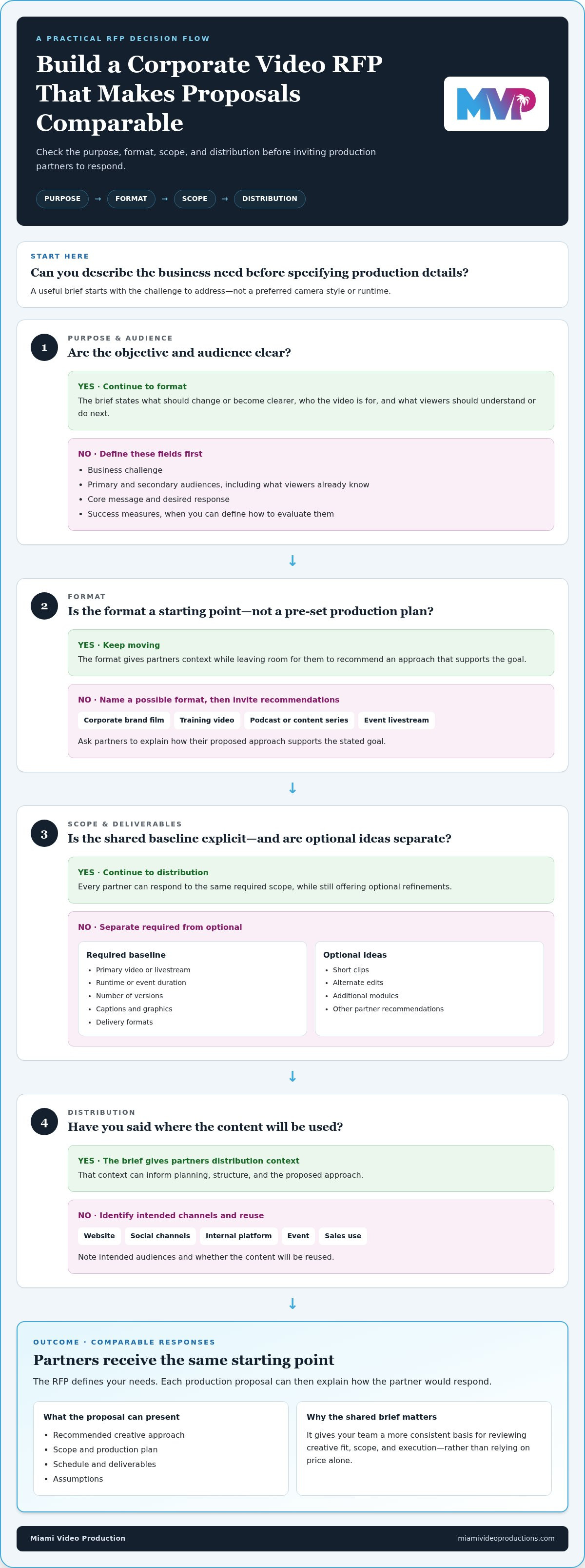
A useful brief starts with the business need, not a preferred camera style or runtime. State what challenge the video should address, who needs to see it, and what you want those viewers to understand or do next. This gives production partners a strategic foundation for recommending a format and approach.
Set objectives and audience before describing the video
In your corporate video RFP template, have stakeholders complete these fields before defining production details:
- Business challenge: What needs to change or become clearer? For example, a brand film might help prospective clients understand what differentiates the company.
- Primary and secondary audiences: Who is the video for, and what do they already know? Note whether viewers will watch during an event, as part of training, or while researching a service.
- Core message and desired response: What is the one idea viewers should remember, and what action should follow?
- Success measures: How will your organization assess whether the video served its purpose? Include measures only when you can define how to evaluate them.
Clear objectives make production scope more useful by connecting each requested deliverable to an audience need and a way to assess its value.
Specify format, deliverables, and distribution
Once the purpose is clear, describe a format that could serve it: a corporate brand film, training video, podcast or content series, or event livestream. Treat the format as a starting point, then ask production partners to explain how their proposed approach supports the stated goal.
Separate required deliverables from optional ideas. This ensures every proposal addresses the same baseline while leaving room for partners to suggest refinements. Use project-specific fields rather than assuming every video needs the same package:
- Required: [Primary video or livestream], [runtime or event duration], [number of versions], [captions], [graphics], and [delivery formats].
- Distribution: [Website], [social channels], [internal platform], [event], or [sales use]. Note intended audiences and whether content will be reused.
- Optional: [Short clips], [alternate edits], [additional modules], or other ideas for the production partner to recommend.
Distribution affects planning. A film intended for a company website may need a different structure from training content designed for repeated internal use. An event livestream also has different scope considerations from a produced brand film. Specify required aspect ratios or platform versions when your organization has defined them. Otherwise, ask partners to recommend formats based on the channels and intended reuse.
If project goals and distribution are still taking shape, video strategy support can help connect the brief to a production approach.
Use this corporate video RFP template to request comparable proposals
A useful corporate video RFP template gives each production partner the same project context and asks for a response in a consistent format. Copy the outline below, tailor the fields to your project, and distinguish confirmed requirements from items you want the partner to recommend. If a detail is undecided, label it as an open question to avoid competing assumptions.
Copy-ready corporate video RFP sections
Use these prompts to describe the project. Include what’s relevant, and share budget parameters only if your organization has approved them for disclosure.
- Company and project background: [Organization, relevant context, and reason for the project]
- Purpose and objectives: [Business challenge] / [What should the video help accomplish?]
- Audience and message: [Primary and secondary audiences] / [Core message] / [Desired viewer response]
- Format and scope: [Brand film, training video, content series, livestream, or other format] / [Required assets and optional ideas]
- Production details: [Known filming locations] / [Interview needs or participants] / [Access, scheduling, or other constraints]
- Distribution and accessibility: [Channels and intended reuse] / [Required versions, captions, graphics, or delivery formats]
- Evaluation and process: [Selection criteria] / [Stakeholders and review process] / [Questions and submission instructions]
For any field that depends on a partner’s recommendation, write “propose” rather than guessing. For example, ask the production team to recommend filming locations or content versions based on the objectives and distribution plan.
What to ask production companies to include
Request responses in a shared structure so your team can assess both creative thinking and execution. State the submission format, recipient, deadline, and any procurement steps or question period required by your organization. Keep these instructions practical and aligned with your internal process.
- Creative approach: Proposed concept, narrative direction, and how the idea supports the project objectives.
- Production plan: Key phases, proposed schedule, team roles, and project communication approach.
- Scope and deliverables: Included work, deliverable descriptions, review rounds, and any exclusions.
- Assumptions and dependencies: Information, access, approvals, participants, or materials needed from your organization. Ask partners to list open questions rather than silently filling gaps with assumptions.
- Relevant experience: Examples of comparable formats or communication goals, with a brief explanation of their relevance.
Requesting assumptions and client responsibilities alongside the proposed plan makes gaps visible before selection. It also helps stakeholders compare like with like, then discuss meaningful differences in creative direction and production execution.
Compare video production proposals by fit, scope, and execution
When proposals arrive, review them against the same criteria instead of letting presentation style or the first quoted price set the agenda. Build a side-by-side matrix with one column per production partner and one row per criterion. Agree on a scoring scale before reviewing responses, such as 1 for “doesn’t address the requirement,” 3 for “addresses it with some gaps,” and 5 for “clearly meets it with relevant detail.” Add notes beside each score so stakeholders can see the reasoning behind the rating.
A practical corporate video proposal evaluation matrix
Use the goals and scope in your corporate video RFP template as the baseline. Assess how well each proposal connects the audience and objective to its creative recommendation. Then compare what the partner will deliver and how the work will be managed. A concise matrix might include:
- Strategic understanding: Does the response reflect the business goal, audience, and desired viewer response?
- Creative approach: Is the concept suited to the message and distribution plan, with a clear rationale?
- Scope and deliverables: Are included assets, responsibilities, exclusions, review rounds, and assumptions explicit?
- Team and execution: Are key roles and the production plan clear and relevant to the project?
- Post-production and communication: Does the response explain the editing workflow, approvals, and how the team will coordinate?
Compare scope before interpreting price. A lower bid may reflect fewer deliverables, a different production plan, or assumptions that shift responsibilities to your team. Treat cost as one decision factor, then clarify differences so you’re comparing equivalent requirements rather than headline figures.
Assess local production and event execution
For work in Miami, Broward, West Palm Beach, Fort Lauderdale, North Miami, Fort Myers, or Naples, include location logistics in the evaluation where relevant. Compare how each proposal accounts for filming locations, venue access, event schedules, coordination with venue or internal teams, and dependencies your organization must manage. These details can affect the practicality of a plan even when the creative idea is strong.
For an event livestream, assess whether the proposed technical direction and production plan respond to the event’s format, audience, venue, and distribution needs. Look for a clear explanation of responsibilities and coordination, not just a general service description. This broadcast-quality livestreaming planning guide offers added context for evaluating event requirements.
After scoring, discuss the leading proposal with stakeholders and resolve unclear assumptions before making a decision. To review your project scope with a production partner, discuss your video production project.
Move from corporate video RFP to a confident production partnership
Selecting a proposal is a decision, not the production kickoff. Before work begins, hold an alignment meeting with the chosen production partner and the stakeholders who will shape or approve the project. Confirm the objectives, creative direction, deliverables, responsibilities, review workflow, and any assumptions that could affect the plan.
Close the decision process with shared expectations
Walk through the proposal alongside your final corporate video RFP template. Confirm that the selected approach still answers the original brief, then resolve open questions about scope, roles, approvals, and dependencies. For example, clarify who supplies interview participants or source materials, who consolidates feedback, and which stakeholders provide final approval.
Record the agreed decisions in a concise project summary. Include the selected proposal and rationale, confirmed deliverables, assigned responsibilities, unresolved dependencies, and internal approvals required before production. This gives stakeholders a shared reference point and explains why the chosen approach fits the business goal, not simply why it ranked well in a comparison.
A strong RFP also leaves room for a production partner to refine the initial thinking. If a proposed creative direction better serves the audience or distribution plan, discuss the change and document its effect on scope and deliverables before approving it. The brief should guide the work without preventing sound creative recommendations. For brand-film planning, explore this guide to cinematic corporate video strategy.
Turn the RFP into a focused project conversation
Bring a clear starting point to the next discussion: your objectives, intended audience, preferred format, distribution context, and known constraints. That context helps a production team understand what success should look like and where its creative and production expertise can add value. The conversation can then focus on the choices that will shape the work, whether you’re developing a corporate brand film or planning an event livestream.
Miami Video Production works collaboratively with businesses on corporate films and event livestreams, aligning production planning with project goals. Discuss your video project with the production team to explore an approach grounded in your objectives, audience, and intended use.
Turn a clear brief into your next confident video project
A strong corporate video RFP template starts with business goals, audience, and distribution needs, then gives production partners a consistent scope to respond to. Compare proposals on creative fit, deliverables, execution, and assumptions, not price alone. Before production begins, align stakeholders and your production partner on responsibilities, approvals, and the final plan.
Miami Video Production supports projects from planning through filming and post-production, including cinematic corporate brand films for local businesses and broadcast-quality livestream production for South Florida events. A clear brief is the first step toward a productive partnership and a video built around your objectives.
Discuss your corporate video project with Miami Video Production and start shaping an approach that fits your audience, goals, and distribution needs.
Frequently Asked Questions
What should a corporate video RFP include?
A corporate video RFP should define the project’s purpose, audience, scope, deliverables, constraints, and proposal requirements. Include the core message, intended distribution channels, desired viewer response, review process, and criteria for evaluating responses. Separate mandatory deliverables from optional ideas so production partners respond to the same baseline. Add known schedule or location details, and ask respondents to identify assumptions, dependencies, and open questions clearly.
How do I write an RFP for a corporate video project?
Start by describing the business challenge the video should address, then identify its audience and the response you want from viewers. Specify a suitable format, such as a corporate brand film or training video, and outline required deliverables, distribution, constraints, and review steps. Keep the brief focused on needs rather than dictating every creative choice. Set submission instructions and a deadline that fit your organization’s procurement process.
What is the difference between a video RFP and a production proposal?
A video RFP is the buyer’s request: it describes project needs, goals, scope, constraints, and how responses will be evaluated. A production proposal is the production partner’s answer, outlining its recommended creative approach, production plan, deliverables, schedule, and assumptions. In short, the RFP sets the request; the proposal explains how the partner would address it. Smaller projects can combine RFP and creative brief elements in one document.
How many production companies should receive a corporate video RFP?
There’s no universal number. Invite a manageable shortlist of production companies whose experience and approach appear relevant to your project, while following any internal procurement rules. Consider whether your team can give each response a fair review and complete required follow-up conversations. A broad distribution isn’t automatically better: focused invitations can help ensure proposals address your actual goals and give stakeholders time to compare scope, creative thinking, and execution.
Can a corporate video RFP include a budget range?
Yes, include a budget range if your organization has approved it for sharing. A clear budget parameter can help production partners recommend an approach that fits your priorities and identify trade-offs. State whether the figure covers the full project or only specified elements, if that distinction applies. If you can’t share a range, request a clearly itemized scope and ask respondents to state their assumptions, exclusions, and optional recommendations.
How do I compare corporate video production proposals fairly?
Use the same criteria for every response and agree on what each score means before reviewing proposals. Compare how well each partner understands the objective and audience, then assess creative approach, deliverables, team, production plan, post-production, communication, and assumptions. Review what each scope includes before comparing price. If proposals differ substantially, clarify responsibilities and exclusions so stakeholders can make an informed comparison rather than relying on headline cost alone.
What should an RFP include for a corporate event livestream?
An event livestream RFP should describe the event format, audience, schedule, venue, distribution needs, and what viewers should experience. Include known venue access and coordination requirements, plus any defined technical or accessibility needs. Clarify who manages event information, approvals, and communication with relevant teams. For events in Miami, Fort Lauderdale, Broward, West Palm Beach, or nearby South Florida areas, include location-specific logistics that may shape the proposed production plan.
