
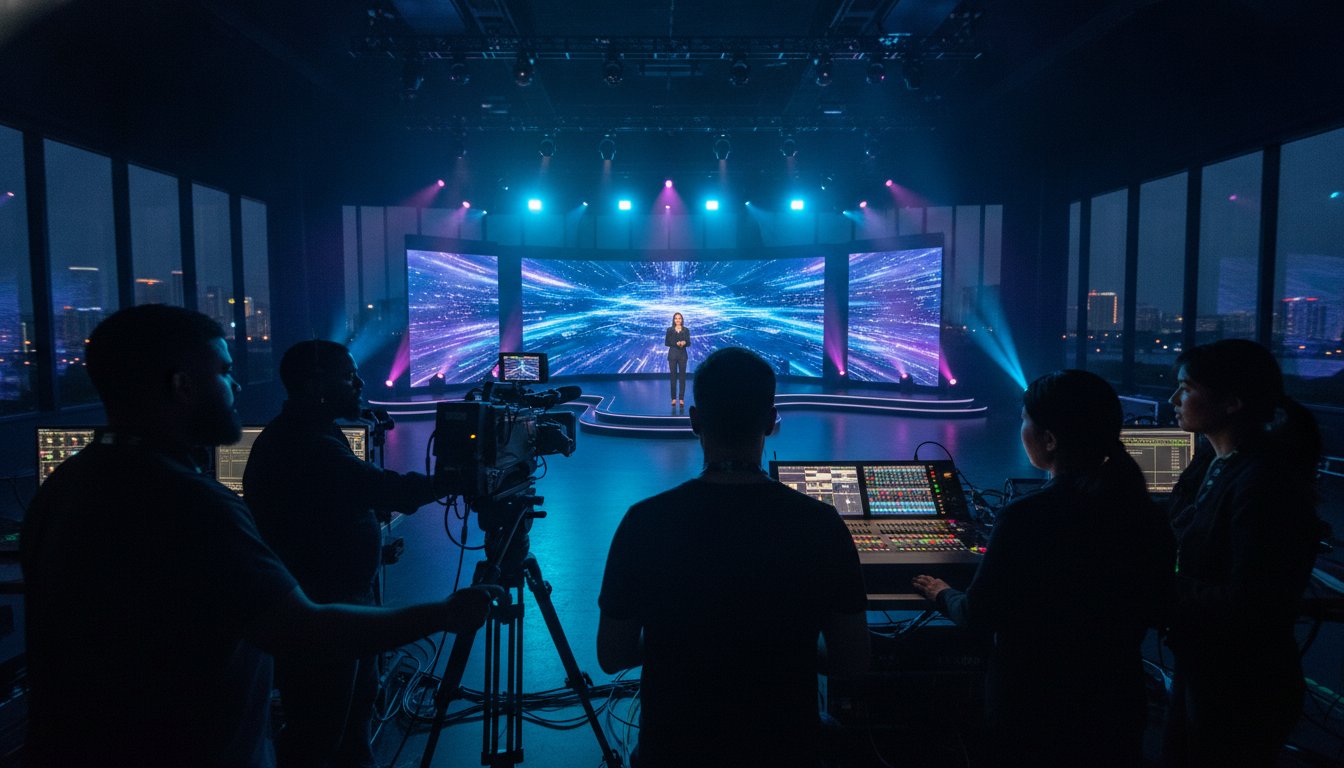
What if the success of your next global town hall didn't depend on your internet speed, but on the redundancy of your technical architecture? Most leaders view a digital broadcast as a simple video project, but in a high-stakes environment, it's actually a mission-critical infrastructure challenge. Learning how to livestream a corporate event in 2026 requires more than just a stable connection and a decent camera. It demands a sophisticated approach to broadcast-standard storytelling that bridges the gap between your physical stage and a global digital audience.
You've likely felt the tension of a live countdown, wondering if the audio will sync or if a remote speaker will drop off at the worst possible moment. That pressure is real because the stakes are high. A single technical glitch can undermine months of strategic planning and erode brand confidence. We understand that in a professional setting, there's no room for "good enough" when the eyes of your stakeholders are on the screen.
This guide provides the strategic blueprint to eliminate those single points of failure and deliver a polished, cinematic experience. We'll explore the hardware configurations, multi-camera switching techniques, and engagement strategies necessary to ensure your broadcast feels like a premium production rather than a standard video call. By the end, you'll have a fail-safe plan to master the technical and creative demands of modern corporate broadcasting.
Key Takeaways
- Elevate your digital presence by transitioning from casual video calls to broadcast-standard storytelling that reflects your brand’s professional sophistication.
- Eliminate technical vulnerabilities by engineering redundant audio paths and utilizing multi-camera switching for a cinematic, high-stakes viewer experience.
- Master how to livestream a corporate event with absolute security by implementing bonded internet protocols that combine cellular, satellite, and hardline connections.
- Ensure a seamless execution by utilizing a comprehensive Run-of-Show and a rigorous pre-flight checklist to manage every minute of your broadcast.
- Partner with a strategic technical director who prioritizes your business outcomes and understands the nuances of local South Florida venue infrastructure.
Defining the Broadcast Standard for Corporate Livestreaming
Understanding how to livestream a corporate event begins with a fundamental shift in perspective. A professional broadcast isn't merely a video call scaled for a larger audience; it's a technical architecture designed to project authority and reliability. While social streaming often prioritizes immediacy over aesthetics, a corporate broadcast must prioritize stability, clarity, and brand alignment. When the stakes involve global stakeholders or high-value clients, the technical execution becomes a direct reflection of your organization’s operational excellence.
Corporate vs. Social Streaming Standards
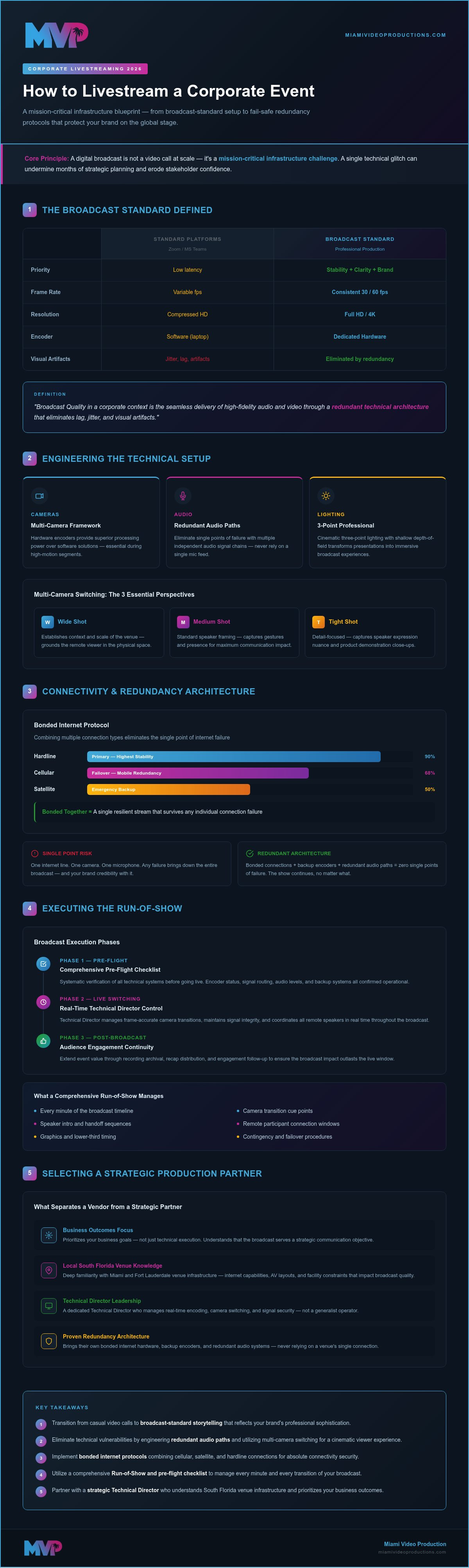
Standard platforms like Zoom or Microsoft Teams are excellent for internal collaboration, but they often fall short during high-stakes keynotes. These tools prioritize low latency over visual fidelity, frequently resulting in compressed bitrates, variable frame rates, and distracting visual artifacts. A professional broadcast bypasses these limitations by using dedicated hardware encoders and high-bitrate delivery networks. This ensures that your presentation remains crisp and fluid, regardless of the viewer’s location. Broadcast Quality in a corporate context is the seamless delivery of high-fidelity audio and video through a redundant technical architecture that eliminates lag, jitter, and visual artifacts.
- Frame Rates: Consistent 30 or 60 fps delivery for smooth motion.
- Resolution: Full HD or 4K streams that maintain detail in complex slide decks.
- Bitrate Management: Strategic allocation of data to ensure a stable, high-definition image.
The Strategic Impact of High-End Production
For organizations operating in competitive hubs like Miami and Fort Lauderdale, production quality is a strategic differentiator. A cinematic approach, utilizing shallow depth-of-field lenses and professional three-point lighting, transforms a standard presentation into an immersive experience. This level of intentionality signals to your audience that the message is significant. It moves the needle from a "viewable" stream to a compelling broadcast that commands attention and drives retention, especially when paired with the professional event communication expertise of Ocomedy Show.
Building a technical foundation for a professional broadcast requires more than just high-end gear; it requires a cohesive system designed for redundancy. When planning how to livestream a corporate event, your choice of "brain" is the first critical decision. While software encoders are accessible, dedicated hardware encoders offer superior processing power. This ensures your stream remains stable even during high-motion segments or complex transitions, providing a level of security that standard laptop-based solutions simply can't provide.
The Multi-Camera Switching Framework
A single camera angle is a passive view, but a multi-camera setup is an active narrative. By utilizing a strategic switching framework, you keep the audience’s attention focused exactly where it needs to be. A professional technical director manages this flow by alternating between three essential perspectives:
- The Wide Shot: Establishes the context and scale of the venue, grounding the viewer in the physical space.
- The Medium Shot: The standard framing for speakers, capturing their gestures and presence.
- The Tight Shot: Used for detail, such as capturing the nuance of a speaker’s expression or a physical product demonstration.
To maintain this synchronization, a professional crew relies on tally lights and dedicated communication headsets. Tally lights signal to the presenter which camera is currently "hot," allowing them to maintain eye contact with the digital audience. This level of coordination ensures that lower thirds, presentation slides, and live video are woven together into a single, polished output.
Audio Engineering for Flawless Communication
Audio is often described as 70% of the video experience. If the visual signal drops, viewers might wait; if the audio fails, they leave. Engineering for high-stakes events requires redundant audio paths for every key speaker. We typically integrate primary wireless lavalier microphones with backup handheld units ready at the lectern. This "fail-safe" approach ensures that the message is never lost to a battery failure or signal interference.
Managing the "Mix-Minus" is another critical technical layer, especially when integrating remote participants. This specialized audio routing prevents remote speakers from hearing their own voice echoed back, which can be incredibly distracting. Professional audio quality serves as the first line of defense against the cognitive load and "Zoom fatigue" that often plagues digital attendees. By prioritizing clear, balanced sound, you ensure your audience remains engaged with your content rather than struggling to hear it.
Achieving this balance of visual and auditory excellence is part of what we do as a technical director partner for corporate leaders. Beyond the gear, it's about the consistent exposure and color matching that makes a broadcast feel cinematic. In variable venue environments, professional lighting ensures that speakers look their best on camera, regardless of the room's native lighting conditions.
Ensuring Connectivity: Bonded Internet and Redundancy Protocols
The most frequent point of failure in digital broadcasting isn't the camera or the microphone; it's the connection to the outside world. Venue Wi-Fi is notoriously unreliable for high-capacity events. It's shared. It fluctuates. It fails. When determining how to livestream a corporate event with absolute security, you must treat your internet connection as a critical utility rather than a convenience. Relying on a single hardline is a risk that high-stakes environments cannot afford to take.
Bonded internet technology eliminates this vulnerability by creating a single, robust data pipe from multiple sources. By aggregating bandwidth from 5G cellular networks, satellite feeds, and the venue’s dedicated fiber line, we ensure that the stream remains uninterrupted even if one source drops out completely. This technical architecture provides the "premium reliability" required for global stakeholder meetings where every second of uptime is vital.
The Connectivity Redundancy Checklist
A professional broadcast requires a dedicated, symmetrical upload speed of at least 10Mbps to maintain high-definition clarity. This is distinct from download speed, which is what most venues advertise. We utilize industry-standard hardware from Peplink or Teradek to manage this bonding process. These devices act as the traffic controllers for your data, intelligently routing packets across the strongest available connections in real-time.
- Symmetrical Bandwidth: Ensure your upload speed matches your download capacity for a stable stream.
- Hardware Bonding: Use dedicated routers to combine cellular and hardline signals.
- Failover Testing: Rigorously test the transition between connection sources before the first attendee logs in.
Platform Fail-Safes and Backup Streams
Redundancy must also exist at the encoder and platform levels. We configure primary and secondary stream keys, ensuring that if one server path encounters an issue, the broadcast automatically switches to the backup without the audience ever noticing a glitch. For high-risk technical transitions, such as moving between live speakers and complex data visualizations, we often incorporate "simulive" segments. These are pre-recorded elements played back during the live stream to guarantee a flawless delivery of critical information.
Partnering with a broadcast quality livestreaming company ensures these technical layers are managed with precision. Beyond the digital signal, physical power fail-safes are equally important. A professional UPS (Uninterruptible Power Supply) system provides the necessary buffer against local power surges or unexpected circuit trips within the production hub, keeping your encoders and switchers online through any local electrical instability. This multi-layered approach to redundancy is what separates a standard stream from a secure corporate broadcast.
Executing the Run-of-Show: From Pre-Flight to Live Switching
A Run-of-Show (ROS) is the heartbeat of a professional broadcast. It's a minute-by-minute blueprint that ensures every stakeholder, from the technical director to the keynote speaker, is aligned. When you're learning how to livestream a corporate event, you quickly realize that technical excellence is nothing without disciplined execution. This document serves as the central source of truth, detailing every transition, graphic overlay, and speaker cue to eliminate ambiguity during the high-pressure environment of a live broadcast.
The 60 minutes before "Go Live" represent the most critical window in your production schedule. This pre-flight phase involves final signal checks, audio gain adjustments, and confirming that remote presenters are staged in a digital Green Room. This virtual space allows the technical team to verify a remote speaker’s lighting, framing, and latency before they are brought into the main program feed. By managing these variables in the background, you ensure the audience only sees a seamless, polished presentation.
The Technical Rehearsal (Tech-Run)
A full-dress rehearsal is a non-negotiable requirement for high-stakes corporate events. It's not just about the gear; it's about the rhythm. We use this time to test slide transitions and video playback cues, ensuring the technical crew and the speakers are in perfect sync. During the Tech-Run, we coach presenters on camera eye contact and microphone technique. This helps them bridge the gap between the physical stage and the digital audience, ensuring their delivery carries the same weight online as it does in the room.
Live Switching and Show Direction
During the event, the Show Caller acts as the central conductor. They direct the technical crew, calling every camera angle and graphic overlay with frame-accurate precision. A well-executed ROS prevents dead air during transitions by ensuring the next asset is always cued and ready to go. This role is especially vital in hybrid environments where the remote audience can easily feel like an afterthought. We prioritize the digital viewer's experience, ensuring they receive the same cinematic impact as those attending in person.
Real-time engagement, such as Q&A and live polling, must be integrated without breaking the show's flow. We typically manage these inputs through a dedicated moderator who filters questions and delivers them to the speaker via an on-stage confidence monitor. This keeps the momentum high while fostering true connection with your global audience. If you're ready to move beyond basic streaming and need a partner to lead your technical direction, explore our corporate livestreaming and technical production services to ensure your next event is a success.
Selecting a Strategic Production Partner in South Florida
When you're finalizing the plan for how to livestream a corporate event, the choice of a production partner often dictates the project’s ultimate ROI. Many vendors focus strictly on technical specifications, but a high-stakes broadcast requires a partner who operates as a strategic consultant. This means looking beyond the camera list to find a team that understands your business objectives and the long-term impact of your content. A strategy-first approach ensures that the technical architecture supports your growth goals rather than just filling a screen.
Effective technical direction involves more than just switching angles; it requires comprehensive project management. This includes overseeing the integration of your broadcast into a broader video growth strategy consulting framework. By aligning the live event with your annual communication goals, you ensure that the resources invested in the broadcast continue to deliver value long after the stream ends. Reliability in this context isn't just about uptime; it's about the consistent professional sophistication your brand projects to the world.
Navigating South Florida Venue Logistics
Local expertise is a critical asset when managing events across Miami, Fort Lauderdale, and West Palm Beach. Every venue presents unique infrastructure challenges, from the thick coral rock walls of historic Miami properties to the signal interference common in high-rise conference centers. A team familiar with these local hurdles can anticipate connectivity issues before they impact your schedule. They understand the specific load-in requirements and permitting nuances of South Florida’s premier venues, ensuring that the setup process is as seamless as the broadcast itself.
Beyond the Broadcast: Repurposing Content
A successful livestream is a significant content asset that shouldn't be treated as a one-time occurrence. We prioritize capturing high-bitrate local recordings of every camera feed, providing you with a library of pristine footage for post-event marketing. This allows you to transform a two-hour keynote into a recurring video content series or a set of high-impact social clips. By planning for these deliverables during the pre-production phase, you maximize the lifecycle of your event and reinforce your brand’s authority across multiple platforms.
The transition from a standard video project to a professional broadcast requires precision, experience, and a commitment to excellence. If you're ready to elevate your next meeting with a fail-safe technical plan and cinematic production values, Partner with Miami Video Production for your next high-stakes event. We'll ensure your message is delivered with the security and sophistication it deserves.
Mastering the Future of Corporate Broadcasting
The transition from a basic video feed to a broadcast-standard production is a strategic move that pays dividends in brand authority and stakeholder trust. Success in learning how to livestream a corporate event requires a focus on technical redundancy, from bonded internet protocols to a disciplined Run-of-Show. By prioritizing these architectural layers, you eliminate the fear of failure and replace it with the confidence of a professional, cinematic delivery. Your digital stage should reflect the same excellence as your physical presence, and you can discover Remote Podcast Recording and Production as a way to extend that professional standard to your audio content.
We specialize in providing high-level technical direction and multi-camera setups with real-time encoding across Miami, Fort Lauderdale, and West Palm Beach. As strategic partners for B2B video growth, we ensure your event isn't just a moment in time, but a catalyst for long-term engagement. Don't leave your high-stakes communication to chance when you can partner with experts who thrive under pressure.
Secure your high-stakes event with broadcast-quality livestreaming from Miami Video Production and deliver a message that resonates with global impact.
What is the minimum internet speed required to livestream a corporate event?
A symmetrical upload speed of at least 10Mbps is the baseline for a high-definition broadcast. Most corporate venues in Miami provide high download speeds, but upload capacity is often restricted. We recommend a dedicated fiber line that isn't shared with other event attendees to prevent fluctuations. For mission-critical events, we supplement this with bonded internet to ensure your stream remains stable even if the primary connection encounters a sudden drop in bandwidth.
How many cameras do I need for a professional-looking corporate livestream?
A professional-standard broadcast typically requires a minimum of three cameras to maintain viewer engagement. This setup allows for a wide shot to establish context, a medium shot for the speaker, and a tight shot for detail or product demonstrations. Using multiple angles is essential when considering how to livestream a corporate event effectively, as it prevents visual stagnation. A technical director switches between these feeds in real-time to create a cinematic, broadcast-quality experience.
What is the best platform for hosting a secure corporate livestream?
The best platform depends on your specific security and engagement requirements. For public-facing keynotes, professional CDNs like Vimeo or YouTube Live offer global reach and stability. However, for internal stakeholder meetings, we often recommend secure, white-label portals that provide password protection and detailed analytics. These platforms ensure that your sensitive corporate data remains private while offering a polished, branded interface that aligns with your organization's professional identity and strategic communication goals.
How do I handle remote speakers in a hybrid event setup?
Handling remote speakers requires a dedicated digital green room and a specialized audio routing technique known as mix-minus. This setup allows the technical team to verify a speaker's connection and framing before they go live. By using low-latency return feeds, remote presenters can interact with on-stage moderators without the distracting delay typical of standard video calls. This approach ensures that hybrid events in Fort Lauderdale or Miami feel like a single, cohesive conversation rather than two separate broadcasts.
What happens if the internet goes down during our livestream?
We prevent total outages by implementing bonded internet protocols that aggregate bandwidth from multiple sources. If the venue's primary fiber line fails, our hardware automatically shifts the data load to backup cellular or satellite connections. This failover happens in milliseconds, ensuring the audience never notices an interruption. This level of technical redundancy is a cornerstone of how to livestream a corporate event with absolute security, protecting your brand from the reputational risk of a broadcast failure.
How much does professional corporate livestreaming cost in Miami?
Professional livestreaming costs in South Florida are determined by the complexity of the technical architecture and the size of the production crew. Factors such as the number of camera operators, the use of bonded internet hardware, and the integration of remote speakers all influence the final fee. We provide project-based pricing that reflects the strategic value and technical direction required for high-stakes events. This ensures that every resource is aligned with your specific business outcomes and production standards.
Can we record the livestream to use for future marketing content?
Capturing high-quality local recordings is a standard part of our production process. We record each camera feed individually, known as ISO recordings, which allows for professional editing after the event concludes. This content is an invaluable asset for your long-term video growth strategy. You can repurpose a single livestream into a series of short-form social clips, training modules, or a highlights reel to maintain marketing momentum across Miami and Broward business networks long after the live broadcast ends.
What is the difference between an encoder and a streaming platform?
An encoder is the technical "brain" that converts your raw camera and audio signals into a digital format for transmission. A streaming platform is the "destination" where your audience actually watches the content. While the encoder handles the heavy lifting of real-time processing, the platform manages the distribution and viewer interface. Both are critical components of a professional setup, and choosing high-performance hardware encoders over software solutions is essential for maintaining the stability required for serious corporate broadcasts.
