How to Livestream a Hybrid Event: The 2026 Strategic Production Guide
The most common mistake in modern production is treating the remote audience as a passive observer rather than a primary participant. In a high-stakes corporate environment, a livestream that feels like an afterthought isn't just a technical oversight; it's a missed strategic opportunity. You've likely felt the mounting pressure of balancing complex hardware requirements with the need for flawless execution. The fear of a mid-broadcast failure or a disengaged virtual crowd is real, especially when technology and platforms can account for 30% to 60% of your total budget. Learning how to livestream a hybrid event with precision requires moving beyond basic setups toward a sophisticated, dual-first production strategy.
We understand that you need more than just a camera in the back of the room. You're looking for a professional partnership that prioritizes reliability and cinematic excellence. This 2026 strategic guide will show you how to master the technical framework required to deliver a seamless, broadcast-quality experience for both in-person and remote audiences. We'll preview the essential fail-safe plans, high-end multi-camera workflows, and engagement tactics that ensure your final recording is as polished as the live moment itself.
Key Takeaways
- Adopt a Dual-First strategy that prioritizes the remote experience to ensure your virtual audience remains fully engaged throughout the broadcast.
- Master the technical essentials of how to livestream a hybrid event, from multi-camera switching to isolated audio workflows that prevent feedback.
- Evaluate and select event platforms based on their ability to facilitate real-time interactivity and gamification for a cohesive attendee experience.
- Execute a fail-safe production by conducting detailed site surveys and mandatory technical rehearsals to identify potential bandwidth or hardware bottlenecks.
- Leverage professional technical direction to manage the complexities of real-time encoding and high-stakes production decision-making.
The Hybrid Framework: Bridging the Audience Engagement Gap
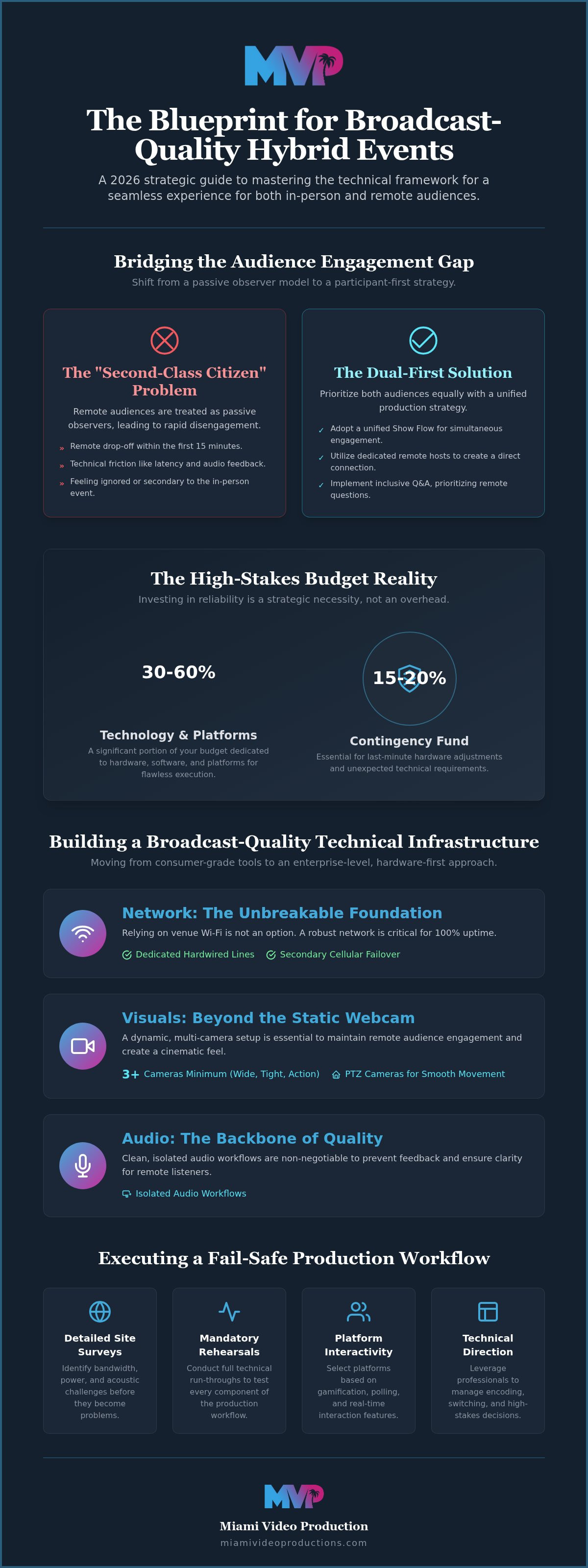
Successful production begins with a Dual-First mentality. This means you don't just point a camera at a stage and hope for the best. You treat the remote audience with the same level of strategic intent as those sitting in the front row. To understand What is a Hybrid Event? in a professional context, we must view it as a dual-path production where neither side is secondary. When planning how to livestream a hybrid event, you must address the psychological gap between physical and digital spaces. This gap is often widened by technical friction like latency, which creates jarring delays in Q&A sessions, or audio feedback that ruins the professional sheen of your broadcast.
A unified Show Flow is your most vital tool for bridging this gap. It ensures that every transition, video roll, and speaker change serves both audiences simultaneously. Instead of just tracking stage time, your production team should monitor engagement KPIs that reflect true participation. Success is found in average watch time, poll participation rates, and chat sentiment. These metrics provide a much clearer picture of ROI than simple login counts or total viewer numbers. They tell you if your content actually resonated or if people simply left the tab open in the background.
The "Second-Class Citizen" Problem
Data shows that remote audiences often drop off within the first 15 minutes if they feel ignored. To combat this, we recommend using dedicated remote hosts who speak directly to the camera during transitions. This creates a bridge across the digital divide. Inclusive Q&A strategies, where questions from the chat are prioritized alongside in-room hands, ensure that your virtual guests don't feel like they're just watching a movie of someone else's experience. You want them to feel like they're in the room, even if they're across the country.
Strategic Mapping for South Florida Events
Venues in Miami and Fort Lauderdale often present unique architectural challenges, from high ceilings that create acoustic echoes to limited power grids. When you're managing how to livestream a hybrid event in these spaces, strategic mapping involves aligning the physical room layout with camera sightlines. This ensures on-site attendees don't block the view of your remote participants. It's vital that your local audience understands the broadcast nature of the event. Their energy often elevates the quality of the live stream when they know they're part of a global conversation.
Building a Broadcast-Quality Technical Infrastructure
Building the physical architecture for a hybrid event requires a shift from consumer-grade tools to enterprise-level hardware. While browser-based software is convenient for small webinars, it lacks the processing power and stability needed for a ballroom setting. To master how to livestream a hybrid event, you must prioritize a hardware-first approach. This includes dedicated hardware encoders and managed network switches that can handle the high-bitrate demands of 2026 broadcast standards. Relying on venue Wi-Fi is a risk that high-stakes projects can't afford; instead, we insist on dedicated hardwired lines with a secondary cellular failover to maintain a 100% uptime record.
By following the protocols of a broadcast quality livestreaming company, you transform a standard meeting into a cinematic production. This transition requires a 15% to 20% contingency fund within your technology budget to account for unexpected technical requirements or last-minute hardware adjustments. When executing how to livestream a hybrid event at scale, your infrastructure must be invisible to the audience but indestructible in its performance.
Visuals: Beyond the Static Webcam
A single, wide-angle camera at the back of the room is the fastest way to lose remote engagement. We recommend a three-camera minimum to create a dynamic viewing experience: one wide shot for context, one tight shot for the speaker, and one "action" shot for audience reactions or demonstrations. Using professional PTZ (Pan-Tilt-Zoom) cameras allows for smooth, remote-controlled movements without the footprint of multiple manned units. Integrating professional lower thirds and branded overlays in real-time, alongside high-quality physical displays from Signarama, ensures that your stream looks like a polished television broadcast rather than a casual video call.
The room microphone is often the primary cause of stream abandonment. It picks up ambient noise, chair scrapes, and room echo, which creates a fatiguing experience for remote viewers. A professional setup uses a dedicated audio mix for the stream, completely isolated from the house PA system. In high-density areas like North Miami, wireless frequency coordination is essential to prevent interference from surrounding corporate offices. We also utilize "Mix-Minus" routing for remote speakers, which allows them to hear the room without hearing a delayed, echoing version of their own voice. Partnering with experts for technical direction ensures these granular details are managed before the first frame goes live.
Navigating Platforms and Real-Time Audience Engagement
After securing your hardware, the next strategic hurdle is selecting the digital environment. Choosing the right platform is critical when determining how to livestream a hybrid event because it dictates the level of friction your remote guests will encounter. The market has seen significant consolidation recently, with Cvent’s acquisitions of Goldcast and ON24 signaling a move toward integrated, all-in-one solutions. Your choice should be driven by the complexity of your program. Small events for under 100 attendees can often thrive on plans under $500 per month, while large scale enterprise programs requiring custom workflows can reach $40,000 per year.
Strategic platform selection is the cornerstone of how to livestream a hybrid event that converts viewers into long-term partners. We often recommend leveraging video growth strategy consulting to align your technology choice with specific business outcomes. This ensures you're not just paying for features you won't use, but rather investing in a digital venue that supports your long-term communication goals. Beyond the software, we suggest appointing a Digital Concierge. This specialist manages remote troubleshooting and chat moderation, ensuring the virtual audience feels seen and supported in real-time.
Choosing Your Digital Venue
You must decide between "On-Air" browser solutions and high-security private portals. Browser-based tools like Zoom Events, starting at $149 per month, offer accessibility and ease of use. However, for cinematic corporate brand films or high-stakes summits, a white-labeled Hubilo or Bizzabo portal provides a more professional aesthetic. These enterprise platforms offer robust data analytics, allowing you to track attendee movement and lead generation metrics with precision. This data is the key to proving ROI to your stakeholders after the broadcast concludes.
Real-Time Engagement Tactics
Engagement is not a byproduct of the stream; it's a deliberate design choice. We recommend implementing live Q&A sessions that explicitly prioritize remote questions to maintain a sense of equity. You can also utilize "Second Screen" experiences, encouraging mobile users to participate in live polling or gamified challenges without leaving the main video feed. Other effective tactics include:
- Virtual Swag Bags: Digital vouchers or exclusive content downloads delivered via the platform.
- Digital Networking Lounges: Breakout rooms designed for specific industry topics or peer-to-peer connection.
- Gamification: Leaderboards that reward attendees for chat participation or visiting virtual sponsor booths.
Execution: The Hybrid Event Production Workflow
Execution is the phase where strategic planning transforms into a broadcast-quality reality. Unlike basic webinars that claim you can set up in minutes, a professional corporate event requires a methodical, multi-day approach to ensure technical stability. When mastering how to livestream a hybrid event, your workflow must account for the physical variables of the venue and the digital requirements of the stream. This process begins weeks before the event with a rigorous pre-production phase and culminates in a post-event strategy that extends the life of your content.
The Technical Site Survey
A site survey is much more than a simple walkthrough. It's a deep dive into the venue's infrastructure. In South Florida venues, particularly in downtown Miami or West Palm Beach, we focus heavily on verified upload speeds rather than just download capacity. 2026 standards for 4K streaming necessitate consistent, high-bitrate bandwidth that many older hotels struggle to provide. We also map out power requirements and cable runs to eliminate tripping hazards for on-site guests. Identifying local frequency interference is critical in high-density corporate areas to ensure wireless microphones and camera links remain crystal clear.
The "Run of Show" (ROS)
The Run of Show is the technical director's flight plan. It's a minute-by-minute guide that scripts every transition, camera angle, and audio cue. When you're managing how to livestream a hybrid event, your ROS must specifically address the handoffs between in-person speakers and remote participants. We build in specific buffer time for technical pivots. If a remote speaker's connection lags, the TD must have a pre-planned "Plan B", such as a video roll or a speaker swap, ready to execute instantly. This level of precision prevents the awkward silence that often plagues amateur productions.
Conducting a technical rehearsal, or "Tech Run", is non-negotiable for high-stakes projects. It allows the production team to test signal acquisition and confirm that the dedicated audio mix is perfectly balanced for the remote stream. Once the live broadcast concludes, the work continues with a strategic post-event workflow. This involves repurposing the high-quality recording into a Content Series or training modules to maximize your initial production investment. For a partner who understands the stakes of these high-pressure moments, discuss your next production with Miami Video Production.
Elevating Your Hybrid Experience with Professional Technical Direction
The final piece of the puzzle in mastering how to livestream a hybrid event is the human element. While hardware and software form the skeleton of the operation, the Technical Director (TD) acts as the nervous system. A TD doesn't just switch camera angles; they anticipate the speaker's next move and manage the real-time encoding process with surgical precision. There's a profound difference between simply renting gear and hiring a full-scale production team. Renting equipment places the burden of technical failure on your internal team, whereas professional production shifts that responsibility to experts who thrive under high-pressure scenarios.
Professional technical direction is your primary tool for risk mitigation. When a remote speaker loses their connection or a local microphone frequency experiences interference, a seasoned TD executes a pre-planned pivot before the audience even notices a glitch. This level of expertise is essential when consulting on cinematic corporate brand films, as it ensures the live aesthetic matches the high-end production values of your pre-recorded content. You aren't just hiring a crew; you're securing a pilot for your most important corporate moments.
The Strategic Partner Approach
We believe in moving beyond the role of a standard vendor to become your Video Growth Consultant. This shift in perspective is what separates a basic broadcast from a strategic business asset. When you understand how to livestream a hybrid event with a focus on brand authority, you're not just hosting a meeting; you're creating a library of high-value content. The long-term ROI of these assets is significant. They can be repurposed for training, marketing, and internal communications long after the live stream ends. In the competitive South Florida market, this level of sophistication signals to your stakeholders that your organization values excellence and precision.
Working with Miami Video Production
Our team brings deep local expertise to every project, whether you're hosting in the heart of Broward or at a corporate retreat in Naples and Fort Myers. We specialize in customizing technical setups for high-stakes corporate town halls and international conferences where downtime isn't an option. We don't just provide equipment. We provide the premium reliability that allows you to focus on your message while we handle the technical complexity. If you're ready to master the technical and strategic framework required for a seamless broadcast, Partner with us for your next hybrid event.
Master the Future of Hybrid Production
Transforming a standard corporate meeting into a global broadcast requires more than just high-speed internet. It demands a deliberate "Dual-First" strategy where the remote experience is engineered with the same precision as the on-site environment. By prioritizing a hardware-first infrastructure and choosing platforms that foster genuine interactivity, you move beyond simple streaming toward true audience engagement. Success rests on the transition from basic gear rentals to professional technical direction. This ensures every transition is seamless and every frame meets cinematic standards.
When you're ready to master how to livestream a hybrid event with zero technical downtime, partnering with a seasoned production team is the most effective way to secure your ROI. We provide broadcast-quality multi-camera switching and expert technical direction for South Florida corporate events. Our team maintains the highest cinematic production standards to protect your brand authority. Don't leave your high-stakes communication to chance. Elevate your next hybrid event with Miami Video Production and deliver an experience that resonates long after the signal ends. Your vision deserves the security of professional excellence.
Frequently Asked Questions
What is the minimum internet speed required for a 4K hybrid livestream?
A professional 4K stream requires a dedicated upload speed of at least 25 Mbps, though 50 Mbps is recommended for optimal stability. It's vital to secure a hardwired, synchronous connection at your South Florida venue rather than relying on shared guest Wi-Fi. In high-density areas like Miami or Fort Lauderdale, bandwidth can fluctuate significantly. We recommend testing the line multiple times during pre-production to ensure it can handle the heavy data load without dropping frames.
How do I prevent audio echo between the remote speakers and the in-person room?
Audio echo is prevented by using a mix-minus routing configuration on your digital sound board. This allows remote speakers to hear the room audio without hearing their own voice returned to them with a delay. When we manage how to livestream a hybrid event in local ballrooms, we also use dedicated echo-cancellation hardware. This setup ensures that the conversation between the stage and the virtual participants remains clear and free of distracting feedback loops.
What is the best platform for a hybrid conference in 2026?
The ideal platform depends on your event's scale and strategic goals. For large-scale enterprise summits, platforms like Bizzabo or Hubilo offer immersive networking and robust analytics. If you're hosting a simpler corporate town hall in North Miami, Zoom Events provides a reliable, user-friendly interface. We often help clients choose the right digital venue through our video growth strategy consulting to ensure the technology aligns with their specific business outcomes and engagement needs.
How many cameras do I really need for a professional hybrid event?
A professional hybrid production requires a minimum of three cameras to maintain high engagement levels. This setup includes a wide shot for context, a tight shot for the presenter, and a third camera for audience reactions or demonstrations. Using multiple angles allows the technical director to create a cinematic rhythm that keeps remote viewers focused. In South Florida venues, PTZ cameras are a popular choice because they provide broadcast-quality movement without requiring a large physical footprint.
Can I livestream a hybrid event using only Zoom or Teams?
You can use these platforms, but they often lack the broadcast-quality switching and branding required for high-stakes corporate events. These tools are designed for meetings rather than high-end productions. To achieve a polished look, we integrate these platforms with professional hardware switchers and encoders. This approach allows you to use the familiar interface of Teams while delivering a cinematic experience that features professional lower thirds, multi-camera angles, and superior audio isolation.
What happens if the internet goes down during the live broadcast?
Reliability is built through redundancy, such as using cellular bonding to merge multiple internet sources into one stable connection. If the primary line fails at a venue in West Palm Beach or Naples, the system instantly pivots to the backup without interrupting the stream. We also maintain local recordings on all cameras and the master switcher. This ensures that even in the rare event of a total signal loss, your content is preserved for post-event distribution.
How do I handle Q&A so both audiences feel included?
Equity is achieved by using a dedicated digital concierge to moderate and prioritize questions from the virtual audience. This specialist acts as the voice of the remote participants, ensuring their inquiries are addressed by the on-stage speakers. This integrated approach is a cornerstone of how to livestream a hybrid event that feels unified and collaborative. We recommend displaying the virtual chat on screens inside the room so the physical audience feels the presence of their digital peers.
Should I record the hybrid event or just stream it live?
You should always do both to maximize the ROI of your production. While the live stream provides immediate engagement, the high-quality recording is a valuable asset for your long-term content strategy. We help clients in Fort Myers and Naples repurpose these recordings into training modules, social media clips, or a podcast series. Capturing the event in broadcast quality ensures that your message continues to drive growth and authority long after the live broadcast has concluded.
