
Multi-Camera Livestreaming in Miami: The 2026 Strategy for High-Stakes Events
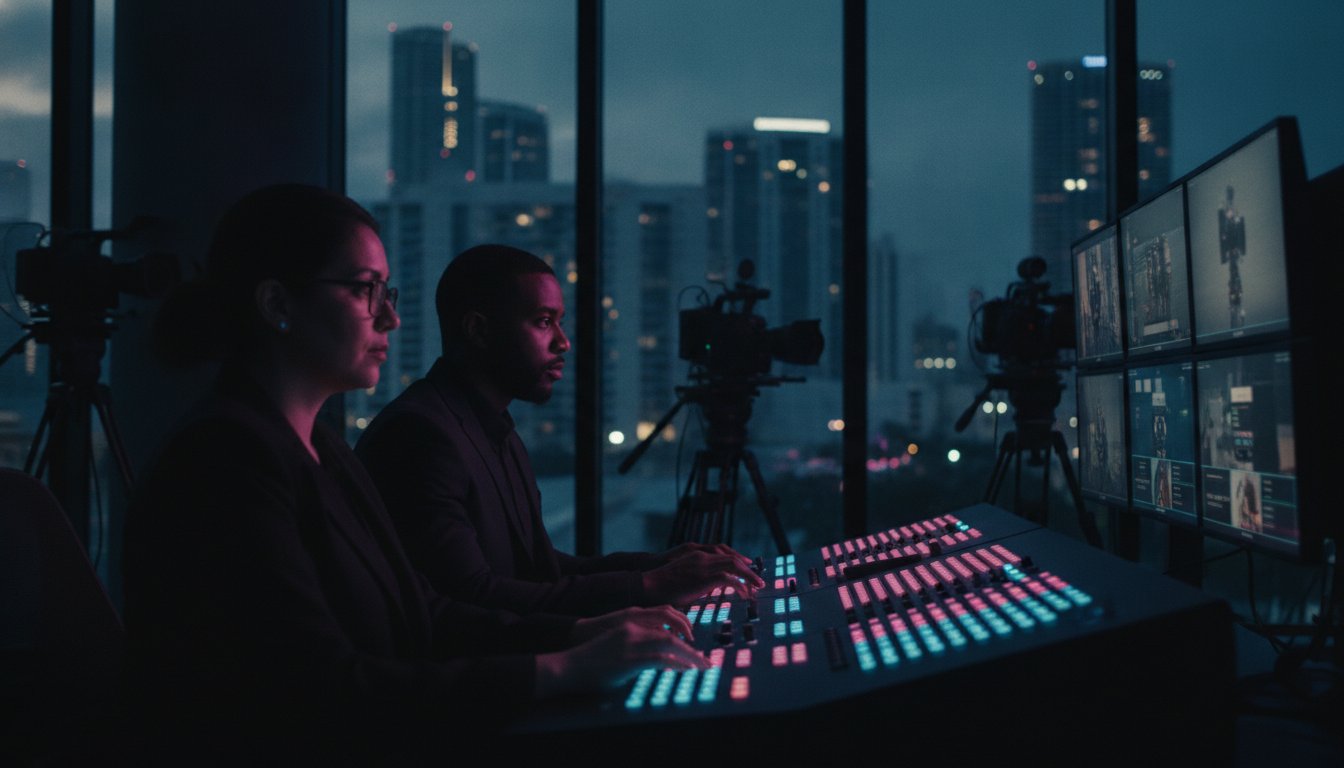
What if your next high-stakes corporate event felt less like a standard video call and more like a live network television broadcast? When you're coordinating multi-camera livestreaming miami, the difference between a static feed and a dynamic, multi-angle production is often the difference between losing your audience to "Zoom fatigue" and capturing their full attention. You understand the immense pressure of a live broadcast where there's zero room for technical glitches or unpolished visuals. It's a common concern for leaders in South Florida who need reliable technical direction but struggle to find crews that treat video as a strategic asset rather than just a technical task.
We agree that your brand deserves a platform that reflects its excellence. With the global livestreaming market projected to reach $2.58 billion in 2026, the standard for professional delivery is higher than ever. This article reveals how to leverage professional multi-camera setups to deliver broadcast-quality livestreams that engage global audiences and protect your professional reputation. We'll preview the essential production strategies, from redundancy protocols to real-time encoding, that ensure your stream looks like a premium TV production. You'll learn how to move beyond basic streaming and into high-level technical direction that drives viewer retention and growth.
Key Takeaways
- Discover how multi-camera livestreaming miami utilizes cinematic switching and diverse perspectives to eliminate viewer fatigue and maintain high engagement levels.
- Understand the technical necessity of hardware-based encoding and professional SDI signal paths to ensure a flawless, broadcast-standard transmission.
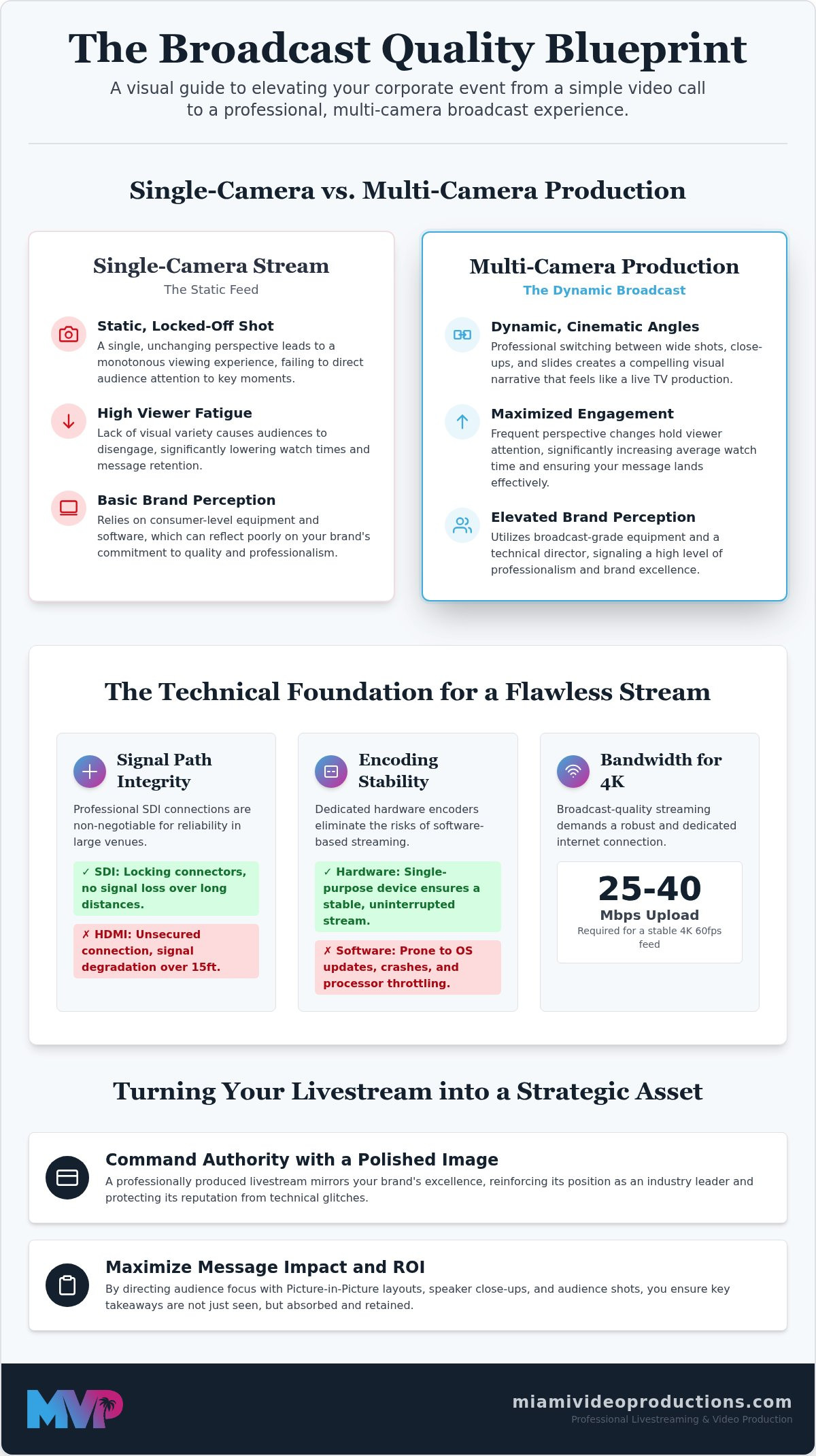
- Evaluate the strategic difference between a static "lock-off" shot and a directed multi-camera production that elevates your brand’s professional perception.
- Learn how to audit Miami venues for critical infrastructure requirements, including dedicated upload bandwidth and power capacity for high-end broadcast rigs.
- Explore how to integrate instructional design and video growth strategy into your live broadcasts to turn training sessions into high-impact corporate assets.
What is Multi-Camera Livestreaming and Why Does Your Miami Event Need It?
Multi-camera livestreaming miami is more than just having extra hardware in the room. It's a sophisticated, real-time broadcast strategy that utilizes multiple angles and professional switching to craft a seamless visual narrative. For high-stakes corporate events, this approach transforms a passive viewing experience into a strategic communication tool that commands authority. Think of it as the difference between a static security feed and a network television production. In a city where business moves at a relentless pace, your digital presence must match the physical excellence of your brand.
The "Cinematic Advantage" is a psychological necessity in modern communication. Humans are naturally wired to respond to movement and changes in perspective. When a stream remains fixed on a single wide shot for an hour, the audience inevitably experiences mental fatigue. By varying perspectives, you actively prevent this checkout and maintain interest throughout the entire session. This isn't just about aesthetics; it's about ensuring your strategic message actually lands with your remote stakeholders. Miami's competitive business landscape demands a level of polish that standard AV providers often fail to deliver.
The Evolution of Corporate Streaming in 2026
In 2026, the line between an in-person event and a digital experience has blurred completely. Modern technology now allows for 4K multi-cam streams with minimal latency, provided you have the 25 to 40 Mbps upload speed required for a stable 4K 60fps feed. Remote attendees no longer tolerate grainy, single-camera "webinars." They expect high production value that mirrors the quality of the brand they're investing in. This shift requires a technical director who manages every transition with precision, ensuring the broadcast feels like a deliberate production rather than an afterthought.
Engagement Metrics: Why One Camera Isn't Enough
Data-driven insights from modern streaming platforms show that frequent angle changes significantly increase average watch time and viewer retention. By switching between speakers, slide decks, and audience reactions, you provide a comprehensive view that a single camera simply cannot capture. Multi-Camera Switching is the process of selecting the live feed to ensure visual dynamism. This level of sophistication allows you to highlight the most important moments of your event. You'll find that variety keeps eyes on the screen:
- Close-up shots to emphasize a speaker's emotional delivery and key points.
- Wide shots to establish the scale, energy, and professional environment of the room.
- Picture-in-picture layouts to keep critical slide decks visible alongside the presenter.
It ensures that key takeaways aren't lost in a static, unengaging frame. When you show the presenter's passion and the audience's reaction simultaneously, you build a connection that one-way communication can't replicate. This isn't just about showing the event; it's about directing the audience's attention to what matters most.
The Technical Architecture of a Reliable Multi-Camera Stream
Building a broadcast-grade infrastructure requires moving beyond consumer-level gear. In a professional multi-camera livestreaming miami setup, the signal path begins with high-definition SDI cameras. Unlike HDMI, SDI connections lock into place and support longer cable runs without signal degradation; this is essential for large Miami ballrooms where cameras are often positioned far from the switcher. These feeds travel to a dedicated hardware switcher managed by a Technical Director. This individual orchestrates the visual narrative, timing every cut and transition to match the energy of the room.
While software-based encoders are common, they rely on a computer's operating system, which introduces variables like background updates or processor throttling. We utilize dedicated hardware encoders that serve one purpose: converting video into a stable stream. This ensures the 4K 60fps feed maintains the required 25 to 40 Mbps upload speed without interruption. To further professionalize the output, the Technical Director integrates real-time graphics, lower thirds, and branding overlays that align with your corporate identity. This level of detail transforms a simple video feed into a branded digital experience.
Fail-Safes and Redundancy: Protecting Your Broadcast
High-stakes events leave no room for a "reboot." Reliability starts with internet bonding, which combines multiple sources like fiber, cellular, and even satellite into a single, unbreakable connection. In major South Florida business districts, we often leverage "Dark Fiber" infrastructure to provide dedicated, high-capacity bandwidth that bypasses public network congestion. Beyond the connection, we employ dual-encoder setups. If a primary encoder fails, the secondary unit takes over instantly, ensuring your global audience never sees a black screen. It's this commitment to redundancy that defines a strategic production partnership.
Audio Engineering for Live Broadcasts
Audio is frequently the most overlooked element of a livestream, yet it's the first thing that will cause a viewer to leave. A professional broadcast requires a dedicated audio mix that is separate from the in-room public address system. The mix for the room accounts for physical acoustics, while the mix for the stream must be optimized for headphones and laptop speakers. In dense Miami environments like Brickell or South Beach, managing wireless interference is a constant challenge. Our engineers use RF coordination to prevent signal dropouts caused by the local congestion of a busy city.
If you're planning a hybrid panel, we also integrate low-latency return feeds. This allows remote callers to hear and see the on-site speakers in real-time, eliminating the awkward delays that plague standard video calls. Integrating these complex layers ensures that your message is heard clearly, regardless of where your audience is located. When the technical architecture is sound, you can focus on your delivery instead of worrying about the technology.
Single-Camera vs. Multi-Camera: The High-Stakes Comparison
A single-camera setup, often referred to as a "lock-off" shot, provides a persistent wide view of the stage. While functional for a basic record, it's inherently limited for a high-stakes broadcast. It forces the viewer into a passive role, watching a distant figure from a single fixed perspective for the duration of the event. This often results in an amateur aesthetic that can inadvertently signal a lack of investment in the audience's experience. In contrast, a directed multi-camera broadcast creates a premium environment. It allows the viewer to see the nuance of a speaker's expression through a tight shot while maintaining context with wider angles. This dynamism is what separates a professional corporate event from a standard video call.
Decision-makers often ask if the cost of a full crew is justified for a one-hour town hall. The answer lies in the stakes of the communication. If the message is critical enough to broadcast to a global workforce or a board of directors, it's critical enough to execute flawlessly. A single camera offers no room for error. If the speaker moves unexpectedly or a technical glitch occurs with that one source, the entire broadcast is compromised. Utilizing multi-camera livestreaming miami acts as a form of "visual insurance," ensuring the brand remains polished regardless of what happens on stage. It moves the needle from "getting it done" to "leading the conversation."
Risk Mitigation for Executive Presentations
Executives are dynamic. They move, they gesture, and they occasionally step outside the frame of a single camera. A multi-camera setup provides "safe" angles that a Technical Director can switch to instantly. If the primary camera operator needs to adjust focus or reposition, the broadcast doesn't stop. We simply cut to a secondary angle or a branded graphic. This fluidity builds profound trust with stakeholders. It shows that the production is under control and that every detail has been anticipated. This level of reliability is non-negotiable for high-pressure corporate environments.
ROI and Content Longevity
The value of a professional stream extends far beyond the moment the "end broadcast" button is pressed. A multi-camera production provides a wealth of high-quality footage that can be edited into a video content series for social media or internal training. Because you have multiple angles, the post-production team can create dynamic clips that look like they were filmed specifically for marketing purposes rather than just captured from a live feed.
Some industry reports suggest that multi-camera streams can achieve up to a 40% higher engagement rate for on-demand viewing compared to static recordings. While a single shot might lead to audience drop-off after fifteen minutes, the visual variety of a directed broadcast keeps viewers tuned in longer. This longevity makes the footage a valuable corporate archive, serving as a high-end training asset for years. Investing in quality upfront ensures the content continues to deliver value for your organization long after the live event concludes.
Planning Your Miami Livestream: Venue and Logistics Checklist
Successful multi-camera livestreaming miami requires more than just high-end gear; it demands a meticulous audit of your chosen venue's infrastructure. While many Miami hotels and convention centers advertise high-speed internet, their marketing materials often focus on download speeds for guest Wi-Fi. For a broadcast-quality 4K feed, we prioritize a dedicated, synchronous upload speed. A reliable connection of 50+ Mbps is recommended to handle a 4K stream at 60 frames per second, which typically requires a sustained 25 to 40 Mbps. Without this headroom, your global audience may experience buffering that undermines your brand's authority.
Power requirements are equally critical. A full broadcast fly-pack, professional lighting rig, and hardware encoders can easily overload a standard 15-amp circuit. We coordinate with facility managers in Fort Lauderdale and West Palm Beach hotels to secure dedicated 20-amp circuits, ensuring your production remains isolated from other venue loads. Additionally, managing acoustics in high-ceiling Miami ballrooms requires strategic microphone placement and potentially acoustic dampening to prevent the "echo" effect that often plagues large-scale corporate recordings. If you're currently vetting locations, we can provide a technical venue audit to ensure your site is broadcast-ready.
The Pre-Production Roadmap
A physical site survey in Miami is mandatory before any high-stakes event. We use these walkthroughs to identify signal path obstacles, locate primary and secondary power drops, and test the actual upload stability of the venue's hardline. This data informs the Run of Show (ROS), a detailed document that aligns the production team with your event agenda. During this phase, we also consult on how to hire a video production company in Miami to ensure your specific technical needs, such as 8K capability or SRT protocol support, are met by the right specialized crew.
Platform Selection: Where to Broadcast?
Choosing the right platform depends on your strategic goals and audience security needs. LinkedIn Live and YouTube Live offer massive reach for public-facing brand announcements, while private secure portals are essential for internal corporate town halls. Hybrid logistics introduce another layer of complexity; we specialize in integrating professional broadcast feeds directly into Zoom or Teams. This allows your remote speakers to interact with the on-site audience with minimal latency. For maximum impact, we can execute simultaneous multi-platform streaming, allowing you to dominate the digital conversation across South Florida markets and beyond.
Partnering for Excellence: The Miami Video Production Approach
At Miami Video Production, we view every broadcast as a critical component of your corporate narrative. Our "Strategic Partnership" model moves beyond the transactional nature of standard AV rentals. We act as high-level consultants who understand that multi-camera livestreaming miami is a vehicle for business growth, not just a technical requirement. By aligning production values with your specific communication goals, we ensure your event resonates with global stakeholders and maintains the highest standards of brand integrity. We don't just provide equipment; we provide the professional confidence that your message will be delivered without compromise.
This strategic depth is particularly evident when we integrate our instructional video expertise into live corporate training streams. We don't just capture a lecture; we design a visual experience that facilitates learning and retention through dynamic switching and clear graphics. Whether you're operating in the heart of Miami, the corporate hubs of Broward, or the executive retreats of Naples and the Palm Beaches, our local expertise ensures that venue-specific challenges are anticipated and neutralized long before the first camera goes live. Our commitment to cinematic quality and broadcast-standard technical direction remains the cornerstone of every project we undertake.
From Strategy to Execution
Success in the control room depends on a disciplined, specialized crew. Our team is led by a Director who maintains the creative vision, a Technical Director who executes the live switching with precision, and professional Camera Operators who capture the cinematic angles required for high engagement. This professional composition allows us to manage the complexities of a broadcast-standard production while you focus on your delivery. Once the stream concludes, we analyze viewer metrics and provide a roadmap for repurposing your footage, ensuring your livestream continues to drive growth as part of a broader video strategy.
Booking Your 2026 Livestream
We believe in defining your strategic goals before discussing gear. Our consultation process begins with a deep dive into your desired outcomes, audience demographics, and technical constraints. This allows us to customize setups for everything from intimate executive podcasts to massive global conferences. We thrive under the high-pressure demands of 2026 corporate communication, delivering the premium reliability and sophistication your brand requires. When you're ready to elevate your next event from a simple video feed to a broadcast-standard digital experience, we're here to lead the way. Request a strategic livestreaming consultation today.
Elevate Your Brand’s Digital Presence in 2026
Your corporate communication is too valuable to leave to chance. Moving beyond a static single-camera setup is a strategic decision that protects your brand's reputation and maximizes viewer engagement. By prioritizing broadcast-quality technical direction and cinematic multi-camera setups, you ensure your message isn't just seen; it's felt. In a competitive market like South Florida, the difference lies in the details of redundant internet bonding for 100% uptime and a methodical approach to venue logistics.
Securing your next multi-camera livestreaming miami doesn't have to be a source of technical anxiety. When you partner with a team that treats your event as a strategic asset, you gain the freedom to focus on your vision while we handle the technical execution. We're ready to help you turn your next high-stakes broadcast into a cinematic digital experience that resonates globally.
Take the first step toward a flawless production. Schedule a Strategic Livestreaming Consultation to discuss your 2026 event roadmap. We look forward to helping you lead the conversation with excellence.
Frequently Asked Questions
What is the difference between a standard webinar and a multi-camera livestream?
A standard webinar typically relies on a single webcam or a fixed wide angle, which often leads to viewer fatigue. In contrast, a multi-camera livestream utilizes professional switching between multiple cinematic perspectives to create a broadcast-standard production. This approach transforms a passive digital meeting into a dynamic experience that mirrors the quality and engagement of network television.
How much internet bandwidth is required for a 4K multi-camera stream in Miami?
A 4K livestream at 60 frames per second requires a sustained upload speed of at least 25 to 40 Mbps. To ensure 100% reliability during your multi-camera livestreaming miami, we recommend a dedicated, wired connection of 50+ Mbps. This provides the necessary overhead to handle network fluctuations without compromising the visual integrity of your broadcast.
Can you livestream to multiple platforms like LinkedIn and YouTube simultaneously?
Yes, we utilize specialized restreaming technology to broadcast to LinkedIn, YouTube, and private secure portals at the same time. This strategy allows you to maximize your reach across diverse audience segments simultaneously. It ensures your message is accessible on the platforms where your stakeholders are most active without requiring additional bandwidth at the venue.
Do you provide technical direction for hybrid events with remote speakers?
We provide comprehensive technical direction that integrates remote presenters into the live broadcast via low-latency return feeds. Our team manages the real-time mix so on-site and virtual participants can interact without the awkward delays common in standard video calls. This creates a cohesive narrative that feels unified for both the in-room and digital audience.
What happens if the venue's internet goes down during the live broadcast?
We protect your broadcast using cellular bonding and redundant hardware encoders that automatically switch to a secondary network if the primary line fails. This protocol ensures continuous uptime even in the event of a localized service provider outage. Our commitment to fail-safe architecture means your global audience remains connected regardless of venue infrastructure challenges.
How many cameras are typically needed for a corporate conference in South Florida?
A standard high-stakes conference typically requires three cameras to capture a wide establishing shot, a tight speaker shot, and audience reactions. This configuration provides the Technical Director with enough variety to keep the visual narrative engaging. For larger panels or complex stage setups, additional angles can be integrated to ensure no critical moment is missed.
Do you offer post-event editing for the recorded livestream footage?
Yes, we offer full post-production services to transform your live recording into high-impact marketing assets or training modules. Because we capture multiple angles, we can edit the footage into a multi-camera livestreaming miami content series for social media. This allows you to extend the lifecycle of your event and drive long-term engagement across your digital channels.
How far in advance should I book a multi-camera production team in Miami?
We recommend booking your production partner at least 30 to 45 days in advance to allow for site surveys and technical planning. For major city-wide events like Art Basel, earlier booking is essential to secure your dates and coordinate with venue AV departments. Proper lead time ensures every detail of the technical architecture is tested and ready for a flawless execution.
