
Multi Camera Livestreaming in Miami: The Strategic Guide for High-Stakes Events
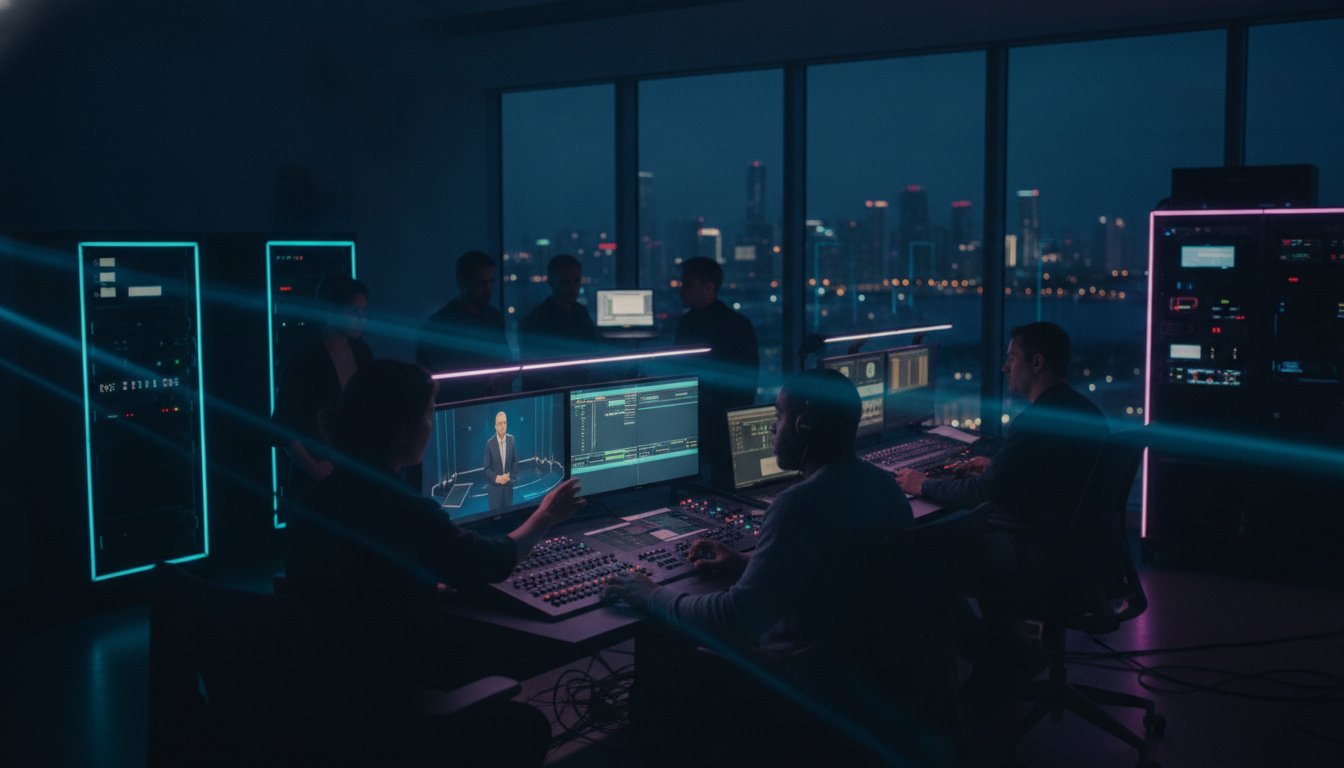
A single, static camera feed isn't a broadcast; it's a digital liability that risks your brand's reputation the moment your high-stakes event begins. You've likely felt the tension of a live countdown, wondering if the venue’s Wi-Fi will hold or if your remote audience is already tuning out due to a lack of visual energy. When you're managing a major corporate summit or a global brand launch, professional multi camera livestreaming miami becomes more than just a technical upgrade. It is a strategic safeguard against the "boring" factor that often plagues standard digital events.
We recognize that technical glitches and the logistical maze of Miami-Dade permit requirements or power limitations can turn a visionary event into a stressful ordeal. This guide will show you how professional production transforms standard broadcasts into high-engagement, cinematic experiences that mirror television standards while protecting your professional image. You'll discover the essential logistics of local venue infrastructure, the critical role of redundant internet connections, and how a reliable technical partner handles the complexity so you can focus on your message.
Key Takeaways
- Learn how to eliminate "webcam fatigue" by utilizing dynamic camera angles that maintain viewer engagement and uphold your brand's professional authority.
- Navigate the specific technical demands of multi camera livestreaming miami, from managing venue bandwidth to leveraging South Florida’s premier fiber-optic infrastructure.
- Identify the essential broadcast-grade components, such as dedicated video switchers and high-end sensors, required to produce a television-standard digital event.
- Understand the critical risks of DIY setups and how professional technical direction prevents common failures like audio-visual desync and connectivity drops.
- Discover the value of a strategy-led partnership that aligns cinematic production quality with your long-term corporate communication and growth goals.
Why Single-Camera Streams Undermine Professional Brand Authority
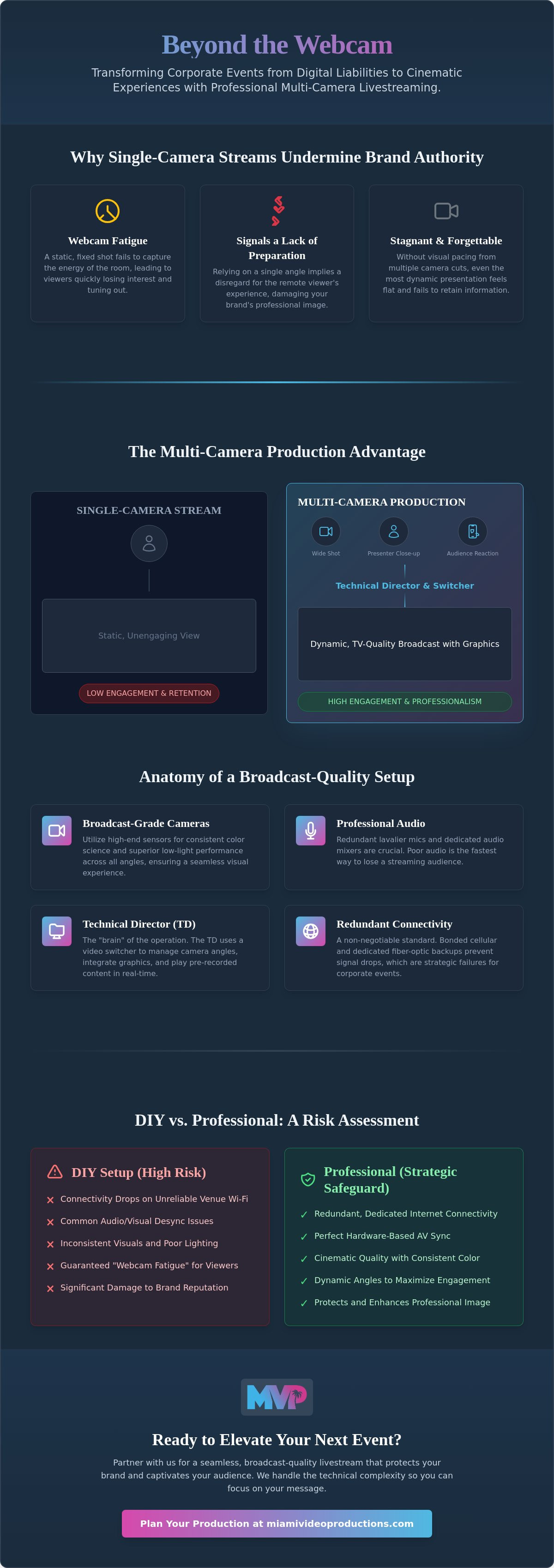
In a corporate environment, first impressions are often digital. Relying on a single, static camera angle for a major event signals a lack of preparation and a disregard for the remote viewer's experience. A professional multiple-camera setup is a synchronized broadcast that uses several vantage points to create a dynamic, TV-like experience. This approach ensures that your message isn't just heard, but felt. When you invest in multi camera livestreaming miami, you're choosing to move beyond the limitations of a basic webcam and into the world of strategic communication.
Static angles lead to what industry experts call "webcam fatigue." In high-pressure corporate settings, a fixed shot fails to capture the energy of the room or the nuance of a speaker's delivery. Viewers quickly lose interest when there's no visual progression. By contrast, switching between wide shots of the stage, tight close-ups of the presenter, and shots of audience reactions keeps the narrative moving. This level of production quality directly equates to your company’s professionalism in the eyes of your stakeholders. It shows that you value their time and their engagement.
The Psychology of Viewer Engagement
The human brain is wired to respond to movement and perspective shifts. When a broadcast cuts from one angle to another, it resets the viewer’s attention span and emphasizes specific points of data or emotion. This is vital for long-form content like keynote speeches or annual town halls where focus naturally drifts. Visual pacing is the intentional rhythm of camera cuts used to maintain viewer focus and improve information retention throughout a broadcast. Without this pacing, even the most brilliant presentation can feel stagnant and forgettable.
Cinematic Standards in a Digital-First World
Audience expectations have reached an all-time high. With the global livestreaming industry projected to reach $534 billion by 2030, the gap between "streaming an event" and "producing a digital broadcast" has widened significantly. In 2026, corporate standards require broadcast-quality visuals to remain competitive in a crowded digital marketplace. Your remote attendees shouldn't feel like they're watching from the sidelines; they should feel like they have the best seat in the house. This transition to cinematic production ensures your brand authority remains intact, regardless of where your audience is located. High-stakes events in a city as vibrant as Miami demand a visual standard that reflects the importance of the occasion.
The Anatomy of a Broadcast-Quality Multi-Cam Setup
Achieving a television-standard broadcast requires a sophisticated ecosystem of hardware and expertise that goes far beyond simply placing several cameras in a room. At the core of every successful multi camera livestreaming miami project is professional imaging. We utilize broadcast-grade sensors that ensure consistent color science and superior low-light performance across all angles. This consistency is vital; when a director cuts from a wide stage shot to a tight presenter close-up, the visual quality must remain seamless to preserve the viewer's immersion and your brand's authority.
While visuals capture attention, audio quality serves as the foundation of viewer retention. Industry data confirms that poor audio is the fastest way to lose a streaming audience, often causing viewers to drop off even if the video remains crisp. A broadcast-quality setup integrates professional microphones, such as redundant lavaliers for presenters, into a dedicated audio mixer. This signal is then synced perfectly with the video feed before reaching the encoder. To ensure your message reaches its destination without interruption, we employ hardware-based encoding with bonded cellular or dedicated fiber-optic backups. This level of redundancy is a non-negotiable standard for high-stakes corporate events where a signal drop isn't just a technical glitch; it's a strategic failure.
The Role of the Technical Director
The technical director (TD) functions as the "brain" of the live production. While camera operators focus on framing and focus, the TD sits at the video switcher to execute real-time technical direction. This role involves much more than just switching angles. The TD manages the integration of lower thirds, branded graphics, and pre-recorded video playbacks. They also coordinate the transitions between live on-site speakers and remote presenters, ensuring the digital audience experiences a polished, cohesive narrative. For organizations looking to elevate their next broadcast, partnering with a professional events and livestreaming team provides the specialized oversight needed for these complex workflows.
Essential Hardware for High-Stakes Reliability
Reliability in high-interference environments, such as the Miami Beach Convention Center or crowded boutique hotels in Coral Gables, requires specialized hardware. We prioritize fiber-optic cabling over wireless transmitters whenever possible to eliminate the risk of signal interference from hundreds of attendee mobile devices. Additionally, professional tally systems are essential; these small lights on the cameras signal to the presenters which lens is currently live, allowing them to maintain direct engagement with the remote audience. By using dedicated hardware switchers like the ATEM series rather than software-only solutions, we reduce the strain on individual computers and significantly increase the overall stability of the stream.
Strategic Reliability: Why DIY Multi-Cam is a Risk for Corporate Events
Attempting a DIY approach for corporate communication often leads to a cascading failure where one technical oversight compromises the entire broadcast. While prosumer equipment has become more accessible, it lacks the architectural stability required for high-stakes multi camera livestreaming miami. The hidden complexity lies in the precise synchronization of multiple video and audio sources; even a slight delay between a speaker's lips and their voice can shatter the professional illusion and distract your audience. Professional teams use specialized clocking hardware to ensure every frame and sound wave aligns perfectly across every camera angle.
Relying on standard hotel Wi-Fi is one of the most common mistakes in event planning. These networks are typically shared with hundreds of guests, meaning your upload speed can plummet without warning when the audience starts using their devices. A professional setup treats internet connectivity as a mission-critical utility. We utilize dedicated bandwidth that isn't shared with the public, ensuring your stream has a clear, unobstructed path to the platform.
Strategic reliability means building triple redundancy into every potential point of failure. This includes using uninterruptible power supplies to guard against Miami's frequent summer power surges and maintaining multiple signal paths to the cloud. When you weigh the investment of a professional crew against the reputational cost of a failed executive broadcast or a broken shareholder meeting, the value of an expert partner becomes clear. It's the difference between hoping the technology works and knowing that every detail is under control.
Common Technical Pitfalls in South Florida
Miami's dense urban corridors, like Brickell and Downtown, present unique challenges for wireless signal integrity. High-interference environments can cause consumer-grade wireless transmitters to drop frames or lose connection entirely. Additionally, the region’s high humidity and heat require specialized thermal management for hardware to prevent mid-stream shutdowns during outdoor or semi-sheltered setups. Cellular bonding is a non-negotiable requirement for Miami event reliability because it combines multiple cellular networks into one robust, unbreakable data pipe that functions even if one carrier fails.
The Importance of Pre-Production and Testing
Excellence in livestreaming is won in the 48 hours before the event begins. We conduct rigorous site surveys to verify upload speeds and test power grids long before the first attendee arrives. These sessions allow our Technical Director to rehearse transitions and graphics overlays, ensuring the timing of the live feed is flawless. In major Miami conference centers, we often look for the "Dark Fiber" advantage, securing dedicated, unlit fiber optic connections to provide the highest possible tier of signal security and speed for our clients.
Navigating Miami’s Technical Landscape for Flawless Streaming
Miami’s status as a global business hub makes it a premier destination for high-stakes events, but the city's unique geography presents specific hurdles for live production. Executing multi camera livestreaming miami involves more than just bringing gear to a room; it requires a deep understanding of local infrastructure and regulatory requirements. From the expansive Miami Beach Convention Center to the intimate ballrooms of boutique hotels in Coral Gables, each venue demands a tailored technical strategy. While modern high-rises in Brickell often offer robust fiber-optic connectivity, older sites in Coconut Grove may require supplemental network solutions to ensure a stable uplink.
Navigating the regulatory environment is equally critical for a seamless broadcast. Any video production on public property requires a Miami-Dade film permit, which carries a non-refundable $150 fee and remains valid for 28 days. To obtain this, companies must provide proof of at least $1,000,000 in general liability insurance. For larger scale productions using public spaces, special event permit applications must be submitted at least 30 days in advance for groups under 1,000 attendees, or 45 days for larger gatherings. Failing to secure these documents early can halt a production before it begins, making early coordination a strategic necessity.
Miami Venue Spotlight: Infrastructure Realities
The contrast between Miami’s neighborhoods directly impacts streaming reliability. Brickell’s financial district is built on modern digital foundations, making it easier to secure the high-speed upload channels necessary for 4K broadcasts. Conversely, historic sites in Coconut Grove or the Design District may have "dead zones" where cellular signals struggle to penetrate thick masonry. In these cases, working closely with in-house AV teams to bypass standard guest networks is essential. Securing a dedicated VLAN ensures your stream doesn't compete with the social media activity of hundreds of attendees.
Logistics and Crew Coordination
Logistical success in South Florida is often a matter of timing. Scheduling equipment load-ins requires accounting for notorious traffic patterns on I-95 and the Palmetto Expressway to ensure a minimum of three hours for setup and testing before doors open. A local Miami crew understands these rhythms and the specific layouts of major venues, allowing for faster problem-solving. They also know how to protect sensitive broadcast electronics from the tropical heat and humidity that can cause equipment to throttle or fail during outdoor segments. To ensure your next event is managed with this level of local expertise, you can partner with our team for professional events and livestreaming services.
Partnering with Miami Video Production for Seamless Execution
Successful communication during a high-stakes event requires more than technical proficiency; it demands a partnership grounded in strategic intent. When you engage our team for multi camera livestreaming miami, you're working with consultants who prioritize your business outcomes over simple camera placement. We don't just provide gear. We provide a comprehensive communication framework that ensures every camera angle and graphic overlay serves a specific purpose in your brand narrative. This "Strategy First" approach aligns our high-end production values with your specific corporate goals, whether you're launching a product or hosting a global summit.
Our commitment to excellence is reflected in the broadcast-standard equipment we deploy, using the same tools found in major television networks. However, the true value lies in our experienced Technical Direction. With decades of experience managing high-pressure live environments, our team anticipates challenges before they impact your feed. We provide end-to-end support that begins during initial pre-production and continues through the final sign-off. This level of oversight allows your executive team to focus entirely on their message while we manage the complex technical ecosystem behind the scenes.
Beyond the Stream: Content Longevity
The value of a professional multi-camera production extends far beyond the live broadcast. We help you maximize your investment by repurposing raw footage into high-impact marketing assets, Training & Education Videos, or a dedicated Podcast & Content Series. By capturing multiple angles simultaneously, we provide a wealth of cinematic material that can be edited into highlight reels or social media clips. Our team works with you to develop a Video Growth Strategy, creating a roadmap for how this content can support your long-term communication objectives. We integrate seamlessly with your existing marketing departments to ensure the visual style remains consistent with your established brand identity.
Start Your Professional Broadcast Today
Every event has a unique set of technical requirements and logistical hurdles. Our consultation process begins with a deep dive into your event’s specific needs, from venue connectivity to audience engagement goals. We offer tailored solutions for corporate town halls, international conferences, and cinematic brand films that require a sophisticated digital presence. By choosing a partner who understands the nuances of the Miami market, you ensure that your broadcast is reliable, professional, and impactful. Elevate your next event with Miami Video Production and transform your standard stream into a world-class digital experience.
Elevating Your Brand Through Strategic Broadcast Standards
Transitioning from a basic stream to a broadcast-standard digital event is a strategic move that pays dividends in brand reputation and audience retention. You've seen how dynamic angles eliminate viewer fatigue and how navigating Miami’s specific logistical requirements, from permits to fiber-optic infrastructure, is essential for technical success. Professional multi camera livestreaming miami ensures that your message isn't just delivered; it's presented with the authority your organization deserves.
Securing this level of excellence requires a partner who thrives in high-pressure environments. We provide broadcast-quality multi-camera switching and expert technical direction for clients throughout Miami, Fort Lauderdale, and West Palm Beach. By handling the complex layers of redundancy and synchronization, we allow you to focus on your strategic goals while we safeguard your broadcast. Partner with Miami Video Production for your next high-stakes event to ensure your communication remains seamless and impactful. We look forward to bringing your vision to life with precision and expertise.
Frequently Asked Questions
How many cameras do I need for a professional corporate livestream?
A standard three-camera setup is considered the professional best practice for most corporate events. This configuration usually includes a wide shot of the stage to establish the setting, a tight close-up for the active presenter, and a third angle for audience reactions or side perspectives. While more complex productions may require eight or more cameras, three angles provide the visual pacing necessary to maintain high remote engagement throughout the broadcast.
What is the difference between an encoder and a switcher in a multi-cam setup?
The switcher and the encoder perform distinct but equally critical roles in the production chain. A switcher is the central hub where the technical director cuts between different camera angles and overlays graphics in real time. The encoder then takes that final produced signal, compresses it into a digital format, and transmits it to your chosen streaming platform. Both are essential for a polished, professional result.
Can you stream to multiple platforms like YouTube, LinkedIn, and Zoom simultaneously?
Yes, we can broadcast to multiple platforms at the same time through a process known as multistreaming. This technique allows your event to reach audiences on YouTube, LinkedIn, and Zoom simultaneously without requiring additional bandwidth from the venue. It is a highly effective strategy for maximizing reach and ensuring your content is accessible where your stakeholders are already most active.
What happens if the internet goes out during my live event in Miami?
We mitigate the risk of internet failure by using redundant connections and bonded cellular technology. If the primary venue line drops, our system automatically switches to a backup signal, such as a combination of multiple cellular networks, to keep the stream live. This fail-safe approach is a cornerstone of our multi camera livestreaming miami services, ensuring your broadcast remains uninterrupted regardless of local network instability.
How much bandwidth is required for a broadcast-quality 4K livestream?
For a broadcast-quality 4K livestream, a dedicated upload speed of at least 25 to 50 Mbps is recommended. While lower speeds can support 1080p, 4K requires significantly more data to maintain its cinematic resolution and clarity. We always perform a site survey to verify that the venue’s infrastructure can handle these high-bitrate requirements long before the first attendee arrives.
Do you provide on-site technical direction for hybrid conferences in Fort Lauderdale?
Yes, we provide full on-site technical direction and production services throughout Fort Lauderdale and the surrounding South Florida region. Our team manages the entire technical ecosystem, including camera operations, audio mixing, and live switching for hybrid conferences. This partnership ensures that your remote attendees receive the same high-quality experience as those sitting in the front row of the venue.
How long does it take to set up a multi-camera production at a Miami venue?
A professional multi-camera production typically requires a minimum of three to five hours for on-site setup and testing. For high-stakes corporate events, we often recommend a full setup and rehearsal day prior to the live broadcast. This allows our crew to calibrate color across all sensors, test every signal path, and ensure the technical director is perfectly synced with your event’s specific run-of-show.
Can you integrate remote presenters into a live multi-camera broadcast?
We can seamlessly integrate remote presenters into your live broadcast using professional call-in software that maintains high-definition quality. These remote feeds are treated as an additional camera source, allowing the technical director to cut between on-site speakers and off-site experts. This capability is essential for modern hybrid events that feature global panels or executive speakers who cannot travel to the physical location.
