
Questions to Ask a Video Production Company: The 2026 Vetting Checklist
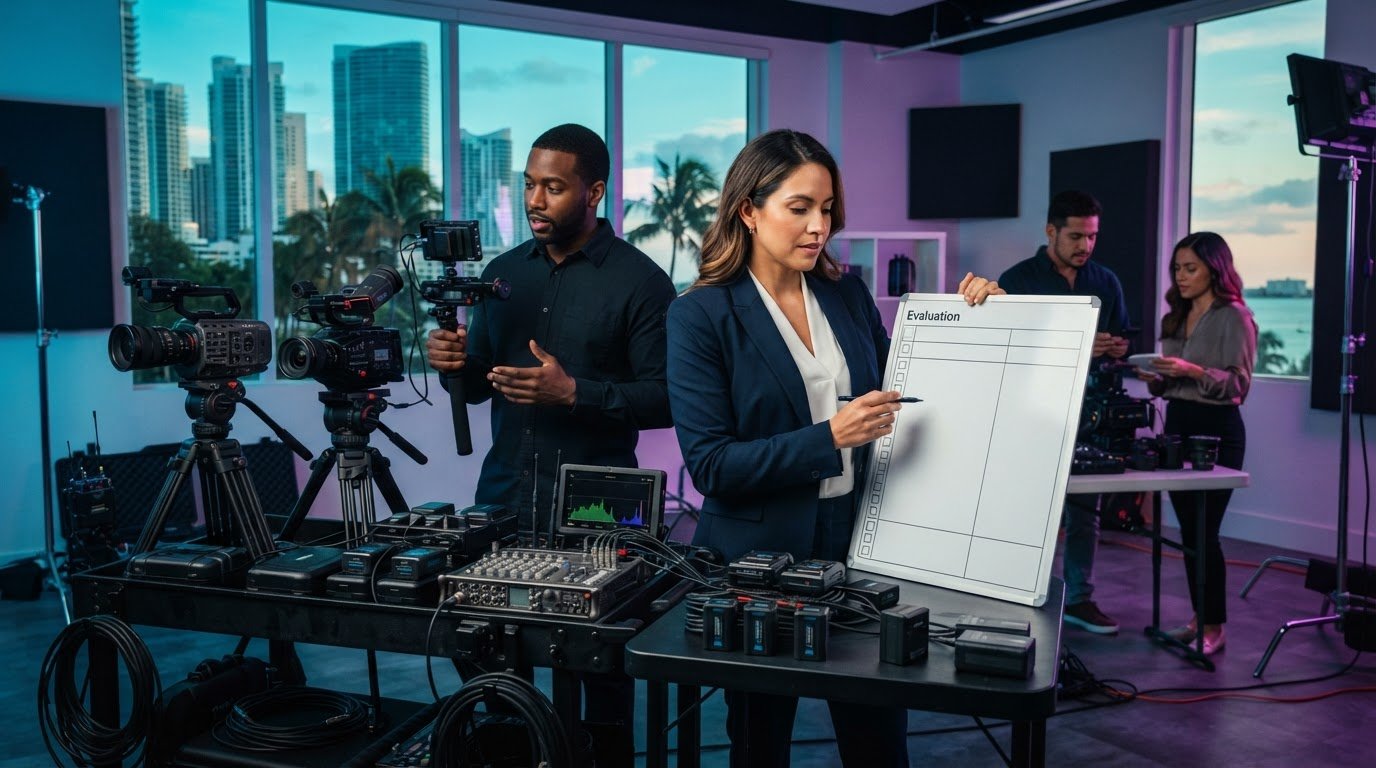
A cinematic showreel won't protect your high-stakes executive shoot from an unrecoverable audio failure, nor will 8K resolution guarantee qualified pipeline growth. When you interview prospective media partners, the essential questions to ask a video production company must look past the camera gear to interrogate operational fail-safes, risk management, and strategic alignment.
You already know the frustration of polished agency pitches that unravel into scope creep, surprise budget overages, or slick deliverables that generate zero measurable business impact. High-visibility corporate events and executive communications demand far more than a transactional crew pointing lenses; they require dependable technical direction that acts as comprehensive risk insurance for your brand.
This guide equips corporate decision-makers with a structured vetting framework to evaluate vendor proposals, clarify usage rights, and probe mission-critical redundancies before signing a contract. Ahead, you'll find the exact strategic questions needed to score prospective agencies objectively and secure an accountable, broadcast-grade production partner.
Key Takeaways
- Learn the critical questions to ask a video production company to verify whether they diagnose core business objectives before pitching creative visual concepts.
- Audit essential technical redundancies and multi-camera fail-safes, treating seasoned technical direction as vital risk insurance for high-stakes productions.
- Pinpoint contractual blind spots regarding intellectual property ownership, revision boundaries, and change-order triggers to eliminate scope creep.
- Assess on-set management workflows and dedicated leadership roles to safeguard executive comfort and brand integrity during filming.
- Implement a structured, weighted scorecard to evaluate vendor proposals objectively based on business alignment, technical reliability, and process maturity.
Strategic Discovery Questions to Gauge Business Alignment and Creative Vision
Creative flair means very little if a production misses your core commercial targets. Many agencies pitch stylized visuals, mood boards, and flashy camera movements before uncovering who your buyer is or what action they need to take. Prioritizing artistic intuition over business objectives wastes capital on content that fails to move pipeline. When compiling your core questions to ask a video production company, begin by auditing their strategic discovery methodology rather than their creative preferences.
A transactional crew asks about filming dates and run times. In contrast, an end-to-end strategic partner interrogates your customer acquisition model, stakeholder concerns, and quarterly revenue milestones. To evaluate whether past case studies reflect commercial performance rather than self-serving creative awards, test prospective vendors with rigorous discovery prompts:
- "What specific commercial metrics did your last three enterprise projects achieve?"
- "How do you resolve creative differences between our executive vision and customer conversion requirements?"
- "What is your discovery process before writing scripts or storyboarding scenes?"
Questions on Strategic Goal Mapping and Audience Definition
A successful engagement integrates your corporate message into an overarching commercial journey. Inquire about the exact framework the director uses to translate dry, corporate messaging into a compelling executive narrative. Ask how the team maps specific buyer personas across distinct sales funnel stages, ensuring top-of-funnel brand films hand off seamlessly to middle-of-funnel product education.
Agency leadership should clearly define how comprehensive video growth strategy consulting shapes early planning sessions to align brand assets with revenue targets. Probe their metrics tracking protocols. Rather than relying solely on surface-level view counts, ask how they measure audience retention drop-offs, qualitative executive reception, and post-campaign conversion benchmarks.
Vetting Portfolio Relevance Across Corporate Environments
Reviewing a general showreel will not tell you if an agency can navigate a regulated corporate boardroom. You must examine their command of the end-to-end video production process within high-pressure enterprise environments. Probe specifically for past experience handling strict executive schedules where a CEO has only twenty minutes for filming.
Scrutinize portfolio samples filmed under difficult acoustic conditions, such as glass-walled conference centers or active corporate campuses, to see how they resolve lighting and sound challenges. Finally, verify their operational protocols for managing tight facility security, data handling safeguards, and strict corporate non-disclosure agreements before bringing outside crews onto private property.
Technical Capability Questions: Equipment, Redundancy, and Crew Deployment
High production values collapse instantly if an audio channel drops during a keynote address or a primary camera sensor overheats mid-take. When preparing your technical questions to ask a video production company, scrutinize their operational engineering and risk mitigation protocols. Experienced technical direction functions as essential risk insurance for high-stakes corporate productions, turning potential points of failure into non-events.
Avoid vendors who rely on ad-hoc dry hires or overburdened generalists juggling camera operation, sound monitoring, and lighting adjustments at the same time. Dedicated role specialization ensures accountability across every technical touchpoint. As outlined in Lumira Studio's practical guide to choosing a production partner, evaluating an agency's equipment inventory and technical workflow provides clear insight into their professional maturity.
Live Event Infrastructure and Broadcast Redundancy
Live broadcasting leaves zero margin for technical error. You need to know exactly how a crew handles hardware crashes, power dips, and network drops before stepping on stage. Test their live infrastructure with these baseline inquiries:
- "What hardware fail-safes are deployed if the primary broadcast encoder crashes mid-stream?"
- "Do you implement bonded cellular networks alongside local venue ethernet to guarantee continuous transmission?"
- "How does your technical director orchestrate multi-camera switching, graphics integration, and audio sub-mixes in real time?"
Demanding enterprise gatherings require the battle-tested protocols of a broadcast quality livestreaming company. If an agency cannot detail their primary and secondary signal paths down to the hardware switchers, they aren't equipped for high-visibility corporate broadcasts.
Cinematic Capture Standards for High-Value Brand Content
For executive brand films and training assets, ask about internal recording specifications. Professional corporate work requires minimum 10-bit 4:2:2 capture pipelines to preserve dynamic range and color science fidelity during post-production color grading. Verify that their camera packages write simultaneously to dual internal media cards to prevent data corruption.
Sound capture deserves equal scrutiny. Inquire whether a dedicated sound recordist will monitor wireless lavaliers and boom microphones in real time, especially when managing echo-prone corporate boardrooms. Ask how their gaffers shape lighting packages around difficult reflections on glass walls, conference tables, and mixed ambient lighting conditions. If you need certainty across complex South Florida venues, consult with Miami Video Production to evaluate broadcast-grade camera packages and redundant crew configurations.
Scope, Timelines, and Legal Terms: Contractual Questions That Prevent Hidden Fees
Budget overruns rarely stem from equipment charges on shoot day. They occur during post-production when ambiguous contract terms collide with evolving stakeholder expectations. Vague production bids leave revision rounds open to interpretation, fail to define asset handoffs, and conceal licensing limitations that create costly legal bottlenecks later. When preparing questions to ask a video production company, scrutinize the master services agreement with the same rigor you apply to technical specifications.
A transparent scope details exactly where collaborative editing ends and billable change orders begin. To protect corporate budgets, enterprise buyers must contrast loose estimates against fixed scopes of work across several vital contractual benchmarks:
- Deliverable specifications: Exact run times, aspect ratios, language cuts, and format exports explicitly itemized.
- Feedback consolidation: Mandatory internal stakeholder consensus before revision notes enter the editing suite.
- Milestone sign-offs: Written sign-offs required at treatment, script, rough cut, and sound mix stages to lock progress.
- Copyright assignment: Unambiguous transfer of master files and usage rights upon final invoice clearance.
Defining Post-Production Revision Limits and Change Orders
Establish exact boundaries for post-production editing before signing an agreement. Ask specifically how many formal rounds of review are included in the baseline quote, and require the agency to specify turnaround windows for executive review notes. Inquire how the team handles post-approval modifications: if your leadership requests script revisions after voiceover recording, what formal change-order triggers apply, and how will that adjustment shift the final delivery date?
Securing Raw Footage Ownership, Music Licensing, and Talent Releases
Under U.S. copyright law, the author of a visual work owns the underlying intellectual property by default unless explicitly transferred in writing through work-for-hire agreements. You must include strict contractual questions regarding raw footage ownership. Ask whether transferring native camera rushes and project files requires buyout fees, licensing markups, or additional hard-drive processing charges.
Audit commercial music licensing terms across paid media horizons. Ensure the selected soundtrack licenses extend to television, paid digital advertising, and perpetual web distribution without geographical limitations or sudden expiration triggers. Finally, verify the vendor's standard protocols for executing binding talent releases, location agreements, and crew non-solicitation contracts. These documents provide total brand security long after the cameras wrap.
Production Process and Communication: What to Ask About On-Set Management
A shoot day can quickly devolve into chaos without disciplined floor leadership. While strategic alignment and contracts establish your project's foundation, on-set operational rigor determines executive comfort, schedule efficiency, and brand protection. Experienced C-suite leaders notice disorganized crews immediately. When assessing prospective vendors, your operational questions to ask a video production company must probe their live communication chains, executive management workflows, and location protocols.
Demand clarity on organizational hierarchy before filming begins. A dedicated producer acts as the operational firewall between your internal stakeholders and technical crew, managing the call sheet, maintaining time discipline, and resolving real-time logistical hurdles without pulling directors away from the monitor. Verify their field communication structure with direct questions:
- "Who serves as our single, dedicated point of contact on set to communicate schedule shifts?"
- "What is your protocol for briefing internal brand managers before the first camera rolls?"
- "How do you manage real-time client feedback during live takes without disrupting talent momentum?"
On-Set Producer Roles and Executive Media Coaching
Capturing genuine authority from C-suite leaders requires structured guidance, not passive observation. Ask who directs on-camera talent and how they coach executives who have limited broadcast media experience. Standard preparation workflows should include pre-shoot interview outlines, wardrobe guidelines that prevent moiré patterns on camera, and professional teleprompter support with dedicated operators.
To assess these executive management benchmarks, examine industry frameworks for capturing authentic leadership presence in cinematic corporate brand films. A skilled producer knows how to extract conversational, high-impact responses under strict enterprise schedule constraints.
Local Permitting, Insurance, and Venue Coordination
Overlooking municipal red tape can shut down a corporate production within minutes. Commercial enterprise venues and municipal authorities require verified documentation before permitting large camera packages on site. Review the compliance procedures detailed in how to hire a video production company in Miami to ensure your agency handles regional administrative hurdles properly.
Verify that your prospective partner maintains active commercial general liability insurance policies, with coverage tailored to high-traffic corporate spaces and luxury hospitality venues. Confirm their coordination process for load-in docks, freight elevator access, and security badging with hotel or convention hall facilities across regional business corridors. To ensure seamless, fully insured corporate execution across South Florida, partner with Miami Video Production for your upcoming enterprise media initiatives.
The Partner Evaluation Matrix: How to Compare Proposals and Make the Final Selection
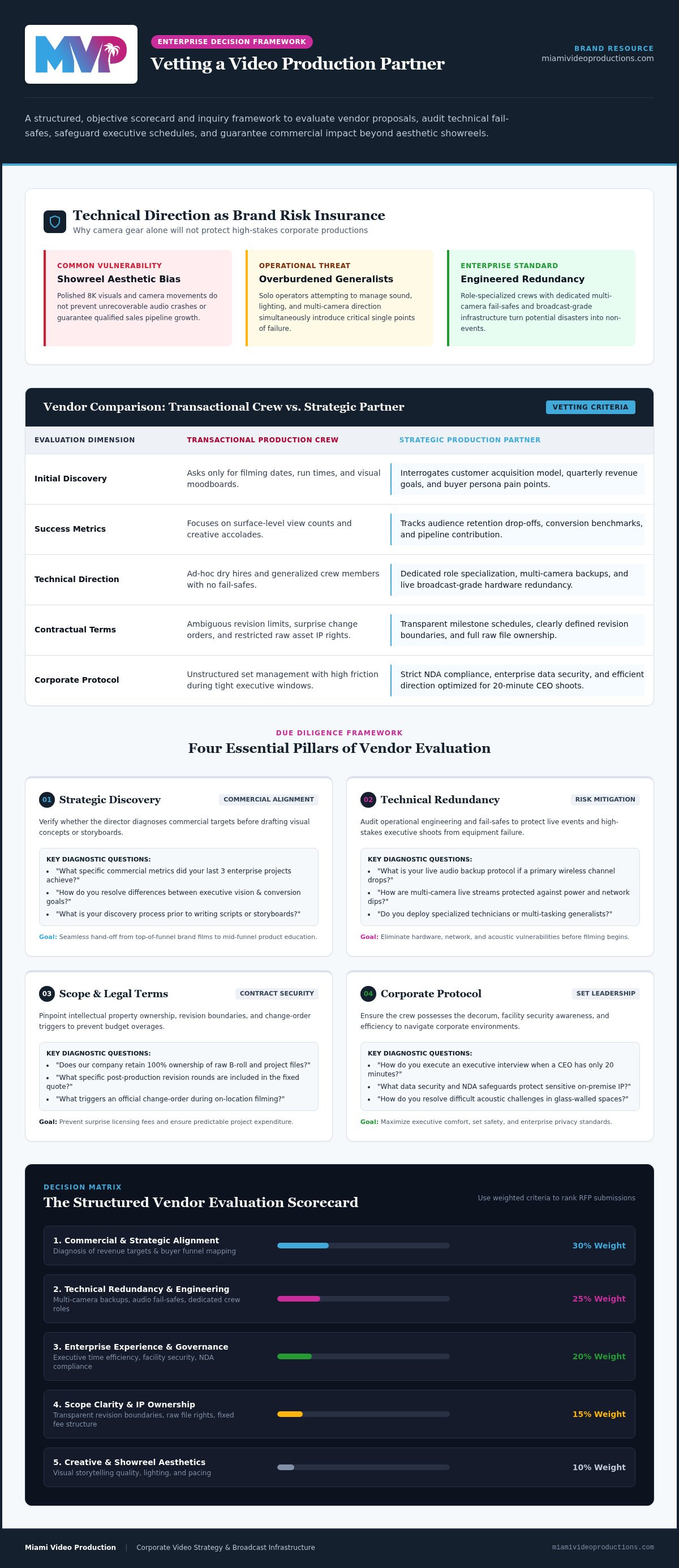
Subjective impressions and aesthetic bias frequently derail vendor evaluations. Corporate buying committees often fall into the trap of selecting an agency simply because their reel features dynamic drone shots or emotionally resonant music. To make an accountable business decision, procurement leaders need an objective framework. By translating your core questions to ask a video production company into quantifiable metrics, you remove guesswork and align stakeholders around operational stability and commercial value.
A balanced evaluation weighs four foundational pillars rather than fixating on the lowest bottom-line estimate. Bids that seem unusually inexpensive regularly omit essential redundancies, post-production rounds, or music licensing clearances, creating significant cost creep downstream. Evaluate finalists across a structured scoring distribution:
- Strategic Business Alignment (30%): Understanding of buyer personas, sales funnels, and measurable corporate objectives.
- Technical Infrastructure and Redundancy (30%): Specialized crew roles, multi-camera switching capabilities, and hardware fail-safes.
- Process Governance and Legal Rigor (25%): Revision thresholds, clear IP asset transfers, and venue insurance compliance.
- Creative and Aesthetic Caliber (15%): Narrative pacing, lighting craftsmanship, and overall portfolio polish.
Building a Multi-Criteria Vendor Scorecard
Convert your criteria into an internal scoring sheet where evaluators grade vendors on a 1-to-5 scale across each category. Pay close attention to how the agency communicated during the proposal phase. Did they ask clarifying questions about your commercial goals, or did they simply provide a flat equipment list? An agency's promptness, transparency, and thoroughness during the pitch stage directly mirror how they will manage your account during high-pressure production cycles.
Conducting Strategic Reference Calls and Onboarding Alignment
Past client references provide unvarnished insight into an agency's real-world crisis management. Instead of asking generic questions about whether the client enjoyed working with the crew, probe specific pressure points. Inquire directly about unforeseen timeline slips, budget modifications, or on-set equipment failures, and ask how the production team resolved those issues without escalating stress for internal brand leaders.
Once you select your strategic partner, transition immediately into structured onboarding. Kick off the engagement with an alignment session that gathers all internal department leads, locks the production schedule, and formalizes review milestones. This organized handoff ensures your strategic vision translates cleanly into executive-level execution from day one.
Choose Strategic Reliability Over Transactional Production
Selecting an enterprise media partner requires moving beyond cosmetic showreels to evaluate operational resilience. When you apply these targeted questions to ask a video production company, you shift vendor vetting from subjective aesthetic taste to objective risk management. Verifying broadcast fail-safes, locking strict revision thresholds, and demanding strategic audience alignment ensures your creative investment drives tangible business outcomes rather than unexpected overages.
High-stakes executive shoots and corporate events leave zero room for unvetted assumptions. Across South Florida boardrooms, convention centers, and regional corporate campuses, dependable execution demands seasoned technical direction and cinematic storytelling built around measurable pipeline impact. Take total command of your upcoming media initiatives. Schedule a strategic production consultation today to protect your brand integrity, eliminate technical vulnerabilities, and turn your corporate vision into measurable business growth.
Frequently Asked Questions
What is the most critical question to ask a video production company before hiring?
Ask how they measure business outcomes and align their creative strategy with your corporate pipeline goals. Instead of focusing on camera models, interrogate how the agency plans to move your audience through the sales funnel. In competitive South Florida commercial hubs like Miami and Fort Lauderdale, visual polish is common. A true strategic partner diagnoses corporate messaging, distribution channels, and viewer engagement metrics before suggesting visual concepts.
How do I ensure a video agency will not exceed our approved production budget?
Demand a fixed, fully itemized scope of work with clearly defined milestone sign-offs and change-order triggers. Unplanned costs typically emerge from ambiguous revision limits and mid-project script adjustments. Require explicit definitions for deliverable formats, post-production review cycles, and location expenses across regional hubs like West Palm Beach and Broward. Ensure your contract dictates that any billable work beyond the approved statement of work requires prior written authorization.
Why should I ask about video equipment if I am not technically inclined?
You ask about equipment to evaluate operational reliability and risk mitigation rather than technical specifications. Knowing camera brand names is unnecessary, but you must confirm that the vendor deploys dual-card recording, backup audio channels, and calibrated lighting kits. Among the critical questions to ask a video production company, verifying that they own professional-grade equipment rather than relying on dry rentals ensures on-set familiarity and prevents costly technical breakdowns.
How many rounds of edits should be standard in a video production contract?
Two to three consolidated revision rounds represent the enterprise standard for professional post-production workflows. The baseline agreement should clearly separate minor pacing or color adjustments from structural script changes. Ensure the contract requires your internal stakeholders to provide a unified, non-conflicting feedback document for each round. This structure keeps corporate brand film schedules on track and eliminates surprise editing fees across multi-department corporate review teams in Miami and Naples.
What questions should I ask when hiring a company for high-stakes corporate livestreaming?
Inquire directly about redundant transmission protocols, backup power supplies, and multi-camera hardware switching architecture. Ask whether the crew integrates bonded cellular networks alongside local venue ethernet to prevent broadcast drops during keynote addresses. When formulating questions to ask a video production company for major conferences across Fort Lauderdale, Miami, or West Palm Beach, confirm they assign dedicated technical directors to manage audio sub-mixes and switch cameras without single points of failure.
Who owns the raw footage and project files after the video is finished?
The production company owns all raw camera rushes and native project files by default under copyright law unless explicitly transferred in writing. Do not assume delivery of the finished master video grants you rights to the original footage. Confirm whether your contract includes a full copyright assignment and asset transfer upon final payment. Ask if hard drive transfer fees apply so your enterprise retains long-term ownership of its archival media assets.
How far in advance should our organization begin interviewing video production companies?
Begin interviewing potential media partners six to eight weeks before your targeted production or event date. Securing municipal film permits, booking premium enterprise venues, and coordinating executive schedules across South Florida markets like North Miami and Naples requires deliberate pre-production runway. Complex corporate brand films and multi-camera live broadcasts demand adequate preparation to conduct strategic discovery, draft treatments, and build detailed technical run-of-show documentation without compromising production quality.
