
Technical Direction for Live Events: The Strategic Bridge to Flawless Execution
What if the most expensive line item on your corporate event budget isn't the venue or the keynote speaker, but the five minutes of dead air when a technical glitch silences your presentation? For many executives, the fear of a high-stakes failure is a constant shadow over the planning process. You've invested months into your strategy; yet, the success of the day often rests on a complex web of vendors who might not be communicating effectively. It's a high-pressure environment where even a minor oversight can lead to budget overruns or an unprofessional livestream that fails your remote audience.
This is why technical direction for live events is no longer an optional add-on; it's the strategic insurance policy your brand needs. By acting as the bridge between your vision and the technical reality, a professional technical director eliminates risk and ensures a broadcast-quality output. In this article, you'll discover how specialized oversight creates a stress-free environment, streamlines vendor management, and delivers the cinematic standards your audience expects. We'll examine the specific ways that strategic planning transforms technical complexity into a flawless, high-impact experience.
Key Takeaways
- Understand the critical distinction between a standard technician and a technical director who manages the strategic cohesion of your entire production.
- Learn how the pre-production roadmap, including site assessments and signal flow diagrams, prevents technical bottlenecks before they ever occur.
- Discover how professional technical direction for live events ensures your remote audience receives a broadcast-quality experience equal to those in the room.
- Explore the core technical domains, from multi-camera switching to precision audio engineering, that define a sophisticated corporate environment.
- Realize the strategic advantage of local South Florida expertise for managing complex venue logistics and vendor communication in Miami, Fort Lauderdale, and Naples.
What is Technical Direction for Live Events?
Technical direction for live events is the centralized management of every technical discipline involved in a production, from lighting and audio to broadcast video and network stability. It represents the strategic layer that sits above individual operators. While a technician is responsible for a single piece of equipment, the technical direction ensures that all these moving parts function as a single, cohesive unit. It is the "brain" of the operation, making split-second decisions that keep the show moving forward according to the planned schedule.
For corporate leaders, this role is primarily about risk mitigation and brand protection. During a high-stakes town hall or a global conference, the cost of a technical failure isn't just measured in lost time; it is measured in diminished authority and lost trust. A Technical Director (TD) acts as a senior strategist who anticipates these risks long before the first attendee arrives. They ensure that your message is delivered with the precision and excellence your brand demands, shielding you from the unpredictability of live production.
The Core Responsibilities of a TD
The TD serves as the primary architect of the event's technical infrastructure. They begin by translating your creative vision into a comprehensive technical equipment list and a detailed labor plan. This isn't just about ordering gear; it's about ensuring the gear is capable of delivering the specific outcomes you've requested. Their duties include:
- Managing the Run of Show (ROS): The TD owns the technical script, ensuring every cue for lighting, sound, and video playback happens at the exact millisecond required.
- Vendor Coordination: They serve as the single point of contact for all technical vendors, eliminating the "finger-pointing" that often happens when separate companies handle audio and video.
- Technical Feasibility: They assess whether a creative idea is actually possible within the constraints of the venue and budget, providing viable alternatives when necessary.
TD vs. AV Manager: Understanding the Distinction
It's common to confuse a Technical Director with an AV Manager, but their focus areas are fundamentally different. An AV Manager is typically focused on the hardware. They manage inventory, ensure the speakers are plugged in, and verify that the projectors are bright. Their priority is the equipment itself. In contrast, technical direction for live events focuses on the integration and timing of the performance.
A TD manages the intersection of lighting, sound, and broadcast. They understand how a change in stage lighting will affect the color balance on the livestream, or how an audio delay in the room might impact the remote audience's experience. While the AV provider brings the tools, the TD brings the strategy to use those tools effectively. For complex, multi-camera events, having a dedicated director separate from the equipment provider is essential for maintaining an unbiased, high-level perspective on the production's success.
The Technical Director’s Workflow: From Pre-Production to Strike
Successful technical direction for live events begins months before the first spotlight is turned on. It's a methodical progression from high-level vision to granular execution. In South Florida, this often starts with rigorous site visits to major venues in Miami and Broward. These assessments aren't just walk-throughs; they're feasibility studies. We analyze power distribution, rigging points, and internet bandwidth to ensure the venue can support a broadcast-quality production.
Once the physical constraints are understood, the workflow shifts to technical design. This involves creating precise floor plans and signal flow diagrams that map out every cable and connection. By adhering to industry standards set by organizations like the United States Institute for Theatre Technology (USITT), a director ensures that the technical infrastructure is both safe and efficient. This level of detail prevents "day-of" surprises that often lead to budget overruns or delays.
Labor management and vendor coordination follow. The director sources specific equipment and assembles a team of specialists, from audio engineers to camera operators. They act as the central hub, ensuring every vendor understands their role within the broader strategy. If you're planning a high-stakes corporate event, partnering with a team that provides comprehensive events and livestreaming services can bridge the gap between creative ambition and technical reality.
Pre-Production: The Foundation of Success
The pre-production phase is where the technical insurance policy is written. Site surveys identify critical limitations like insufficient dedicated power for lighting or firewalled internet that could kill a livestream. From these findings, the director builds a technical rider and a minute-by-minute load-in schedule. This roadmap ensures that rehearsals happen on time, giving presenters the confidence they need before the doors open.
Live Execution: Calling the Show
On the day of the event, the director moves into show call mode. They manage the intercom system, or comms, providing real-time cues to every operator. They oversee multi-camera switching, ensuring transitions are cinematic and well-timed. Most importantly, they manage the fail-safes. Whether it's a backup internet line or a redundant playback server, the director is ready to deploy solutions instantly, ensuring the audience never sees a glitch. This real-time troubleshooting is the final bridge to a flawless execution.
Why High-Stakes Events Require Professional Technical Direction
Corporate town halls and global conferences are more than just gatherings. They're high-stakes demonstrations of leadership. When technical glitches disrupt a CEO's keynote, the damage isn't just a momentary pause. It's a direct hit to executive credibility and brand authority. Professional technical direction for live events acts as a safeguard against these vulnerabilities. By viewing the production through a lens of strategic risk management, a director ensures that every technical decision supports the overarching business objective rather than distracting from it.
Beyond risk mitigation, a director serves as an essential auditor for your production budget. It's easy for AV providers to over-spec equipment, leading to redundant gear that adds cost without adding value. A director evaluates the specific needs of the venue and the program to optimize the equipment list. This ensures you have exactly what's necessary for a cinematic experience, such as multi-camera livestreaming in Miami, without paying for gear bloat that serves no strategic purpose.
Eliminating the "Single Point of Failure"
Reliability in live production is built on redundancy. A professional director designs systems where no single failure can stop the show. This includes redundant internet lines for streams, backup power solutions, and secondary audio paths. Following best practices established by PLASA (Professional Lighting and Sound Association), the director prepares a disaster recovery plan that allows for instantaneous switching to backup systems. This level of preparation is what separates a standard AV setup from a fail-safe corporate production. We don't just hope for the best; we engineer for the worst-case scenario.
Bridging the Gap Between Hybrid Audiences
Modern events must cater to two distinct audiences simultaneously. Ensuring the remote viewer has a "front row" seat requires more than just a static camera at the back of the room. It requires a director who can synchronize in-room visuals with the digital feed while managing low-latency return feeds for remote speakers. By implementing sophisticated hybrid conference livestreaming Miami strategies, the production team creates a unified experience. This ensures the content feels personal and professional for every attendee, regardless of their physical location.

Key Technical Domains Managed by the Director
The complexity of modern production requires a director who understands the physics of sound, the optics of light, and the architecture of digital networks. While individual operators manage their specific consoles, the technical direction for live events ensures these domains don't operate in silos. A director manages the delicate balance between the physical environment and the digital broadcast, ensuring that a change in stage lighting doesn't wash out the video feed or that an audio swell in the room doesn't clip the livestream signal.
Lighting design for broadcast is a specific discipline that a director must oversee with precision. It isn't enough for the stage to look good to the naked eye. Speakers must be camera-ready, requiring specific color temperatures and skin-tone accuracy that standard event lighting often ignores. Similarly, audio engineering for high-stakes events involves managing two distinct mixes: one for the acoustics of the ballroom and another for the compressed environment of a digital stream. The director ensures these outputs are synchronized and crystal-clear for every participant.
The Broadcast-Quality Video Switch
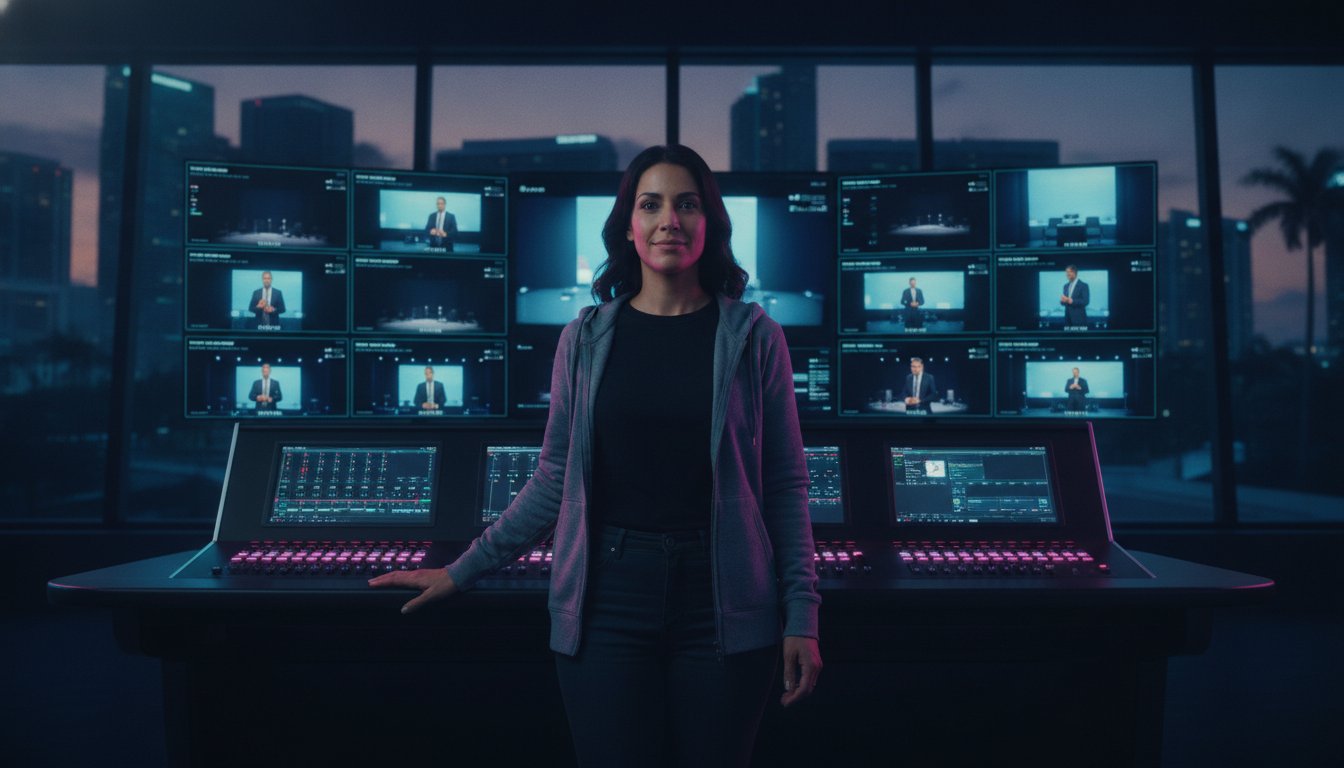
At the center of the production desk, the director manages the video switch. This is where the cinematic feel of the event is created. By directing specific camera angles, the director maintains viewer engagement and prevents the static feel of a single-camera setup. They manage the transition between the Program monitor, which is what the audience sees, and the Preview monitor, which shows what is coming next. This process includes integrating Lower Thirds, branding graphics, and video playback with millisecond precision, ensuring that transitions are seamless and professional.
Network and Encoding Security
In a digital-first environment, the network is the most critical point of failure. A director ensures there is dedicated, symmetrical bandwidth for corporate event livestreaming Miami. They select the appropriate encoding hardware to handle real-time processing, choosing robust hardware encoders over software-based alternatives for high-stakes projects. By monitoring stream health and packet loss in real-time, the director can adjust bitrates on the fly to maintain platform stability. If you want to ensure your next event meets these broadcast standards, you can partner with our expert production team to secure your technical infrastructure.
Partnering with a Strategic Technical Director in South Florida
Logistics in South Florida require more than just technical skill; they require local intelligence. Managing a production at a resort in Naples involves different power, rigging, and access challenges than a high-rise conference in downtown Miami or a convention center in Fort Lauderdale. Professional technical direction for live events provides the logistical foresight to navigate these regional nuances. By anticipating venue-specific hurdles, a director ensures that equipment arrivals, labor calls, and local regulations are managed with precision, preventing costly delays on show day.
Partnering with a director is about more than securing a lead technician. It's about integrating a strategist who understands how cinematic storytelling translates to a live corporate stage. In a high-stakes environment, your technical setup shouldn't just function; it should elevate your brand. This requires a partner who can bridge the gap between complex engineering and your overarching business goals, ensuring every transition and camera angle serves the narrative you've built.
Selecting the Right Partner
When you're evaluating potential partners, look for a history of successful multi-vendor management and hybrid event execution. You need a leader who can command a room of diverse specialists while remaining focused on the executive vision. Ask these critical questions during your selection process:
- How do you manage communication between separate audio, lighting, and video vendors?
- What is your specific protocol for real-time disaster recovery if a primary stream fails?
- How do you ensure the cinematic quality of the livestream matches the in-room experience?
At Miami Video Production, we believe a "Video Strategy" must exist before the first cable is laid. We focus on business outcomes, not just technical specs. If the goal is to project authority during a town hall, every technical cue is designed to support that objective. We don't just provide gear; we provide the strategic leadership necessary to ensure your message is heard without distraction.
The Miami Video Production Advantage
We project the persona of a strategic consultant and an authoritative expert because we understand the stakes involved in large-scale corporate communication. Our authority in broadcast-quality livestreams and cinematic brand films allows us to bring a level of aesthetic sophistication to live events that standard AV companies often miss. We've built our reputation on "premium reliability," a commitment to precision that ensures we thrive under the intense pressure of live production.
Your next event deserves a fail-safe technical foundation and a partner who treats your brand with the same level of excellence you do. If you're ready to eliminate technical risk and deliver a truly broadcast-quality experience, schedule a strategy consultation for your next high-stakes event and let's begin the planning process together.
Elevating Your Production Standards
Your brand’s reputation depends on the seamless delivery of your message. Integrating professional technical direction for live events provides the strategic oversight necessary to transform a standard presentation into a broadcast-quality experience. By prioritizing rigorous pre-production and engineering redundant systems, you eliminate the technical risks that often shadow high-pressure corporate gatherings. This specialized layer ensures that your vision is executed with cinematic precision, allowing you to focus on your audience rather than the equipment.
Choosing a partner who understands the logistical landscape of South Florida is essential for a stress-free event day. Whether you're hosting a global town hall or an intimate executive summit, our team brings broadcast-quality livestreaming expertise and local knowledge to every project. We're committed to serving as a strategic partner for your corporate communication needs, delivering premium reliability when it matters most. It’s time to secure your production and partner with Miami Video Production for your next high-stakes event. We look forward to helping you achieve a flawless execution that resonates with every viewer.
Frequently Asked Questions
What exactly does a technical director do during a live event?
A technical director (TD) serves as the primary conductor of the production, calling every technical cue in real-time. They manage the intercom system to coordinate lighting, sound, and video operators, ensuring the show follows the technical script exactly. Beyond cueing, they monitor system health and deploy backup solutions if a glitch occurs, maintaining a seamless experience for the audience.
How is a technical director different from an AV technician?
While an AV technician operates a specific piece of equipment, a technical director manages the integration of all technical disciplines. The TD is a strategist who oversees the big picture of the show's timing and flow. They bridge the gap between the client's creative vision and the technical crew's execution, ensuring that separate departments like audio and video work as a single unit.
Do I need a technical director for a small corporate meeting?
You typically don't need a TD for simple internal meetings with basic audio; however, any event with a high brand-risk profile or complex elements requires one. If your meeting includes a multi-camera livestream, remote speakers, or a tight run of show for external stakeholders, professional technical direction for live events is essential. It provides the security that a standard AV setup cannot offer.
What is the role of a TD in hybrid event planning?
In hybrid environments, the TD ensures that the remote audience and the in-person attendees receive a synchronized, high-quality experience. They manage the low-latency feeds required for remote speakers to interact with the room without awkward delays. The TD also supervises the real-time encoding and platform stability, ensuring the digital broadcast meets cinematic standards regardless of the viewer's location.
Can a technical director help with budget management?
Yes, a TD optimizes your budget by auditing equipment lists to prevent over-speccing or redundant rentals. They understand exactly what gear is required for your specific outcomes and can identify where gear bloat is adding unnecessary cost. By serving as a technical consultant, they ensure you're investing in the right infrastructure rather than paying for hardware that doesn't serve a strategic purpose.
What technical software do event TDs typically use?
TDs utilize a variety of specialized tools, including CAD software like Vectorworks for floor plans and signal flow diagrams. They also use digital Run of Show platforms to manage technical scripts and cue lists in real-time. For broadcast elements, they monitor stream health using packet-loss analysis tools and hardware-based encoding software to ensure a stable, high-bitrate delivery.
How early should I involve a technical director in my event planning?
You should ideally involve a TD during the initial venue selection and conceptualization phase. Early involvement allows the director to conduct site surveys and identify potential technical bottlenecks, such as power limitations or poor internet connectivity, before contracts are signed. This proactive approach prevents expensive last-minute workarounds and ensures your creative vision is technically feasible from the start.
Does Miami Video Production provide technical direction for events outside of Miami?
Yes, our team provides technical direction for live events throughout South Florida, including Fort Lauderdale, West Palm Beach, and Naples. We understand the logistical nuances of major venues across the region and bring our broadcast-quality standards to every project. Our focus is on providing premium reliability and strategic partnership for high-stakes corporate productions regardless of the specific city.
