
Executive Buy-In for Video Content: A Practical Guide

What if the strongest case for video isn’t the video itself, but the business problem it can help solve? Executives are right to question an investment without a clear audience, objective, or way to assess results. Learning how to get executive buy-in for video content starts with organizational priorities, not production ideas. A concise, evidence-led proposal can show where video fits and why a focused test is a sensible next step.
This guide explains how to connect a proposed video to a business goal, align stakeholders on audience and format, and define practical measures of success before production begins. It also covers how to address concerns about cost, time, and performance with a right-sized pilot instead of an open-ended commitment. The result is a clearer conversation with decision-makers and a production plan grounded in outcomes the organization can evaluate.
Key Takeaways
- Frame video as a response to a defined business priority, not simply a creative idea.
- Build a proposal around the audience, content, distribution, success measures, and specific decision you need.
- Choose a video format that fits the business need, whether that’s a brand film, training video, content series, or event livestream.
- To understand how to get executive buy-in for video content, anticipate questions about ownership, resources, approvals, and how results will be reviewed.
- Translate approval into a clear production plan by aligning strategy, pre-production, filming, post-production, and intended use.
How to Get Executive Buy-In for Video Content by Starting with the Business Problem
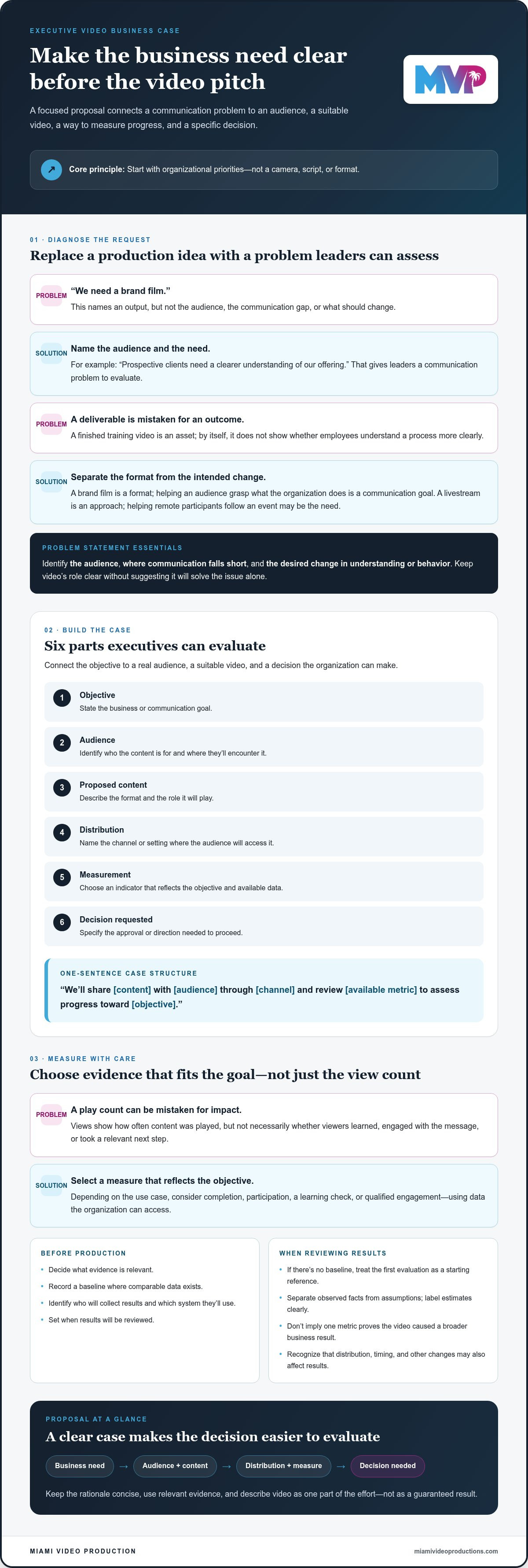
Executive approval rarely comes from enthusiasm for video alone. Leaders need to understand how a proposed initiative supports organizational priorities and addresses a communication need worth solving. Start with diagnosis, not a camera, script, or format. Connect every video proposal to a defined business priority.
This principle reflects the broader idea of Management Buy-In: support is stronger when decision-makers understand how an initiative serves the organization. For a video request, explain who needs to receive a message, what is getting in the way, and what should change. “We need a brand film” names an output. “Prospective clients need a clearer understanding of our offering” identifies a communication problem leaders can assess.
Before recommending a format, write a plain-language problem statement. Identify the audience, the situation where communication falls short, and the desired change in understanding or behavior. Be specific without suggesting video alone will solve the issue. Content can support a broader effort, but its role should be clear from the start.
Identify the business priority behind the video request
Anchor the idea in a priority leaders already recognize, such as clearer communication, employee learning, or stronger brand understanding. Then name the audience and the moment when existing communication isn’t working. For example: “New employees have difficulty following a process after live onboarding, so they need a consistent explanation they can revisit.” This describes a need without treating video as an automatic fix.
Check that the problem matters beyond the requester’s team. Ask what people misunderstand, miss, or struggle to apply, and where that gap appears. A focused statement gives stakeholders a shared issue to discuss before they debate creative preferences.
Translate the idea into an executive-relevant outcome
Separate the asset from the outcome. A completed training video is a deliverable; employees understanding a process more clearly is the intended outcome. A corporate brand film is a format; helping an audience grasp what the organization does is the communication goal. An event livestream is a production approach; enabling remote participants to follow an important event may be the need it serves.
These distinctions keep the conversation grounded in purpose while leaving room to choose a suitable format. A training video may work for repeatable instruction, a brand film may communicate identity, and a livestream may extend access to an event. For a broader framework on aligning content with organizational goals, explore the video growth strategy consulting roadmap. Use that strategic lens to clarify the need before deciding on a format.
Build a Video Content Business Case with Goals, Evidence, and Measurement
Once the communication need is clear, shape it into a case an executive can evaluate. Connect the objective to a specific audience, a suitable video, a distribution plan, credible measures, and a clear decision request. This structure makes how to get executive buy-in for video content a practical business discussion rather than a pitch based on creative preference.
Keep the distinction between the asset and its effect visible. A finished training video is a deliverable; improved employee understanding is an intended outcome. A view count shows how often content was played, but not necessarily whether viewers learned, engaged with the message, or took a relevant next step. Choose measures that reflect the goal and can be tracked with data the organization can access.
- Objective: State the business or communication goal.
- Audience: Identify who the content is for and where they’ll encounter it.
- Proposed content: Describe the format and the role it will play.
- Distribution: Name the channel or setting where the audience will access it.
- Measurement: Choose an indicator that reflects the objective and available data.
- Decision requested: Specify the approval or direction needed to proceed.
Then make the logic easy to repeat in one sentence: “We’ll share [content] with [audience] through [channel] and review [available metric] to assess progress toward [objective].” For example, a training initiative might track completion and use an existing knowledge check to assess whether employees understand the material. The measure should connect to the goal, not imply that one metric proves the video caused a broader business result.
Choose success measures before production begins
Decide what evidence would be relevant before production starts. Depending on the use case, that could mean completion, participation, a learning check, or qualified engagement. Record a baseline where comparable data exists, and identify who will collect results, which system they’ll use, and when they’ll review them. If there’s no baseline, treat the first evaluation as a starting reference, not proof of improvement.
Present evidence executives can evaluate
Use existing campaign data, audience feedback, or internal examples when they directly support the proposal. Separate observed facts from assumptions, and label estimates clearly. A one-page summary can bring the ask, rationale, audience, distribution, measures, and decision point into view without burying the case in production detail.
Be measured in your claims. If results may also depend on distribution, timing, or other organizational changes, describe video as one part of the effort rather than promising a particular return. Video growth strategy consulting can help align objectives, formats, and evaluation into a coherent plan.
Compare Video Content Options by Business Goal, Not by Production Hype
The right format depends on what the organization needs to communicate and how the audience will use that information. Comparing options side by side helps executives weigh reuse, coordination, interaction, and ongoing commitment. It also keeps how to get executive buy-in for video content focused on a practical choice, not a contest over which idea sounds most impressive.
| Business need | Suitable format | Audience | Distribution | Possible measure |
|---|---|---|---|---|
| Communicate identity, values, or organizational story | Corporate brand film | Prospective clients, partners, or employees | Website, presentations, or campaign channels | Relevant engagement or audience feedback |
| Make instruction consistent and repeatable | Training and education video | Employees, customers, or other learners | Learning platform, internal resource hub, or onboarding | Completion, participation, or learning checks |
| Build an ongoing conversation around a subject | Podcast or content series | A defined audience with recurring information needs | Selected publishing and social channels | Episode engagement or qualified audience response |
| Provide live access to an event | Event livestream | Remote participants or viewers | Chosen livestream destination | Attendance, participation, or viewer feedback |
These measures are examples, not universal benchmarks. Choose indicators the organization can access and interpret for its purpose. Production coordination also varies. A livestream requires preparation for a live event and real-time delivery, while a recorded piece can be reviewed and refined in post-production. A series adds recurring planning and publishing needs, but can create related content assets. A focused, one-time project may be a better fit when the need is specific and doesn’t call for sustained publishing.
Match the format to the communication challenge
Start with the audience’s need. Use training videos for repeatable instruction or employee education, a corporate brand film to communicate identity, values, or the organization’s story, and event livestreaming when remote access is central to the event objective. Each format creates a different experience, so choose based on the message and context rather than production style alone.
For an instructional initiative, instructional video production guidance can help clarify how learning needs shape the approach.
Compare a one-time asset with an ongoing content series
A series needs a sustainable supply of topics, subject-matter input, approvals, and a distribution rhythm. It may suit an organization with recurring insights to share and the capacity to publish consistently. A single film, training resource, or livestream may be more appropriate when the need is bounded, the audience is clearly defined, or the team wants to address one communication gap first. Present the scope and coordination involved alongside the format rather than treating video as inherently expensive.
That distinction makes the proposal easier to assess: what will be created, how it will be used, and whether the organization is prepared to support a continuing series or a focused project.
Prepare an Executive Video Proposal That Makes Approval Easier
A strong proposal makes the next decision clear without asking executives to approve an undefined content program. Use a short sequence that moves from the need to a specific request:
- State the need: Describe the communication challenge and why current approaches aren’t sufficient.
- Define the audience: Identify who needs the information and in what context.
- Recommend a format: Explain why a training video, brand film, livestream, or other option fits the need.
- Set measures: Name the indicators, data source, and review point that will inform evaluation.
- Request a decision: Say exactly what approval or direction is needed now.
For a first initiative, consider proposing a bounded pilot. A pilot is a limited test with a stated objective and evaluation criteria. Define its audience, content scope, distribution approach, and review point using a schedule set by the organization. A pilot doesn’t guarantee success. It creates a structured decision point: leaders can review what was learned and decide whether to adjust, continue, or stop before considering a broader investment.
Address the most common executive concerns directly
Answer “Why video?” by connecting the format to the communication problem and explaining where existing approaches fall short. For “How will we know?”, state the agreed measures, where the data will come from, and when results will be reviewed. For “Who will manage this?”, identify the internal owner, decision-makers, subject-matter contributors, and production responsibilities. Clarifying these roles surfaces ownership and approval needs before work begins.
Make the approval request specific and easy to evaluate
Ask for the decision needed now, such as approval to scope a defined pilot for a particular audience. Keep that request separate from later choices about expansion or recurring production. A one-page summary can present the need, audience, recommendation, responsibilities, measures, and decision requested. Include supporting detail only when it helps executives assess the proposal.
Address distribution and approvals in the proposal, too. Name the intended channel, who will provide or review content, and who gives final approval. Note the resources the organization must coordinate, such as subject-matter input or access to the people and settings required. These details make the plan easier to assess and clarify what approval covers.
This disciplined approach is central to how to get executive buy-in for video content: make the decision proportionate to the available evidence, then establish how the organization will learn from the work. A production partner can translate an approved objective into a practical brief and production approach. See video production planning as you shape the proposal.
Turn Executive Approval into a Video Plan with the Right Production Partner
Approval sets the direction; coordinated planning turns that direction into work the team can execute. Carry the approved objective into a production brief, then use it to shape the audience plan, creative approach, production requirements, and distribution. This keeps decisions about filming and post-production connected to why the organization approved the project.
Align production planning with the approved business case
A useful brief makes the approved case actionable. Record the intended audience, communication objective, selected format, success measures, key stakeholders, and where the finished content will appear. Identify who supplies subject-matter input, who approves messaging, and whether the content may be adapted for other uses. Resolving these points early helps the production approach serve its intended use and reduces avoidable changes later.
Planning, filming, and post-production should work as a connected process. For example, a corporate brand film intended for presentations may need a different structure and delivery approach from training content designed for repeat viewing. Miami Video Production creates cinematic corporate brand films and training videos, with project-based production that includes pre-production planning, filming with professional crews, and post-production editing.
Live events call for a further distinction: the content goal is not the same as the operational requirements. The goal might be to give remote participants access to an event; technical direction, multi-camera switching, and real-time encoding support live delivery. For a high-stakes corporate event, a proposal can draw on this broadcast-quality livestreaming strategic guide to consider how production choices connect to the event’s purpose. Miami Video Production provides broadcast-quality livestreams for events in South Florida.
Set a review point and decide what comes next
Before production begins, confirm when stakeholders will review the work and which agreed measures they’ll consider. The review can examine whether the content reached its intended audience, how people responded, and what available evidence suggests about the communication objective. Keep interpretation measured: results can inform decisions without establishing that video alone caused a wider business change.
Use the review to decide whether to refine the format, adjust distribution, revise the scope, or recommend further investment. If results are mixed or evidence is limited, that still provides direction for the next decision. Keep any expansion separate from the initial approval so the next commitment reflects what the organization has learned.
Strategy and production work together. Miami Video Production offers video growth strategy consulting to align content with marketing objectives, as well as end-to-end production for corporate brand films and training videos. For organizations planning an event in Miami, Broward, West Palm Beach, Fort Lauderdale, North Miami, Fort Myers, or Naples, a clear brief can connect the event’s communication goal with the livestream production plan. Discuss a video content strategy to define a practical next step.
Move from Approval to a Clear Next Step
Executive support begins a decision process; it doesn’t mean every proposed video should become a larger program. Treat the next step as an opportunity to learn: clarify who will guide the work internally, keep the original objective visible, and bring what the team learns back to the people who approved it. That gives future decisions a stronger foundation.
If you’re considering how to get executive buy-in for video content, focus the next conversation on the business goal and the practical work required to pursue it. A strategy discussion can connect content decisions with business and marketing objectives before the organization commits to a broader plan.
Discuss a video strategy aligned with your business goals and identify a purposeful next step. With a clear objective and thoughtful collaboration, your team can move forward with confidence.
Frequently Asked Questions
How do you convince executives to invest in video content?
Show how the proposal addresses a business concern executives already recognize, such as customers misunderstanding a service or employees repeatedly asking for the same process explanation. To understand how to get executive buy-in for video content, make the case specific: describe who is affected, what the communication gap looks like, and why the proposed format fits. Invite leaders to shape the decision criteria so their concerns are addressed before production starts.
What should a video content business case include?
A useful business case includes the communication challenge, intended audience, recommended format, distribution context, required internal participation, and how the organization will judge usefulness. Include constraints that could affect delivery, such as subject-matter expert availability, brand review, accessibility needs, or where employees can access the content. Be clear about what’s known and what remains an assumption. This gives decision-makers enough context to assess feasibility, not just creative appeal.
How do you measure the ROI of video content?
Measure ROI by comparing the value the organization can reasonably attribute to the initiative with the resources invested, while being transparent about the limits of attribution. For example, a sales team might compare qualified opportunities that engaged with a video against its normal process, while noting that other campaign activity may also influence results. For internal education, time spent answering repeat questions may be relevant if the organization can track it consistently. Avoid treating correlation as proof of causation.
What video metrics matter most to executives?
The most useful metrics depend on the decision the video is meant to support. Executives may care about qualified engagement for a marketing asset, completion and knowledge checks for training, or attendance and participation for a livestream. Pair a viewing metric with a signal closer to the intended outcome, such as follow-up requests or learner performance. Report the measurement period and data source so leaders can interpret what the numbers do, and don’t, indicate.
How can a company start video content with a small pilot?
Choose one audience and one contained communication task, such as explaining a frequently misunderstood onboarding step to a defined employee group. Limit the pilot to the content needed to address that task, decide where the group will access it, and identify who will gather feedback. Set the review date around the organization’s schedule. Afterward, use audience responses and available data to decide whether to revise, extend, or close the effort.
Should a business create video in-house or work with a production partner?
That depends on the project’s creative and technical demands, internal capacity, and level of coordination. An in-house team may be well placed to capture routine updates with familiar subject-matter experts. A production partner can help translate objectives into a plan and manage planning, filming, and post-production. For organizations producing content in Miami, Broward, West Palm Beach, Fort Lauderdale, North Miami, Fort Myers, or Naples, local production needs may also shape the decision.
What types of video content work best for employee training?
The best training format reflects what employees need to learn and do afterward. A concise demonstration can explain a repeatable task; a scenario-based lesson can give learners a chance to consider how they’d respond to a workplace situation. Break complex material into focused segments employees can revisit, and pair video with a checklist, practice activity, or knowledge check. That combination connects viewing with application on the job.
