
How to Make Corporate Videos Not Boring: A Practical Storytelling Guide
What if the most important thing to leave out of your corporate video is more about your company? If you’re wondering how to make corporate videos not boring, start by shifting the focus from what the organization wants to say to what the audience needs to hear. Viewers are more likely to stay engaged when they can see how the message relates to their work, questions, or decisions.
It’s tempting to include every milestone, service, and stakeholder talking point, especially when a video needs to represent the whole business. But a polished production can still feel generic if it has no clear story or human point of view. A focused message doesn’t diminish your organization. It gives viewers a reason to care about it.
This guide shows you how to shape an audience-focused story, open with a reason to keep watching, and maintain a purposeful pace. You’ll also learn how planning, filming, and editing choices can make a video feel more human without sacrificing professional quality. From the first creative decision to the final cut, every element should serve the story.
Key Takeaways
- Learn how to make corporate videos not boring by replacing company-first messaging with a story grounded in the viewer’s needs.
- Use a simple narrative sequence to move from the audience’s challenge to a useful insight, credible proof, and a clear next step.
- Keep a professional tone while making deliberate choices that feel more human, from specific examples to purposeful visual changes.
- Use a focused brief and production workflow to keep stakeholder input aligned around one central message.
- Recognize when complex messaging, multiple stakeholders, or demanding production needs may call for professional collaboration.
Why Corporate Videos Feel Boring, and What Viewers Need Instead
Corporate content can be polished, credible, and genuinely engaging without becoming comedic or overly casual. The difference isn’t whether the subject is serious. It’s whether the presentation gives viewers a reason to pay attention. A video starts to feel monotonous when it puts company history before audience needs, has no clear purpose, repeats the same claims, or takes too long to reach its point.
Relevance gives a story forward momentum. Viewers should understand what’s at stake, encounter an insight that helps them, and see where the story is leading. Familiar elements of storytelling, including characters, plot, and point of view, can give a business message shape without making it less professional.
Audience-first corporate video storytelling turns a viewer’s real need into the organizing idea for every scene and message.
How to recognize when a corporate video is losing attention
Look closely at the opening. Does it begin with a long greeting, a list of executives, or a company timeline before explaining why the viewer should care? Those details may have a place, but they rarely make the strongest entry point. Momentum also fades when interview answers wander, jargon obscures the message, or several speakers repeat the same broad claim.
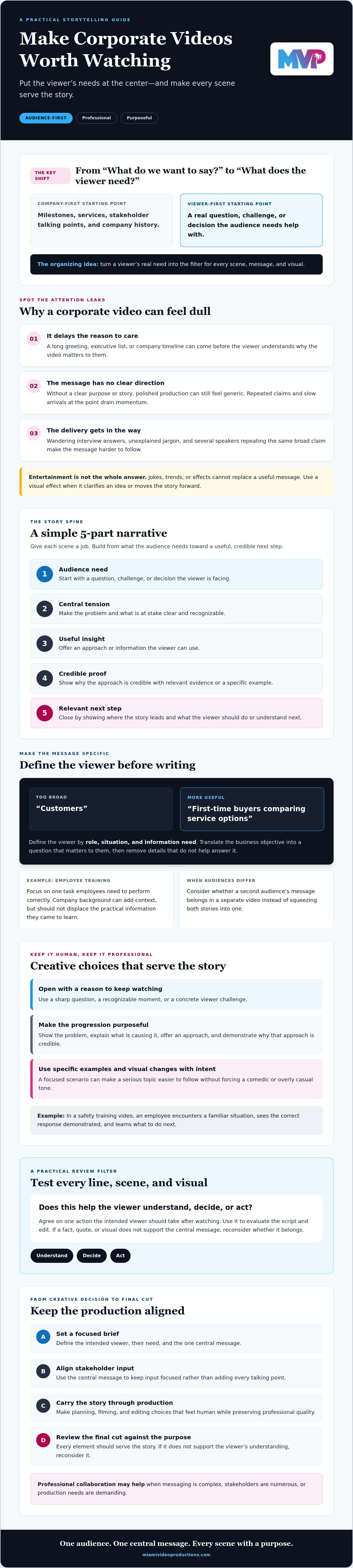
Before revising a script, agree on one action the intended viewer should take after watching. For example, should a new employee follow a specific process, or should a prospective customer understand how a service addresses a particular challenge? Use that action as a practical test for every line and scene. If something doesn’t help the viewer understand, decide, or act, reconsider whether it belongs.
Why making a video entertaining is not the whole answer
Entertainment can support a story, but jokes, trending formats, and visual effects aren’t substitutes for a useful message. If an effect doesn’t clarify an idea or move the story forward, it may distract from both. Meaningful engagement comes from clear stakes and information the viewer can use, even when the topic is technical or serious.
Consider a training video about a revised safety procedure. A playful tone might feel out of place, but a focused scenario can make the stakes clear: an employee encounters a familiar situation, sees the correct response demonstrated, and learns what to do next. The subject stays professional while the narrative gives viewers a reason to follow it. That’s the practical answer to how to make corporate videos not boring: make every choice serve the viewer’s understanding, not simply their momentary amusement.
How to Build a Corporate Video Story Around the Viewer
A strong corporate video doesn’t need to begin with the company’s founding story. It needs to begin where the viewer’s attention already is: a question, challenge, or decision they’re facing. From there, shape the message into a simple progression: audience need, central tension, useful insight, proof, and next step.
Start with what the viewer needs, reveal the challenge, offer a useful insight, support it with proof, and end with a relevant next step.
This structure gives each scene a job. A single central message then acts as a filter for scripts and edits. If a fact, quote, or visual doesn’t help communicate that message, it may belong elsewhere. A resource on video storytelling for business offers another perspective on building a narrative, including the role of context, conflict, and closure.
Choose one audience and one meaningful problem
Define the viewer by role, situation, and information need. “Customers” is broad; “first-time buyers comparing service options” is more useful because it clarifies what the video should explain. Translate the business objective into a question that matters to that viewer. Instead of “introduce our company,” ask, “How can a growing team solve this recurring challenge?” Then remove details that don’t help answer it.
For example, a training video for new employees might focus on one task they need to perform correctly. Company background can provide context, but it shouldn’t displace the practical information employees came to learn. If the video needs to serve a different audience too, consider whether that message belongs in a separate video rather than squeezing it into the same story.
Create a hook, progression, and satisfying conclusion
Open with a sharp question, a recognizable moment, or a concrete viewer challenge. Then arrange points so each one develops the idea: show the problem, explain what’s causing it, offer an approach, and demonstrate why that approach is credible. Avoid circling back to the same benefit in different words. A clear progression makes it easier for viewers to follow and gives editors a stronger basis for deciding what stays.
Finish with a takeaway or next step that fits the video’s purpose. That could be applying a procedure, discussing an option with a team, or exploring a relevant service. If you’re shaping a company story into a polished corporate brand film, reviewing corporate brand film production can help clarify how strategic planning supports the message.
This approach is a practical starting point for how to make corporate videos not boring: focus the story on one viewer, move it forward with intention, and make the ending useful.
How to Keep Corporate Videos Professional Without Making Them Dull
Compelling storytelling doesn’t require a company to give up credibility or adopt an informal voice. The goal is to make the message easier to understand and remember while keeping the tone appropriate to the subject. Specific examples, natural speech, and purposeful visual choices can make a corporate video feel more human without making it less polished.
Compare a broad slogan such as “We put customers first” with a concrete example of how a team responds to a common customer question. The example gives the claim context and helps viewers understand what it means in practice. Employee, customer, or subject-matter perspectives can make abstract ideas tangible, provided each example is accurate and supports the video’s central message.
Use real people and specific examples to make ideas tangible
Help speakers prepare, but don’t make them sound as if they’re reading a brochure. Share the topic and key points in advance, invite concise answers, and ask for a real example that illustrates the idea. Coaching should improve clarity, not erase personality. If a response runs long, guide the speaker toward the main point while retaining enough context for viewers to understand it.
| Dull execution | Polished, more engaging alternative |
|---|---|
| A scripted slogan with no supporting detail | A clear claim supported by a relevant, verified example |
| One static shot held through an entire explanation | Purposeful changes in framing or relevant workplace b-roll that illustrates the point |
| A long interview answer with repeated ideas | A concise response edited to remove repetition while preserving necessary context |
| Effects or music that compete with the speaker | Intelligible audio, restrained sound, and consistent visuals that support the message |
Use pacing, visuals, and sound to support the message
Visual variety should clarify the story, not decorate it. A speaker explaining a process might be paired with relevant footage of that process. A key term can appear on screen when it helps viewers follow a complex point. Avoid adding graphics simply to fill a pause or imitate a trend.
In the edit, remove repeated claims and detours, but don’t cut so tightly that every answer feels abrupt. Natural pauses can make speech feel considered and give viewers a moment to absorb important information. Above all, prioritize clear dialogue and a coherent visual style over effects without narrative value.
For teams asking how to make corporate videos not boring, the useful balance is straightforward: keep the standards of professional communication, then make every spoken and visual choice earn its place.
Corporate Video Planning: From Script to Edit
A disciplined workflow keeps a corporate video focused from the first conversation through final approval. It also gives stakeholders a shared reference point, so useful feedback can strengthen the story instead of adding a new message to every review round. For broader planning context, explore this video growth strategy roadmap.
Use this sequence to move from idea to finished video:
- Brief: Define the purpose, audience, intended action, key message, and essential constraints.
- Audience: Identify who will watch and what they need to understand or do.
- Core message: State the one idea the video should leave with viewers.
- Outline: Arrange the supporting points in a clear order.
- Storyboard: Match each point to an interview moment, visual, demonstration, or graphic.
- Filming: Capture the planned material and relevant supporting footage.
- Edit and review: Shape the story, check it against the brief, and make targeted revisions.
A short brief is especially valuable when several departments have a stake in the project. Ask each contributor to identify what the intended viewer needs, then distinguish essential information from details that can live in another video or supporting resource. This turns review into a prioritization exercise rather than an attempt to satisfy every request in one edit.
Write and storyboard for clarity before filming
Before drafting full narration, write a one-sentence purpose, such as: “This video helps new staff understand how to complete the client handoff.” Build a concise outline around that statement, then map each point to the moment that will communicate it. A storyboard can expose gaps early. If an idea has no clear example, visual, or explanation, refine it before production. For a video teaching a process, see this instructional video production guide.
Edit and review for viewer value, not stakeholder volume
Give reviewers a consistent set of questions: Is anything confusing or repetitive? Does each section serve the audience? Are claims supported? Does the ending deliver the promised takeaway and a fitting next step? Ask for specific notes tied to the brief, rather than open-ended additions. Check that captions are accurate, on-screen text is readable, and framing suits the intended platform.
That structure makes it easier to put how to make corporate videos not boring into practice: plan around viewer value, then use each review to sharpen the story. For support aligning strategy with production, discuss your corporate video plan.
When Professional Corporate Video Production Can Strengthen the Story
Some projects are manageable with an internal team. Outside support may be useful when the message is complex, several stakeholders need to align, or the production requires coordination beyond the team’s capacity. A production partner can help shape the strategy, develop the pre-production plan, film the story, and refine it in post-production. The value is not simply access to equipment. It’s a collaborative process for turning a clear idea into a polished video.
For businesses in Miami and South Florida, consider whether a potential partner understands the local production context relevant to your project. Miami Video Production creates corporate brand films and training videos, and works with clients on video strategy and content planning. The right fit should also understand your audience and business objective before recommending a creative approach. Explore cinematic corporate brand films for further perspective on developing a purposeful company story.
What to look for in a corporate video production partner
A thoughtful partner asks who the video is for, what viewers need to take away, and where the content will appear. Creative recommendations should support those answers, not add visual polish for its own sake. Before production begins, discuss the approval workflow, stakeholder roles, intended deliverables, and production requirements. Clear expectations help decision-makers give focused feedback and keep the story aligned through each stage.
Notice how the partner responds to your brief. Do they help clarify priorities when stakeholders have different requests? Can they explain why a proposed interview, location, or visual choice serves the message? Strategic questions are a useful sign that planning and storytelling are part of the collaboration, not afterthoughts.
Turn the video into a useful next step for your audience
Plan distribution before the final edit. A video intended for a sales conversation may need to answer a different question than one designed for employee training or a marketing channel. That context can inform its framing, supporting text, and closing invitation. Match the next step to what viewers know and what the video has helped them understand. A training piece might direct employees to apply a process; a brand film could invite prospects to learn more about the company.
Knowing how to make corporate videos not boring means considering the viewer’s full experience, including what happens after the video ends. If you’re planning a corporate video project in Miami, Broward, West Palm Beach, Fort Lauderdale, North Miami, Fort Myers, or Naples, you can discuss your project with Miami Video Production and explore how strategic storytelling and professional production could support its goals.
Make Your Next Corporate Video Worth Watching
Engaging corporate videos don’t need gimmicks. They need a clear purpose, a story shaped around the viewer, and production choices that make the message easy to follow. If you’re considering how to make corporate videos not boring, begin with one audience and one useful idea, then let every scene support it.
A focused brief and thoughtful review process can keep stakeholder input aligned while preserving a natural, professional tone. When a project calls for additional expertise, Miami Video Production works across cinematic corporate brand films, training and education videos, and video growth strategy consulting. The team also produces broadcast-quality event livestreams in South Florida, serving organizations in Miami, Broward, West Palm Beach, Fort Lauderdale, North Miami, Fort Myers, and Naples.
Discuss your corporate video project with Miami Video Production to explore how strategic planning can help bring your message to life. With a compelling story at its center, your next video can feel polished, human, and genuinely useful to the people watching.
Frequently Asked Questions
How do you make a corporate video more engaging?
Make a corporate video more engaging by centering it on a specific audience need and giving the viewer a clear reason to keep watching. Open with a relevant question or situation, then move through useful information, a concrete example, and a fitting next step. For how to make corporate videos not boring, prioritize one clear message, natural speech, purposeful visuals, and a pace that removes repetition without making the story feel rushed.
What makes a corporate video boring?
A corporate video often feels boring when it focuses on company details instead of viewer needs, takes too long to reach its point, or repeats broad claims without showing what they mean. Unexplained jargon, unfocused interview answers, and visuals that never change can also weaken momentum. The subject itself may be serious, but the presentation doesn’t have to be monotonous. Clear stakes and useful information give viewers a reason to stay with it.
How long should a corporate video be?
A corporate video should be only as long as needed to deliver its purpose clearly. The right length depends on the audience, subject, and viewing context. A short update may need only a few focused points, while a training video may require enough time to explain and demonstrate a process. Rather than cutting to an arbitrary duration, remove repeated ideas and details that don’t support the viewer’s understanding or intended next step.
Can a corporate video be entertaining and still professional?
Yes. A corporate video can hold attention while maintaining a credible, professional tone. Engagement doesn’t depend on jokes or trendy effects. It can come from a relatable situation, a speaker who sounds natural, and visuals that help explain the message. For example, a training video can use a realistic workplace scenario to clarify a procedure without treating a serious subject lightly. Let the story and production choices suit the audience and purpose.
How do you write a corporate video script that keeps people watching?
Start with the viewer’s question, then build the script around one central message. Organize it into a hook, the issue or tension, a useful insight, supporting proof, and a relevant next step. Use direct language and specific examples, and read the draft aloud to catch stiff phrasing or long explanations. During revisions, remove any line that repeats a point or doesn’t help viewers understand what matters to them.
Do corporate videos need professional video production?
Not always. An internal team may be able to produce a straightforward update, while complex messaging, multiple stakeholders, or demanding production needs can benefit from professional support. Miami Video Production creates corporate brand films and training and education videos, with planning, filming, and post-production as part of project-based production. For organizations in Miami, Broward, West Palm Beach, Fort Lauderdale, North Miami, Fort Myers, and Naples, consider whether a production partner can align the story with your audience and distribution needs.
