
West Palm Beach Internal Video: 2026 Buying Guide
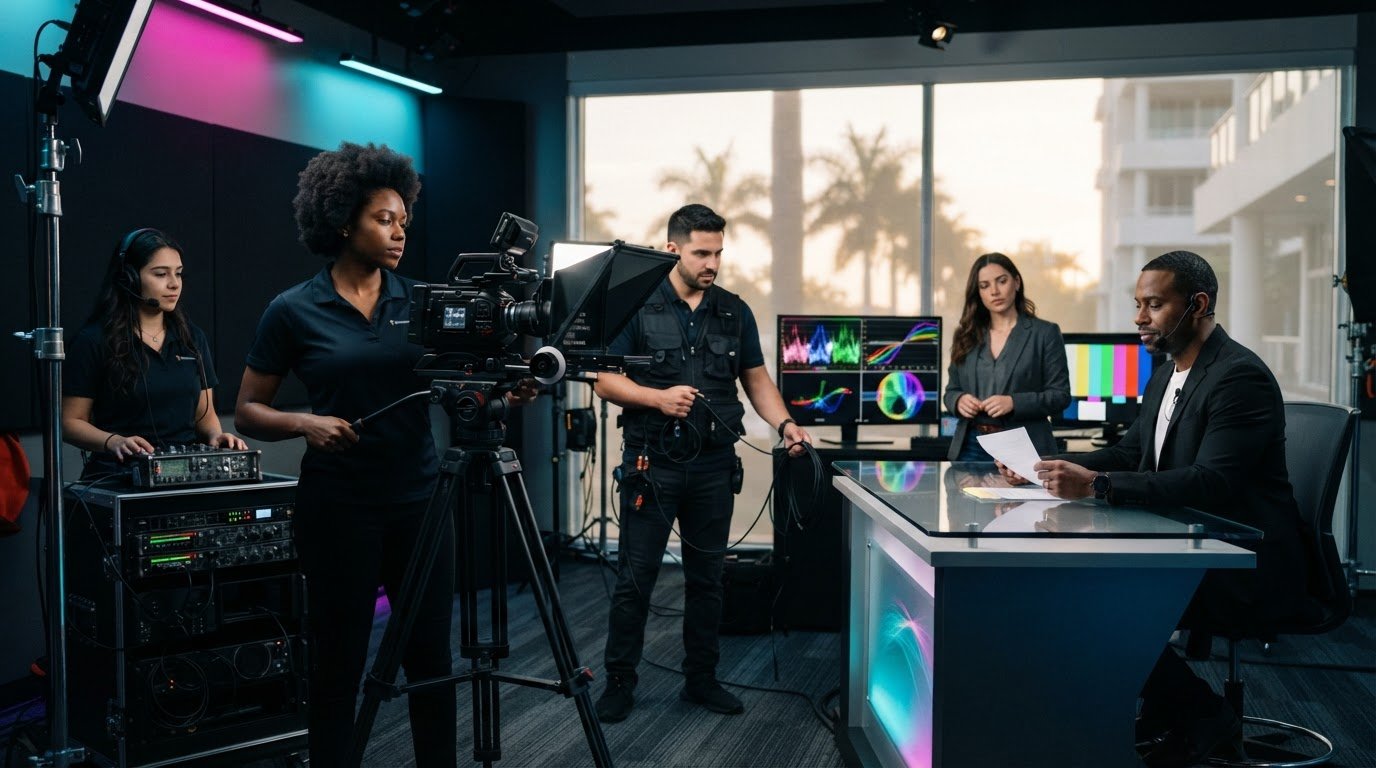
What if the most effective internal video isn’t the most polished one, but the one employees can understand, access, and revisit when they need it? For organizations comparing west palm beach video for internal communications, the challenge is delivering important updates consistently across teams without making every message feel generic. A good production partner starts with the communication goal and employee audience, then recommends a format and workflow to match.
That choice matters whether you’re onboarding staff, explaining a process, sharing a leadership update, or bringing teams together live. This guide covers useful formats, how to assess production partners serving West Palm Beach and South Florida, and how to plan a practical process from early strategy through post-production. You’ll also learn how training videos, livestreaming, and a repeatable video approach can help employees find and return to information. The goal is to choose video that serves people across locations, not just a single announcement.
Key Takeaways
- Start with the employee need and communication goal, then choose a format suited to the message.
- Compare leadership updates, onboarding, training, policy explainers, and livestreams by how employees will use them.
- Assess a production partner’s planning, filming, audio, editing, accessibility considerations, and delivery approach.
- Use a focused brief to align stakeholders on the audience, success measures, and release plan before production begins.
- For west palm beach video for internal communications, decide whether a one-off video, recurring series, or live production best supports your teams.
Why West Palm Beach Organizations Use Video for Internal Communications
Internal communications video is created to inform, train, align, or support employees. Unlike public-facing brand marketing, which is designed to shape customer perception or encourage acquisition, an internal video serves a workforce with a specific need: understand a change, learn a process, or hear directly from leadership. In short, internal communications video connects an organizational goal to an employee audience through a channel employees can access.
That channel might be a company intranet, a learning platform, or a livestream. The broader practice of internal communications includes multiple ways to share information across an organization, and video is one tool within that plan. It can make a complex update easier to follow by combining spoken explanation with visuals, but it can’t guarantee attention or retention. The message, format, and access method still need to suit employees’ needs.
Which employee communication challenges can video address?
Video can help when teams receive inconsistent explanations, ask the same questions repeatedly, or need to revisit information after an announcement. A leadership update may call for a direct, concise address explaining what’s changing and why. A process explanation or training resource may need demonstrations, clear steps, and a format employees can return to while doing the work.
Video is a supporting asset, not a replacement for every written message. Pair it with written summaries, links, or instructions when employees need searchable details, reference material, or an accessible alternative.
When does a West Palm Beach organization need production support?
Consider production support when the message is high-stakes, filming or editing needs are complex, the audience spans multiple teams, or the finished video will be reused. A leadership message, detailed training resource, and internal event livestream each call for different preparation. For west palm beach video for internal communications, account for local filming coordination, including the location, participants, and schedule.
A production partner serving West Palm Beach and South Florida can help plan, film, and edit employee-focused content. Miami Video Production offers training and education videos, livestreaming, and video strategy consulting. If training is the priority, an instructional video production guide can offer more guidance on choosing a useful learning format.
Match Internal Communications Video Formats to Employee Needs
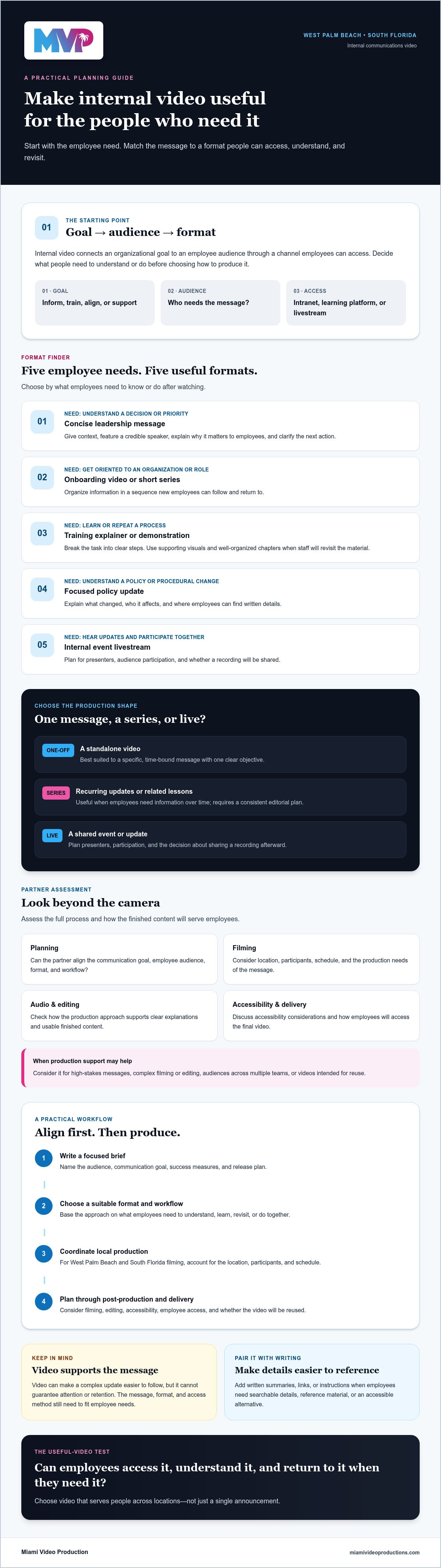
Choose a format by asking what employees need to know or do after watching. A leadership message, repeatable work instruction, and company-wide event have different purposes, so they shouldn’t automatically share the same production approach.
| Employee need | Suitable format | Key production consideration |
|---|---|---|
| Understand a leadership decision or priority | Concise leadership message | Provide context, feature a credible speaker, and clarify the next action. |
| Get oriented to the organization or a role | Onboarding video or short series | Organize information in a sequence new employees can follow and revisit. |
| Learn or repeat a process | Training explainer or demonstration | Break the task into clear steps, using visuals that support the instruction. |
| Understand a policy or procedural change | Focused policy update | Explain what changed, who it affects, and where to find written details. |
| Hear updates and participate together | Internal event livestream | Plan for presenters, audience participation, and whether a recording will be shared. |
Which format fits leadership updates, onboarding, and training?
Leadership updates work best when they explain why a decision matters, show its relevance to employees, and end with a clear call to action. Onboarding and process instruction need a different structure: present information in the order employees need to understand or perform it. If staff will repeat a task, demonstrations and well-organized chapters can make the material easier to revisit. For more detailed guidance, consult an instructional video production guide.
A standalone video suits a specific, time-bound message. A recurring series makes more sense when employees need regular updates or related lessons over time. A series requires a consistent editorial plan, while a one-off keeps attention on a single objective. For broader examples of video in organizations, video technology in government operations explores several communication needs.
When should internal communication be live or on demand?
Live communication suits employees when real-time delivery or participation is central. On-demand video suits them when flexible access or repeat viewing matters most. A town hall may benefit from live questions, while a process explainer is often more useful on demand. Hybrid attendance, recording, and later distribution all require advance planning, including how remote employees can participate and where they’ll find the recording.
For west palm beach video for internal communications, match production scope to the message and employees’ access needs. A production partner can help you weigh training videos, livestreaming, and a repeatable video strategy. Explore internal video production support as you refine your approach.
How to Evaluate a West Palm Beach Internal Video Production Partner
A strong production partner starts with the communication challenge, not a camera list. Before comparing proposals for west palm beach video for internal communications, check whether the team asks who needs the message, what employees should understand or do, how they’ll access the video, and how you’ll assess whether it served its purpose. Clear discovery keeps creative decisions tied to a practical outcome.
Then review the production plan. Ask how the team will manage filming, capture clear speech, shape the edit, consider accessibility, and prepare deliverables for your distribution channel. Clarify how captions or other accessibility needs will be addressed, and which file formats or versions are included. For internal content, also establish who handles employee privacy considerations, stakeholder approvals, revisions, and schedule coordination.
What should a video production proposal clarify?
A proposal should map the work from planning through post-production, with responsibilities, approval points, deliverables, and intended usage clearly identified. Ask which assumptions could affect the scope, such as the number of locations or speakers, access to filming spaces, and review cycles. These details help your team compare proposals on the same basis.
Don’t judge a partner on equipment alone. A reliable process for planning, communication, filming, and editing can matter just as much to the finished video.
How can local production planning reduce friction?
A West Palm Beach project may involve arranging access to a workplace or other filming location, aligning employee and leadership schedules, and confirming who can approve the message. Discuss travel, site access, and filming arrangements directly with the production partner, and confirm the logistics for your specific project before setting a schedule.
Use these questions to guide a first conversation:
- Audience and purpose: Who is this video for, and what should employees take away?
- Access and use: Where will employees watch it, and what versions or deliverables are needed?
- Production plan: What stages, participants, locations, and responsibilities are included?
- Approvals and privacy: Who reviews the content, how are revisions handled, and what employee privacy considerations should you address?
- Schedule and success: What could affect timing, and how will you evaluate whether the video met its communication goal?
Answers should make the workflow and decision points clear before filming begins. For broader partner-selection criteria, consult a video production company hiring guide. Miami Video Production serves West Palm Beach and South Florida, including Miami, Broward, Fort Lauderdale, North Miami, Fort Myers, and Naples. Its services include training and education videos, livestreaming, and video strategy consulting.
Build a Clear Brief and Practical Production Workflow
A focused brief gives stakeholders a shared reference before filming begins. It turns a broad request, such as “explain the new process,” into a defined message, audience, action, and release plan. For west palm beach video for internal communications, that clarity also helps the production team prepare for the right speakers, locations, filming needs, and final deliverables.
Define the communication goal, identify the audience, shape the message, plan production, review the edit, then release and assess the video. This sequence keeps decisions connected from the first conversation through employee access.
- Set the goal: State what employees should understand, feel prepared for, or do after watching.
- Define the audience and access needs: Identify which teams will watch, where they work, and how they’ll reach the video.
- Build the message: Confirm the key points, desired next step, subject-matter experts, and speakers. Decide whether this is a one-time asset or part of a recurring series.
- Plan production: Identify filming locations, participant schedules, timeline needs, and the people responsible for decisions.
- Review and prepare delivery: Assign approval owners, plan consolidated feedback, confirm captions and accessibility expectations, and determine hosting, permissions, and release channels.
- Release and assess: Coordinate publication through existing employee channels and decide how you’ll evaluate whether the video met its communication objective.
What belongs in an internal communications video brief?
Record the intended employee audience, central message, desired next step, and distribution channel. Add relevant subject-matter experts, speakers, locations, schedule considerations, and review stakeholders. If the video supports training, specify which task or information employees need to learn. A clear brief can help communications, HR, leadership, and operational reviewers align before production advances.
How should teams plan review and distribution?
Choose one person to gather and reconcile feedback, then clarify who has final approval. This reduces conflicting revisions and keeps review focused on accuracy, clarity, and the stated goal. Before release, confirm captions, accessibility expectations, hosting, permissions, and whether employees across locations or devices can access the video.
Plan distribution as part of the communication, not as an afterthought. A video might launch alongside a written summary, appear in an employee portal, or be reinforced through a manager update. If you’re preparing a brief or shaping a repeatable workflow, discuss your internal video production needs with a South Florida production partner.
Choose a South Florida Video Partner and Define the Next Step
Make the decision in order: identify the employee need, select the format, define the production scope, then choose a partner whose capabilities fit the work. For west palm beach video for internal communications, a concise one-off video can suit a specific announcement, while a recurring series is better for ongoing updates or related learning. Live production supports real-time participation, but requires planning for presenters, audience access, and how employees who can’t attend will receive the information.
The right choice also depends on your organization’s capacity. If your team can shape the content but lacks time or resources for professional filming and editing, clarify where an external partner should contribute. For a livestream, decide who will manage production requirements and what your internal team will handle. Agree on responsibilities before work begins.
Is a production company the right fit for this project?
Outside production support may be useful when planning, filming, post-production, or live execution exceeds your team’s available capacity. Define the split clearly: your organization might supply subject-matter expertise, speakers, and approvals, while the production partner contributes planning, professional filming, and editing. Confirm the scope and logistics for a West Palm Beach project directly with the provider.
Miami Video Production serves West Palm Beach and other South Florida locations. Its services include training and education videos, corporate brand films, events and livestreaming, and video growth strategy. Strategy support can help organizations develop a repeatable approach instead of treating each internal video as an isolated assignment.
What should happen before requesting a project conversation?
You don’t need a complete script or production plan to start defining the project. Prepare a concise summary so a potential partner can understand the communication challenge and the employees it affects. Gather the essentials:
- Audience and message: Which employees need the information, and what should they understand or do?
- Format and scope: Are you considering a one-time video, a recurring series, or live production?
- Timing and stakeholders: What timeline are you working toward, and who needs to contribute or approve?
- Access considerations: Where will filming take place, and how will employees access the finished content?
These details create a productive starting point without requiring every decision to be final. Discuss your internal communications video project.
Turn Your Internal Video Plan Into a Clear Next Step
Start with the employee need, then choose a format and production scope that fit how people will access and use the information. A concise video may suit a one-time update, while training content, a recurring series, or a livestream can serve different communication goals. A clear brief helps align stakeholders before production begins.
For organizations considering west palm beach video for internal communications, Miami Video Production serves West Palm Beach and other South Florida locations, including Miami, Broward, Fort Lauderdale, North Miami, Fort Myers, and Naples. Its services include training and education videos, corporate brand films, and events and livestreaming. Depending on the project, production can include pre-production planning, professional filming, and post-production editing.
Bring your audience, message, timeline, and access considerations into the conversation. Discuss your internal communications video project and explore an approach that fits your employees and goals.
Frequently Asked Questions
What is video for internal communications?
Video for internal communications is content created to inform, train, align, or support employees. It might explain a workplace process, share a leadership update, or help new team members get oriented. For west palm beach video for internal communications, begin by defining what employees need to understand and where they’ll watch. Video can work alongside written messages, which remain useful for searchable details and reference information.
Which internal communications videos are most useful for employees?
The most useful format depends on what employees need to do with the information. A concise leadership message can provide context for a decision, while an onboarding video can introduce key information in a clear sequence. Training explainers suit processes employees need to learn or repeat. Policy updates can highlight what changed, and livestreams can support events where real-time participation matters.
Should internal communications videos be live or recorded?
Choose live video when employees need to participate in real time, such as during a town hall or internal event. Recorded, on-demand video is a better fit when people need flexible access or may want to revisit instructions later. A hybrid approach can combine a live event with a recording for employees who can’t attend. Plan in advance for participation, recording, permissions, and later distribution.
How do I choose a video production company in West Palm Beach?
Look for a partner that asks about your employee audience, communication goal, access needs, and intended use before recommending a format. Review how its proposal covers planning, filming, audio, editing, accessibility considerations, deliverables, approvals, and revisions. Confirm travel, site access, and filming arrangements for your project directly. Miami Video Production serves West Palm Beach and South Florida, including Miami, Broward, Fort Lauderdale, North Miami, Fort Myers, and Naples.
What should an internal communications video brief include?
Include the intended employee audience, core message, desired next step, and planned distribution channel. Note relevant speakers, subject-matter experts, locations, timing needs, and stakeholders responsible for review and approval. Identify accessibility expectations, including captions, and any hosting or employee access requirements. Also state whether the video is a one-time communication or part of a recurring series, so production planning reflects its intended use.
Can one video production partner create both training videos and livestreams?
Yes. A production partner may support both formats if those capabilities are part of its services. Miami Video Production offers Training & Education Videos as well as Events & Livestreaming. The production needs differ: a training video may require a structured explanation and edited version, while a livestream requires planning for the live event and audience experience. Confirm responsibilities, deliverables, and project logistics before work begins.
How can we make internal videos accessible to employees in different locations?
Plan access before filming. Consider where employees will watch, whether they can reach the hosting platform, and whether permissions work across teams and locations. Include captions in the production brief, and provide a written summary or supporting instructions when employees need searchable details. For a live event, consider how remote staff can participate and whether a recording will be available later through an appropriate employee channel.
