
Measuring Corporate Video ROI: A Practical Guide for 2026

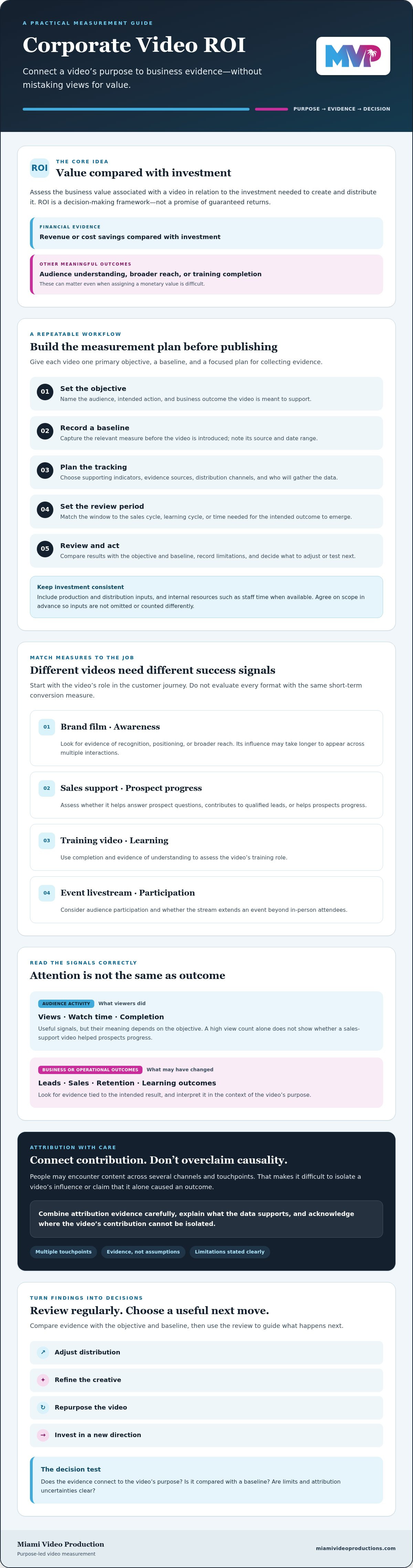
What if the corporate video with the fewest views is doing the most valuable work? Measuring corporate video ROI means looking beyond reach and engagement to evidence that connects a video’s purpose with business outcomes across the customer journey.
It’s reasonable to question whether a video is worth the investment when views, likes, and watch time don’t show what happened next. Prospects may encounter content across several channels and touchpoints, making attribution complex. Stakeholders need reporting that’s credible without claiming more than the data supports.
This guide explains how to choose meaningful metrics, compare performance, and decide what to improve. Set objectives before production, match measures to the video’s role, and interpret audience response, leads, and conversions carefully. A corporate brand film, training video, content series, or livestream may each serve a different purpose, so their success measures shouldn’t be identical. You’ll also learn how to account for multiple touchpoints and turn results into clear next steps.
Key Takeaways
- Define ROI as business value compared with investment, not a promise of guaranteed returns.
- Build a measurement workflow around one primary objective, a baseline, and a focused tracking plan for each video.
- Choose indicators that reflect the video’s purpose, and distinguish audience attention from business or operational outcomes.
- When measuring corporate video ROI, combine attribution evidence carefully and acknowledge where the video’s influence can’t be isolated.
- Use regular reviews to decide whether to adjust distribution, refine the creative, repurpose the video, or invest in a new direction.
What measuring corporate video ROI means, and what it does not
Measuring corporate video ROI means comparing the business value associated with a video against the investment required to create and distribute it. The familiar Return on Investment (ROI) concept is a useful starting point, but video evaluation needs context. Not every worthwhile result appears as immediate revenue, and a positive outcome is never guaranteed.
ROI is a decision-making framework, not a promise that a video will pay for itself. Financial analysis can compare revenue or cost savings with investment. Other outcomes, such as improved audience understanding, broader reach, or training completion, may also matter even when they’re difficult to assign a monetary value. Define the video’s purpose first. Otherwise, metrics can look impressive without showing whether the content did its job.
Separate video activity from business outcomes
Views, watch time, and completion describe audience activity. Leads, sales, retention, and learning outcomes offer evidence of what may have changed for the business. Activity metrics aren’t meaningless, but their value depends on the objective. Completion can help assess a training video, while a high view count alone says little about whether a sales-support asset helped prospects progress.
Corporate video ROI is the business value linked to a video, assessed in relation to the investment required to produce and distribute it. Treat engagement as a signal, then look for evidence tied to the intended outcome.
Start with the video’s role in the customer journey
Different videos serve different stages and audiences. An awareness-focused brand film may aim to build recognition or communicate positioning. A sales-support video may help answer prospect questions or contribute to qualified leads. Assess training videos through completion and evidence of understanding. An event stream may be evaluated by audience participation or by how it extends an event beyond in-person attendees.
Set the evaluation window to match the video’s role. A lead-generation asset may prompt a response soon after viewing, while the effect of a brand film can take longer to appear across multiple interactions. Don’t judge both using the same short-term conversion measure. For more context on strategic brand films, see this cinematic corporate brand film guide.
Before production, agree on the objective, the evidence you’ll track, and when you’ll review it. This makes later comparisons more credible and keeps interpretation grounded in the video’s purpose.
Build a corporate video ROI framework before publishing
A credible framework starts before production, not after the first performance report. For each video, choose one primary business objective and a small set of supporting indicators. This keeps the team focused on evidence that can guide a decision instead of collecting metrics simply because they’re available.
Choose objectives, baselines, and success indicators
Write down who the video is for, what you want that audience to do, where the video will appear, and which business outcome it is intended to support. A training video might aim to improve understanding; a sales-support asset might help qualified prospects take a next step. Select relevant indicators and record a comparable pre-publication baseline, including its source and date range.
A baseline makes later comparisons more credible because it shows what was happening before the video was introduced.
Use a workflow your team can repeat
- Set the objective: State the intended audience, action, and business outcome.
- Record the baseline: Capture the relevant existing measure and document where and when it was collected.
- Plan tracking: Specify the supporting indicators, evidence sources, distribution channels, and who will gather the data.
- Set the review period: Choose a window that reflects the sales cycle, learning cycle, or other time needed for the intended outcome to emerge.
- Review and act: Compare results with the objective and baseline, note limitations, and decide what to adjust or test next.
Record investment consistently, too. Include production and distribution inputs, plus internal resources such as staff time when that information is available. Agree on the scope in advance so later comparisons don’t omit costs or count the same input differently.
Select a calculation that fits available evidence
When you can reasonably estimate attributable financial value, use a consistent formula:
ROI (%) = [(attributable value − total investment) ÷ total investment] × 100
“Attributable value” is the financial value you can credibly associate with the video within the chosen measurement period. “Total investment” is the production, distribution, and relevant internal resource cost included in the analysis. Keep the scope, time period, and assumptions consistent on both sides. Don’t assign a monetary value to outcomes without a defensible basis.
If reliable revenue attribution isn’t available, report qualified proxy outcomes instead, such as relevant audience engagement, completed training, or prospects progressing to an agreed next step. Label these as indicators, not revenue or proven causal impact. For teams defining objectives and reporting plans, video growth strategy can be a useful area to explore.
Match corporate video metrics to the outcome you need
Choose metrics based on the video’s objective, then identify where the evidence will come from. Reach and attention indicators show whether the intended audience encountered and watched the content. Conversion, revenue, and operational indicators help assess whether activity was associated with a business result. These measures answer different questions, so don’t treat a strong attention signal as proof of commercial impact.
Measure awareness, consideration, and lead generation
For awareness, assess qualified reach, watch time, and whether viewers match the intended audience. For consideration, look for relevant page visits, return engagement, or interactions alongside other buying activity. For lead generation, connect tracked video journeys with qualified inquiries and CRM outcomes. Each measure is a clue to interpret, not automatic evidence that the video caused the result.
Measure sales enablement, events, and training
Evaluate sales-support assets through usage alongside suitable stage progression or stakeholder feedback. For livestreams, separate attendance and engagement from follow-up actions tied to the event’s purpose. For a corporate event in Miami, Broward, West Palm Beach, Fort Lauderdale, North Miami, Fort Myers, or Naples, for example, the relevant measures depend on whether the stream is intended to support participation, follow-up, or reach beyond the in-person audience. Training videos may be assessed through completion, knowledge checks, or documented performance indicators, when available. Choose evidence that reflects the intended outcome rather than applying one universal score.
| Video objective | Useful metrics | Possible evidence source | Interpretation caution |
|---|---|---|---|
| Awareness | Qualified reach, watch time, target-audience relevance | Platform reporting and audience data | Views alone don’t confirm that the intended audience noticed or understood the message. |
| Consideration | Relevant page visits, return engagement, assisted interactions | Website analytics and journey records | Other content or touchpoints may also influence these actions. |
| Lead generation | Qualified inquiries and CRM outcomes | Tracked journeys and CRM records | Separate qualified leads from unverified submissions. |
| Sales enablement | Asset usage, stage progression, stakeholder feedback | Sales records and team feedback | Usage doesn’t prove the asset changed the outcome. |
| Events and livestreams | Attendance, engagement, goal-related follow-up | Event records and follow-up tracking | Participation and business action are distinct measures. |
| Training | Completion, knowledge checks, documented performance indicators | Learning records and relevant performance data | Completion isn’t the same as understanding or behavior change. |
Platforms may define or report similar-sounding signals differently. Before measuring corporate video ROI across channels, document what each metric means, how it’s counted, and which reporting source supplies it. Use consistent definitions for comparisons, and keep reach and attention separate from conversion, revenue, or operational outcomes. Views and completion rates can indicate exposure and interest; on their own, they don’t establish business impact.
Attribute video’s contribution without overstating causality
Attribution is imperfect, especially when people encounter a video on one channel and take action later through another. That doesn’t make measurement useless. Consistent tracking can show where video appears in a journey, which actions follow, and whether patterns change over time. Report what the evidence supports rather than claiming that a video alone caused a sale.
Use tracking that connects video exposure to meaningful actions
Combine tracking tools to build a clearer, though incomplete, picture. UTM parameters can identify visits associated with a tagged campaign link. A campaign landing page can help connect responses to a specific video initiative, and CRM records can show whether inquiries progress to meaningful business outcomes. Document how views or interactions are linked to later actions, along with gaps such as untracked sharing, cross-device activity, or missing records.
For broader measurement planning, see this video growth strategy consulting roadmap.
Choose an attribution approach stakeholders can interpret
First-touch, last-touch, and multi-touch reporting are different ways to examine a journey, not definitive accounts of what caused an outcome. Direct-response tracking can connect a tagged interaction with an inquiry, while assisted-conversion reporting can show video’s presence before a later action. Where practical, a controlled comparison between similar groups or periods can offer stronger evidence if the comparison is designed carefully.
| Approach | What it can reveal | What it may miss |
|---|---|---|
| First-touch | Whether video was recorded as the first known interaction | Later interactions that helped move the audience toward action |
| Last-touch | Whether video was the final recorded interaction before an action | Earlier influences that may have built awareness or consideration |
| Multi-touch | How video appears alongside other recorded interactions | Untracked activity and assumptions used to assign contribution |
| Controlled comparison | Differences between comparable groups or periods with different video exposure | Effects of differences between groups or other changes during the test |
Concurrent campaigns, audience differences, seasonality, and changing distribution can all affect results. Keep reporting definitions consistent across campaigns and state assumptions plainly. When measuring corporate video ROI, label conclusions as observed when an action followed recorded exposure, assisted when video appeared in a multi-touch journey, or experimentally supported when a controlled comparison indicates a difference. These labels help stakeholders interpret findings without overstating causality.
If you’re defining a measurement approach for upcoming content, explore video growth strategy consulting.
Turn corporate video ROI findings into your next production decision
Measurement matters most when it informs what happens next. Set a recurring review that compares results with the video’s original objective and recorded baseline. Distinguish a distribution problem from a creative one: if the intended audience isn’t seeing the video, adjust where or how it’s shared. If the audience is reached but doesn’t respond as intended, revisit the message, format, or call to action.
Then decide whether to refine, repurpose, expand, or pause the asset. A useful video may need a new cut or placement rather than a new production. Strong audience response with limited business follow-through may point to a mismatch between the content and the next step. If the evidence is weak or inconclusive, check tracking and attribution assumptions before making a firm judgment.
Create a concise, decision-ready ROI report
Give stakeholders a clear view of what was intended, what happened, and what the evidence can support. Include:
- The objective, intended audience, and distribution channels
- The investment scope and reporting period
- A small set of results compared with the baseline
- Attribution caveats and a recommended next action
Keep the report focused on indicators that can change a decision, not a full export of platform analytics. For training content, completion data may be useful, but pair it with knowledge checks or documented performance indicators when available. This instructional video production guide offers context for planning content around learning objectives.
Plan the next measurement cycle with a production partner
Turn the review into a revised brief before the next project begins. Confirm the audience, objective, distribution plan, success criteria, reporting period, and who is responsible for tracking each measure. These decisions can shape a brand film, training video, livestream, or content series differently because each format may serve a distinct business purpose.
Miami Video Production offers video growth strategy consulting to align content plans with business objectives, alongside corporate brand films, training and education videos, podcasts and content series, and events and livestreaming. Its production fees cover pre-production planning, filming with professional crews, and post-production editing for corporate brand films and training videos. These are options to consider, not a guarantee of a particular return. For a conversation about aligning measurement with an upcoming project, discuss your video measurement goals.
Make your next video decision with confidence
Measuring corporate video ROI is most useful when it starts with a clear objective and ends with a practical decision. Match each video to indicators that reflect its purpose, compare results with a recorded baseline, and report attribution carefully. Views can show exposure, but they don’t establish business impact on their own. A consistent review helps your team decide whether to refine distribution, improve the creative, repurpose an asset, or plan a different approach.
Measurement planning belongs in the production conversation from the start. Miami Video Production offers video growth strategy consulting aligned with business goals, along with end-to-end corporate production from planning through filming and editing. For corporate events in South Florida, its broadcast-quality livestreaming includes technical direction, multi-camera switching, and real-time encoding.
Discuss your video measurement goals and explore how a clear strategy can guide your next project. With objectives and evidence aligned, your team can make more informed decisions and build video content with purpose.
Frequently Asked Questions
How do you measure corporate video ROI?
Measure corporate video ROI by comparing the business value you can credibly associate with a video against the total investment in its production and distribution. Set one primary objective, record a baseline, and choose relevant indicators before publishing. If reliable financial attribution isn’t available, report qualified outcomes such as inquiries or training completion instead of inventing revenue. Teams in Miami, Broward, West Palm Beach, Fort Lauderdale, North Miami, Fort Myers, and Naples can apply the same principles.
What is a good ROI for a corporate video?
There’s no universal ROI benchmark that makes every corporate video successful. A useful result depends on the video’s purpose, investment, audience, and measurement period. A lead-generation asset may be judged by qualified inquiries, while a training video may be evaluated through completion or knowledge checks. Define success before production, then compare outcomes with your baseline and assumptions. Treat any financial calculation as an estimate when attribution is incomplete.
Can you track whether a video generated leads or sales?
Yes, you can track whether leads or sales are associated with a video by using tagged campaign links, dedicated landing pages, and CRM records together. Record how video interactions connect to later inquiries and sales outcomes, and note gaps such as untracked sharing or cross-device activity. This provides useful evidence of a video’s contribution, but a recorded journey doesn’t by itself prove the video caused the conversion.
Which metrics matter most for corporate video performance?
The most useful metrics depend on the intended outcome. Awareness efforts may track qualified reach and watch time; consideration content may look at relevant page visits and return engagement; lead-generation videos can be assessed against qualified inquiries and CRM outcomes. Sales-support assets, livestreams, and training videos need measures suited to their roles. Views and completion rates show exposure or attention, but don’t establish business impact on their own.
How long should you wait before measuring corporate video ROI?
Set the review period before publishing and align it with the time the intended outcome typically needs to emerge. A direct-response campaign may show early signals sooner than a brand film connected to a longer consideration journey. Training outcomes may require time for learners to complete content and take a knowledge check. Review early indicators during the campaign, then assess business outcomes at the agreed interval without changing the timeframe mid-comparison.
What should you do if a corporate video has views but no conversions?
First, check whether the video reached the intended audience and whether tracking is working. Then review the content’s role, message, call to action, landing page, and distribution. Views may indicate exposure without showing purchase intent, so look for relevant audience engagement and progression to the next step. Adjust distribution if reach is misaligned; consider creative changes if the right viewers watch but don’t take the intended action.
Can video engagement prove that a video caused a sale?
No. Engagement can show that people watched or interacted with a video, but it can’t prove the video caused a sale. Other campaigns, audience differences, timing, and touchpoints may have influenced the decision. Use first-touch, last-touch, or multi-touch reporting as different views of the customer journey, and state their limits. Where practical, a well-designed controlled comparison can offer stronger evidence, but conclusions should still reflect the method used.
