
Miami Law Firm Video Production: Strategic Buying Guide
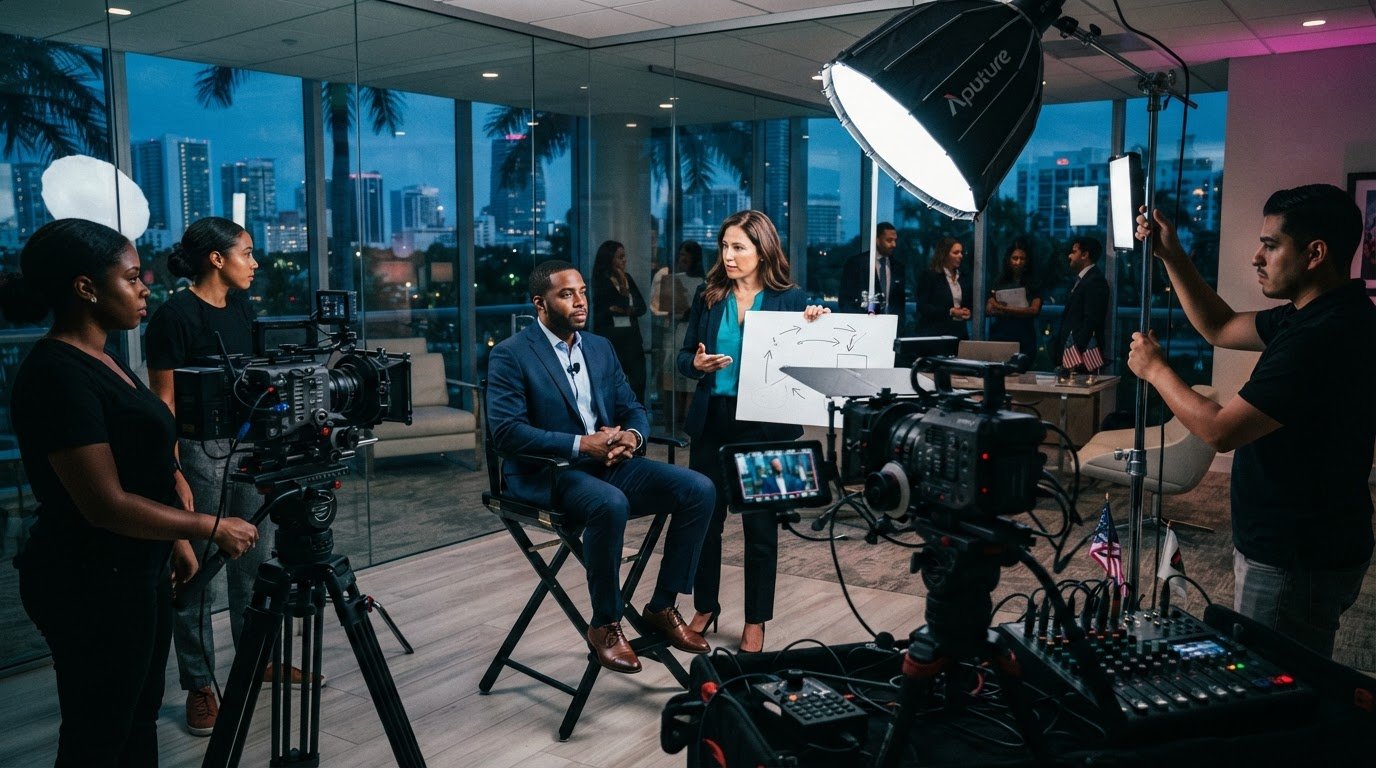
The most effective law firm video isn’t necessarily the most elaborate. It’s the one that answers the right question for the right audience. A strategic approach to video production for law firms miami starts with your firm’s priorities, then matches the format and production plan to them.
Polished content shouldn’t pull attorneys away from their work or put sensitive client information at risk. A clear purpose, focused messaging, and careful preparation help make filming efficient. An attorney introduction, practice-area explainer, firm overview, and educational series can each support a different communication goal.
This guide explains how to choose a format, prepare for production, and create professional video assets for your website, social channels, and ongoing communications. You’ll also learn how coordinated planning, filming, and post-production can keep the process organized, safeguard confidential information, and make each video useful beyond its initial release.
Key Takeaways
- Choose a format by starting with the audience and business goal, then match the message to the right type of content.
- Use a clear production brief to align priorities, key messages, deliverables, and distribution before filming.
- Thoughtful preparation makes video production for law firms miami more focused, organized, and respectful of attorneys’ time.
- Plan participant coordination and location needs across Miami-Dade and Broward during pre-production.
- Consider how brand films, educational and training videos, content series, and livestreaming can support different firm communications.
What law firms in Miami should expect from professional video production
Professional law firm video production is planned business communication, not simply a camera pointed at an attorney. Its purpose is to present the firm clearly, explain what it does, and help a specific audience take an appropriate next step. In short, strategic law firm video production is the planned creation of clear, polished video content that advances a firm’s communication goals with the right audience.
That planning shapes the message, setting, participants, visual style, and final edits. A coordinated process includes pre-production, filming, and post-production, with each stage supporting the same communication goal. If the process is new to your team, this overview of understanding video production introduces common stages and terminology. For a law firm, the value comes from applying those stages to a defined purpose, whether you’re introducing attorneys, explaining a practice area, or developing educational content.
Planned production also differs from casual office footage. A phone clip may capture a useful thought, but uneven lighting, room noise, framing, or messaging can distract from an attorney’s expertise. Professional planning helps create consistency in picture and sound, while a focused outline keeps each video from trying to cover too much. Before filming, identify sensitive information and agree on what should stay out of the frame and script.
Which law firm audiences can video serve?
One video rarely serves every audience equally well. Prospective clients may need a welcoming introduction and a simple explanation of the firm’s work, followed by a clear next step. Existing clients may benefit from process updates or educational material with more detail. Referral sources often need a concise account of the firm’s focus and approach. Employees may need internal training, while community audiences may value accessible explanations of relevant topics. For firms serving Miami and South Florida, define which communities the message should reach, then tailor its language, detail, and call to action.
How marketing video differs from legal videography
Marketing and educational videos communicate the firm’s services, people, and knowledge. Legal videography has a different purpose: documenting proceedings or supporting litigation-related work. This guide focuses on business communications and planned firm content, such as brand films, educational videos, training, podcasts, and livestreams. The distinction matters because the audience, production priorities, and intended use differ. Choose a format based on the communication goal, and don’t confuse promotional storytelling with a legal record.
For video production for law firms miami, begin with the audience and business objective. Then shape the message, setting, and production approach around what viewers need to understand. The result is more than polished footage: it’s a purposeful communication asset that can support the firm’s ongoing outreach.
How to evaluate a Miami video production partner for your law firm
A strong production partnership starts before the cameras arrive. First clarify what the firm needs to communicate, who needs to hear it, and where the finished video will be used. Pre-production then turns that objective into a brief, schedule, location plan, and filming approach. Crew coordination, filming, and post-production should all support the original purpose rather than become disconnected tasks.
When evaluating video production for law firms miami, consider the process as well as the finished look. Review examples for clear storytelling, clean sound, thoughtful lighting, and a tone suited to the audience. A beautifully shot video can still miss the mark if its message is vague or its style doesn’t fit the firm. Look for work that explains complex subjects clearly and presents speakers with confidence.
What should a law firm video brief include?
A useful brief gives everyone a shared reference point and helps attorneys prepare efficiently. Identify the audience, communication challenge, core message, and desired next step. Then list the relevant practice areas, speakers, filming locations, distribution channels, and required formats. An attorney introduction for a bio page, for example, may need a different emphasis and edit from an educational video for current clients.
Set the review process early. Assign one firm contact to consolidate feedback, and give attorneys time to check factual accuracy and messaging before finalizing the video. If the content raises advertising or professional-responsibility questions, route it through the firm’s appropriate review process. Clear roles and a planned review stage help prevent scattered revisions and preserve the intended meaning.
How to assess the production process and creative fit
Pre-production should make filming purposeful. A developed outline, prepared participants, and agreed locations let attorneys focus on communicating instead of deciding what to say on camera. Professional crews support consistent image and sound, while editing shapes the recorded material into a polished, coherent piece. Miami Video Production coordinates pre-production planning, filming with professional crews, and post-production editing as a connected process. This Miami video production partner selection guide can also help you frame the decision.
- Strategy: Does discovery connect the project to a firm priority and a defined audience?
- Preparation: Are the message, participants, locations, and review steps planned before filming?
- Execution: Do the crew and editing approach support clear, consistent communication?
- Use: Are the deliverables suited to where and how the firm plans to share them?
Evaluate strategic fit, the clarity of the brief, preparation, professional execution, and whether the deliverables suit their intended use. To explore video strategy and production for law firms, visit Miami Video Production.
Which video formats fit different law firm goals?
Start with the communication need, not a popular trend or the biggest production idea. A firm introducing its approach has a different task from one educating clients, training employees, or sharing an event with people who can’t attend. The right format makes the message easier to understand and gives it a useful place in the firm’s communications.
Use this comparison to connect a goal with a suitable format and practical planning consideration:
Goal | Suitable format | Planning consideration
Introduce the firm | Corporate brand film | Define the identity, approach, and audience the story should convey.
Explain a topic | Educational video | Focus on a specific question and make the explanation clear and accessible.
Support employees | Training content | Structure instruction so staff can revisit the material as needed.
Build ongoing communication | Podcast or content series | Choose a consistent theme and a sustainable editorial direction.
Share a live event | Livestream | Plan the audience experience, technical direction, and real-time delivery.
Brand films and educational videos for prospective clients
A corporate brand film can introduce prospective clients to the firm: what it stands for, how it approaches its work, and who they may meet. It should express the firm’s character rather than read like a list of practice areas. For a closer look at story development and visual direction, see this cinematic corporate brand film guide.
Educational videos serve a different purpose. They can explain a focused topic the firm is qualified to address, helping viewers understand key concepts without replacing individualized legal advice. A concise explainer may suit a practice-area page or client communication, while a set of related videos can answer different questions over time. Keep each video centered on one clear takeaway.
Training, podcasts, and livestreams for ongoing communication
Training videos can communicate repeatable internal instruction, such as an onboarding process or firm procedure. Employees can revisit a recorded explanation, supporting consistent learning without repeating the same live presentation. Plan the sequence around what staff need to know, and show processes clearly.
Podcasts and content series provide a structure for sustained communication. A firm might develop recurring conversations around a defined subject, with episodes shaped for its audience and shared through appropriate digital channels. Livestreaming suits selected live events where real-time participation matters. Professional production can include technical direction, multicamera switching, and real-time encoding to coordinate the presentation as it reaches viewers.
For video production for law firms miami, let strategy determine the format. A cinematic approach is useful when it supports the message; a straightforward educational video may be stronger when clarity is the priority. Match the scope and style to the goal, audience, and intended use. Build a coherent library over time instead of producing content simply because a format is popular.
How to plan law firm video production in Miami
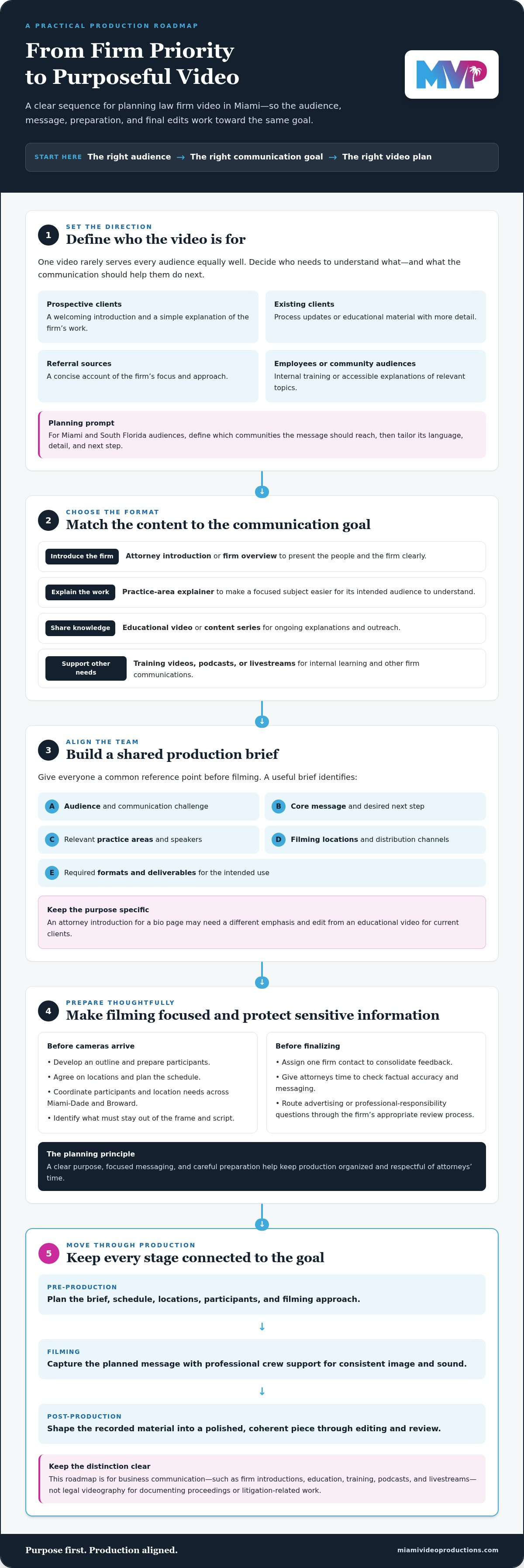
A smooth production starts with decisions made before filming. Agree on the business goal, shape a focused message, prepare participants and locations, then film, edit, and review the content. This sequence keeps production choices tied to the firm’s communication priorities and gives attorneys a clear sense of what’s expected of them.
- Define the goal. Decide what the video should help viewers understand or do, and identify the intended audience.
- Plan the message. Choose the central point, supporting details, and a suitable format. Keep each video focused on a manageable subject.
- Prepare participants and locations. Confirm who will appear, what they’ll cover, and which settings support the message.
- Film with a clear plan. Coordinate the production crew, recording needs, and locations around an agreed outline.
- Edit and review. Check the cut for clarity, factual accuracy, appropriate messaging, and suitability for its intended use.
For firms working across Miami-Dade and Broward, factor location and participant coordination into pre-production. If a project involves multiple offices or settings, align the content and filming needs for each location in advance. A connected workflow brings planning, filming, and post-production together, so attorneys don’t have to manage production details themselves.
Prepare attorneys and locations for a focused shoot
Most on-camera participants benefit from concise talking points rather than a script they must memorize. A script may suit a particular format, but for interviews, an outline can help attorneys speak naturally while staying on message. Share the purpose, audience, and likely questions beforehand so participants arrive prepared.
Choose quiet, visually appropriate locations and limit interruptions during recording. Before filming, identify any client names, documents, screens, or other sensitive material that should stay out of view or the script. Agree on who reviews the edit, how feedback will be gathered, and how factual corrections will be communicated. The firm should also verify applicable legal, privacy, and permission requirements through its own review process.
Plan distribution and review before filming
Decide where each video will appear, such as the firm’s website, social channels, or internal communications. The destination can affect framing, editing, and how much context the video needs. Consider whether separate versions would better serve different audiences or platforms, rather than expecting one edit to meet every need. Planning distribution early helps make each deliverable purposeful.
A video growth strategy roadmap can connect content planning with broader business and marketing objectives. For a thoughtful approach to video production for law firms miami, map the goal, message, participants, locations, review path, and distribution before the shoot. Plan your law firm video production with a coordinated production partner.
Partner with Miami Video Production to create purposeful law firm videos
Effective law firm video begins with a clear objective. The audience, communication goal, and intended use help determine the right format, from a corporate brand film that introduces the firm to an educational video that explains a focused topic. Miami Video Production works with South Florida businesses to align video projects with business and marketing objectives, keeping the production plan connected to what the content needs to accomplish.
Relevant formats include cinematic corporate brand films, training and education videos, podcasts and content series, and video strategy consulting. Each can support a different communication priority. A firm may need a concise introduction for prospective clients, repeatable learning content for employees, or a planned series for ongoing communication. The project’s scope can be shaped around its goals, audience, and intended channels.
What working with a production partner can include
A coordinated project brings planning, professional filming, and post-production editing together. Pre-production clarifies the message, participants, locations, and deliverables. Filming puts that plan into action, and editing shapes the footage into a polished final piece. Collaboration throughout keeps the message consistent and production decisions aligned with the firm’s priorities.
- Corporate brand films that communicate the firm’s identity and approach.
- Education and training videos that explain focused topics or support internal instruction.
- Podcasts and content series that provide a planned structure for continued communication.
- Event livestreaming for relevant live events, supported by technical direction, multicamera switching, and real-time encoding.
Livestreaming is most relevant when the firm has an event or communication need suited to a live audience. It serves a different purpose from recorded brand or educational content, so choose the format based on the event’s goals and viewing experience.
Take the next step on a Miami law firm video project
A productive first conversation can start with a few essentials: who the video should reach, what the firm wants to communicate, the content idea, and where the finished piece will be used. Those details provide a foundation for discussing format, production approach, and project scope. You don’t need every creative decision settled in advance; the plan can take shape around the firm’s priorities.
With video production for law firms miami, a strategic partner can help turn a communication objective into a considered production plan, from planning through filming and editing. Share your goals and project needs to get started.
Discuss your law firm video project
Turn your firm’s next communication goal into a video plan
Choose one communication priority and give it a clear role in your firm’s broader outreach. A well-planned video can support consistent, thoughtful communication, with future content shaped by the questions your audiences continue to raise. For video production for law firms miami, focus on what viewers need to understand and how the content supports your firm’s objectives.
Miami Video Production brings strategy and production together for businesses across South Florida, including Miami, Broward, West Palm Beach, Fort Lauderdale, North Miami, Fort Myers, and Naples. Share your audience, goal, content idea, and intended use to start shaping a project around your needs.
Discuss your law firm video project. Start building a more purposeful video strategy around your next clear message.
Frequently Asked Questions
What types of videos should a law firm create?
Choose a format based on what viewers need to understand or do. A firm introducing a practice area might pair an overview film with short explainers that address common questions. An internal onboarding initiative may call for structured training content. Consider how each video fits into the viewer’s experience, such as a website visit, follow-up email, or employee learning process.
How do I choose a video production company for a law firm in Miami?
Choose a partner that connects the creative approach to your firm’s communication goal and audience. Review complete examples, not only highlight reels, to see whether the storytelling is clear and the finished work suits its viewers. For video production for law firms miami, consider how the project can serve audiences in Miami, Broward, West Palm Beach, Fort Lauderdale, North Miami, Fort Myers, and Naples.
Can law firms use video to explain legal topics?
Yes. Educational video can make a focused topic easier to follow, especially when viewers may be unfamiliar with key terms or processes. For example, an attorney might explain the general stages of a practice-area process using plain language and a simple visual outline. Have the appropriate legal professionals review the content for accuracy, and make clear that general information isn’t advice tailored to an individual viewer’s situation.
How long does law firm video production take?
Production timing depends on the project’s scope, preparation, filming needs, and review process, so one schedule won’t fit every firm. A single interview differs from a coordinated series with several participants or locations. Ask the project team to identify major stages and review milestones, then account for attorney availability and consolidated feedback. Sharing constraints early helps shape a workable plan without assuming a delivery date.
What should attorneys prepare before a video shoot?
Attorneys should know who the video is for, the main point they need to communicate, and what viewers should understand afterward. Prepare a short outline or talking points, and flag names, documents, screens, or details that shouldn’t appear in the recording. It also helps to choose one person to coordinate firm feedback. This preparation gives the production team useful direction while allowing speakers to sound natural.
How can a law firm make video content useful across multiple channels?
Map each video to a specific destination and viewing context before production. A detailed client education piece may suit a practice-area page, while a brief introduction could work better in a follow-up email. Decide whether a subject deserves a series of related pieces or distinct edits for different audiences. Before publishing, review each version in context to confirm that its message is clear and its next step makes sense.
What is the difference between law firm marketing video and legal videography?
Law firm marketing video communicates the firm’s identity, services, knowledge, or internal information. Legal videography is a separate category associated with documenting legal proceedings or deposition-related work. The purpose and intended use differ: a brand film introduces the firm, while a legal record serves a procedural function. This FAQ addresses planned business communication, such as educational content, training, podcasts, and event livestreams.
