
Miami Product Launch Livestreaming: A Strategic Buying Guide
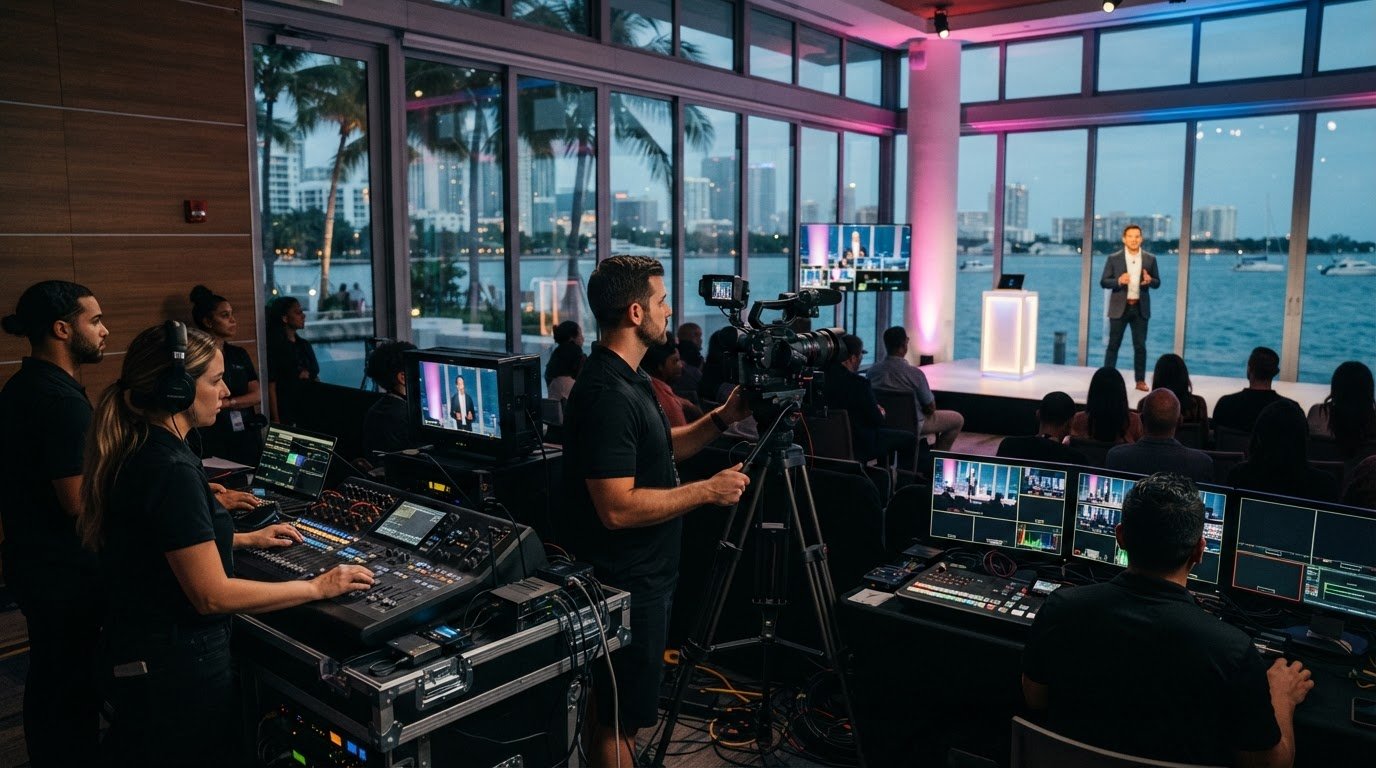
What if your product reveal captivates the room but leaves remote viewers unsure what they’re seeing? That’s the risk of treating miami product launch livestreaming as a camera setup rather than a coordinated event. A high-visibility launch depends on clear storytelling, confident presenters, and a reliable stream working together.
It’s reasonable to worry about technical problems, venue logistics, and which production elements are essential. A practical plan brings those moving parts into focus before launch day, so viewers can follow the reveal and take in the details that matter. Miami Video Production supports events with technical direction, multi-camera switching, and real-time encoding, shaped around the event format, venue, audience, and goals.
This guide explains how to build a polished, audience-focused livestream, from planning the production and coordinating presenters to preparing for remote viewers. You’ll also see how launch footage can support future brand films or content series, helping the event contribute to your communications beyond the live moment.
Key Takeaways
- Start with a clear launch goal and audience so the reveal, product demonstration, and viewer interaction work as one experience.
- Use a run of show to coordinate presenter remarks, key reveal moments, and audience questions for both in-room guests and remote viewers.
- Compare miami product launch livestreaming options by the planning, technical direction, camera coverage, encoding, rehearsal, and follow-up each includes.
- Map venue access, stage layout, power, connectivity, sound, and camera positions before event day to surface production needs early.
- Plan how launch footage could support future brand films or content series, extending the value of the event beyond the live broadcast.
Why Miami Product Launch Livestreaming Needs a Clear Audience and Launch Goal
Remote viewers need the same clear story and key moments as guests in the room. If the product reveal is hard to see, the explanation assumes too much, or the next step is unclear, the broadcast can lose its purpose even when the event itself feels successful.
Product launch livestreaming is a planned live broadcast built to reveal and explain a product, not simply transmit what happens onstage. It uses the fundamentals of live streaming, but shapes the program around a specific audience and outcome. A launch livestream is a product story designed for viewers, not a camera pointed at a stage.
Before planning the production, choose one primary goal. It might be to build awareness, educate prospects, capture leads, or align employees and partners around a launch. These goals can overlap, but naming the main one helps determine what presenters emphasize, how the broadcast flows, and what viewers should do afterward. For effective miami product launch livestreaming, every production decision should support that priority.
Which audiences should a Miami product launch livestream serve?
Different viewers need different context. In-person attendees may want an engaging room experience and a close look at the product. Remote prospects need a concise explanation of its value; partners may care about positioning and launch timing; employees need a consistent story to share; and media may need clear, quotable information.
Audience size, location, and participation expectations shape the event format. A South Florida team might host local guests while remote prospects or colleagues join from other regions. Decide whether remote viewers will simply watch, submit questions, or participate in another planned way. That choice affects the run of show and how much time to reserve for interaction.
What should viewers understand or do after the product reveal?
Give the broadcast a simple audience journey: establish the problem, reveal the product, demonstrate how it addresses that problem, then guide viewers to one next action. Choose proof points that make the product’s differentiating value understandable, such as a focused demonstration or a presenter’s explanation of a key benefit. Avoid loading the reveal with details that distract from the central message.
Make the call to action match the primary goal. For example, an awareness-focused launch might direct viewers to learn more, while a lead-focused event could invite them to submit an inquiry. Competing asks can dilute attention, so keep the live program centered on one clear next step. A well-defined audience and outcome give the production team a practical framework for shaping a coherent, composed broadcast.
How to Design the Product Reveal and Livestream Experience
A launch livestream works best when the story and production are designed together. Use this sequence to move from business intent to a well-paced broadcast. For a broader perspective on strategic product launch planning, align the event plan with the launch’s wider business objectives.
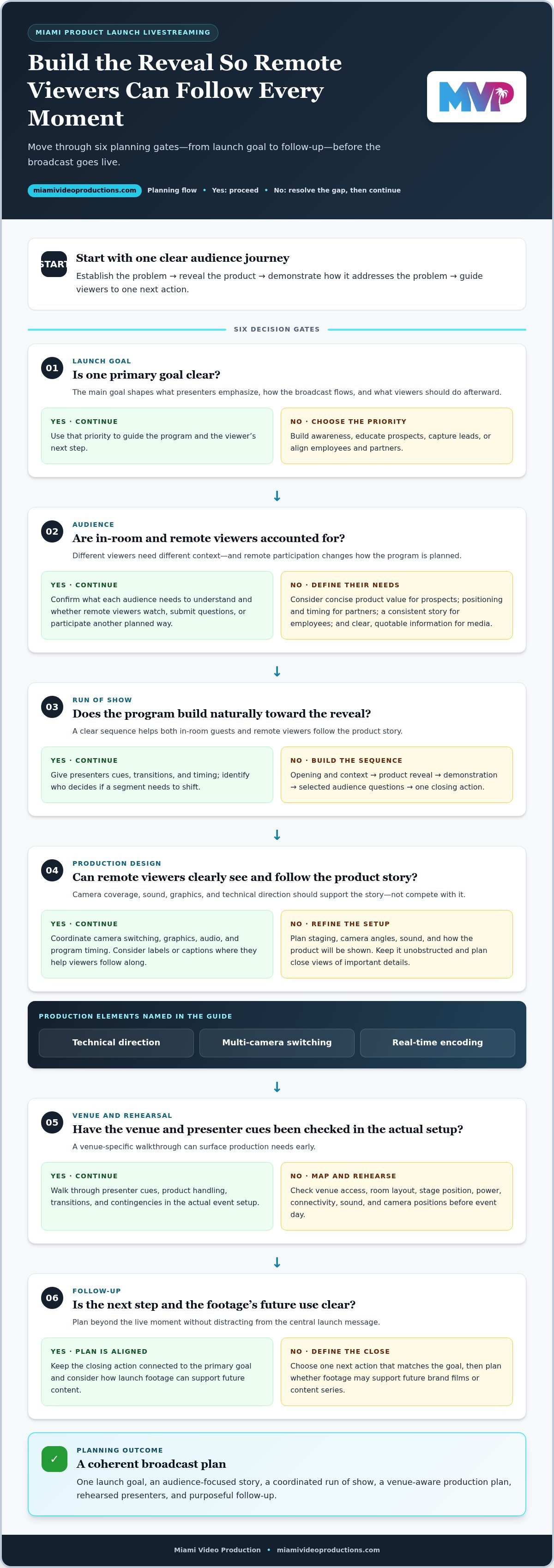
- Confirm the goal. Decide what the broadcast should accomplish, such as educating prospects or aligning partners.
- Define the audience. Identify who will attend in person and who will watch remotely, and what each group needs to understand.
- Build the run of show. Sequence the opening, product context, reveal, demonstration, questions, and closing action.
- Design the production. Plan staging, camera coverage, sound, graphics, and how the product will be shown clearly.
- Rehearse. Walk through presenter cues, product handling, transitions, and contingencies in the actual event setup.
- Plan follow-up. Decide how to direct viewers after the event and how launch footage might support future content.
For miami product launch livestreaming, the venue is part of the plan. Access times, room layout, stage position, and coordination with local crew affect where cameras and presenters can be placed and how the product is lit and framed. A venue-specific walkthrough helps identify dependencies early. For more on reliability planning, see this broadcast-quality livestreaming guide.
How should the run of show build toward the reveal?
Open with a welcome, then give viewers enough context to understand the product’s purpose before the reveal. Follow with a deliberate product moment, a demonstration that proves the central value, and time for selected audience questions. Close with one clear next action. Assign each presenter a cue, transition, and timing, and identify who makes decisions if a segment needs to shift. Keep the product unobstructed and plan close views so remote viewers can see important details.
Which production choices make the launch easy to follow?
Multiple camera angles can distinguish presenter remarks from product details and audience reactions, giving remote viewers a more composed view of the event. Technical direction coordinates camera switching, graphics, audio, and program timing so each supports the story rather than competing with it. Consider on-screen labels or captions where they help viewers follow along, and verify the chosen platform’s current features and applicable accessibility requirements during planning.
These decisions are easier to coordinate with a production partner involved in both the event flow and the broadcast. Explore Miami event livestream production as you shape a reveal that works for the room and the remote audience.
How to Compare Miami Product Launch Livestreaming Production Options
A product demonstration has different demands from a simple stage broadcast. The audience may need to see a presenter explain the product, a close view of its details, and a live switch between those moments without losing the story. Compare production plans by how they handle those needs and who owns each responsibility, not by camera count or technical terminology alone.
The key difference is integration. A basic stream setup may focus on getting a feed live, while a full production partner coordinates the broadcast with the event plan, presenters, venue, and reveal. Use this matrix to clarify the scope behind each proposal:
| Area | Basic stream setup | Full production partner |
|---|---|---|
| Planning | May focus on stream logistics and event-day setup. | Connects production decisions to the launch goal, run of show, and audience experience. |
| Technical direction | Responsibilities may center on starting and monitoring the stream. | Coordinates cues, switching, audio, graphics, and timing across the program. |
| Camera coverage | Coverage may prioritize a fixed stage view. | Plans views for presenter remarks, product details, and demonstration moments. |
| Encoding | Clarify who prepares and monitors the outgoing stream. | Includes real-time encoding as part of a coordinated broadcast workflow. |
| Rehearsal | May cover basic signal checks. | Can rehearse presenter cues, transitions, and product handling in context. |
| Follow-up | Clarify whether post-event needs are part of the scope. | Can plan how launch footage may inform future content. |
What production capabilities matter for a live product demonstration?
Assess each capability against a specific audience need. Camera coverage should keep both the presenter and product details legible. Audio capture should make remarks and demonstration commentary easy to understand. Live switching should guide viewers between those views at the right moments, while real-time encoding prepares the program for streaming. Technical direction brings these elements together through clear cues and coordination. In Miami product launch livestreaming, a polished result depends on the workflow and event integration, not gear alone.
How can a team compare livestream plans consistently?
Ask each proposal to state who owns venue coordination, presenter communication, rehearsal, stream monitoring, and contingency decisions. Compare how the team communicates during the event and what follow-up is included. Look for a plan that clearly assigns responsibility for each step, from the first technical checks to decisions during the broadcast. For broader partner-selection criteria, read the Miami video production hiring guide.
How to Prepare a Miami Venue, Team, and Livestream Run of Show
A broadcast plan has to fit the venue, not just the production schedule. For miami product launch livestreaming, align venue access, crew arrival, presenter preparation, and technical checks early so the reveal can proceed with fewer last-minute decisions. Share one working run of show with the venue team, production crew, presenters, and event leads, and make sure everyone knows which version is current.
Use this checklist during planning:
- Venue access: Confirm access times, load-in arrangements, and when the stage and room will be available for setup and rehearsal. Build the schedule around crew travel and venue access.
- Stage layout: Position presenters and the product so guests can see the reveal and cameras have clear sightlines.
- Power: Identify available power locations and how they relate to the planned production positions.
- Connectivity: Test the planned connection with the venue and production team, and agree on a backup procedure if it’s interrupted.
- Sound and lighting: Listen for ambient noise and check how the room’s lighting affects presenter and product visibility.
- Camera positions: Mark practical positions for presenter coverage, product details, and audience views without blocking guest movement.
What should the venue walkthrough and technical rehearsal cover?
A venue-specific walkthrough lets the production team assess sightlines, room sound, lighting conditions, cable routes, and available camera positions before event day. It can also reveal dependencies between the stage layout, venue access, power, and connectivity, giving the team time to coordinate adjustments. During a timed rehearsal, run the complete sequence, including product handling, presenter cues, graphics, transitions, and audience participation. Test the connection and walk through the agreed backup procedure.
How should presenters and stakeholders prepare?
Give presenters the run of show, their allotted timing, key messages, camera awareness, and handoff cues. Rehearse the demonstration with the actual product and note any steps that need a close camera view or a clean transition. Assign one decision-maker to approve event-day changes and handle escalations, so presenters and crew aren’t waiting on conflicting instructions.
Keep contingencies simple and specific. Decide what the host will say if the start is delayed, which part of a demonstration can be adjusted, and how the team will communicate if the stream is interrupted. For events involving teams across Miami, Broward, West Palm Beach, Fort Lauderdale, North Miami, Fort Myers, and Naples, coordinate travel, venue access, and update channels in advance. A shared schedule and clear points of contact help local teams stay aligned from setup through the final cue.
Coordinate the venue, crew, and broadcast plan with Miami event livestream production.
Choose a Miami Product Launch Livestream Partner and Plan the Next Step
The right production partner connects your launch objective to the details of the live experience. Before planning miami product launch livestreaming, gather the decisions that will shape the event and help the production team build a plan around your actual needs.
- Launch goal and audience: What should viewers understand or do, and who will watch in person or remotely?
- Venue and event format: Where will the launch take place, and how will the room, stage, and schedule support the broadcast?
- Production scope: What coverage, technical direction, and stream coordination will the reveal require?
- Rehearsal: How will presenters, demonstrations, transitions, and audience participation be prepared?
- Success measure: What will help you assess whether the event achieved its primary goal?
What information helps shape a product launch livestream plan?
Start with the launch date, venue, audience, goals, and event format. Add the product demonstration, presenter lineup, planned audience interaction, and desired follow-up. These details help align the run of show with the broadcast and identify where technical direction, multi-camera switching, and real-time encoding fit. Production planning should be tailored to the event, rather than treated as a fixed package: a demonstration-heavy reveal has different coverage needs than a presenter-led announcement.
Miami Video Production creates broadcast-quality livestreams for events across South Florida. A coordinated production brings the event flow and broadcast decisions together, helping remote viewers follow the product reveal while supporting the experience in the room.
How can a launch livestream create value after the event?
Think beyond the live broadcast by identifying footage that could support future communications. With the right permissions and an agreed scope, approved launch footage may inform brand or marketing content. Define the specific edits and deliverables as part of the project instead of assuming they are included. For ideas on connecting video to broader brand storytelling, explore this cinematic corporate brand film guide.
Bring your goals, venue details, and event format into a conversation with Miami Video Production’s livestream team. A clear starting brief makes it easier to shape a production plan around the reveal, the audience, and what you want the event to accomplish.
Make Your Product Reveal Count
A memorable product launch starts with a clear goal and a story that works for both in-room guests and remote viewers. A well-planned run of show, venue walkthrough, and rehearsal help presenters, production teams, and event logistics stay aligned. Comparing production plans by scope and accountability, rather than equipment alone, also gives you a clearer view of how the broadcast will be coordinated.
For miami product launch livestreaming, Miami Video Production brings broadcast-quality event livestreaming to Miami and surrounding South Florida markets. Technical direction, multi-camera switching, and real-time encoding support a composed live experience, while planning can account for your event format, venue, audience, and goals.
Share your launch objectives, venue, audience, and production needs to begin shaping a plan with the team. Plan your Miami product launch livestream with our production team, and move forward with confidence in a reveal designed to connect with viewers.
Frequently Asked Questions
What is product launch livestreaming?
Product launch livestreaming is a planned live broadcast that reveals and explains a product to viewers in the room and online. It combines a clear event narrative with production choices that help remote audiences follow presenter remarks, see product details, and understand the demonstration. Unlike simply pointing a camera at a stage, the broadcast is coordinated around the launch goal, audience needs, key moments, and the next action viewers should take.
How do I livestream a product launch in Miami?
Start by defining the launch goal and audience, then plan the run of show, venue layout, production scope, rehearsal, and viewer call to action. For miami product launch livestreaming, coordinate venue access, stage and camera positions, power, sound, and connectivity with the production team. Miami Video Production creates broadcast-quality event livestreams across Miami, Broward, West Palm Beach, Fort Lauderdale, North Miami, Fort Myers, and Naples, with technical direction and real-time encoding.
What equipment is needed to livestream a product launch?
The equipment depends on the event format, venue, and how the product needs to be shown. A production plan may include cameras for presenters and product details, audio capture for clear remarks, lighting suited to the room, and a switching and encoding workflow to deliver the live program. Connectivity and power also need to be considered. The important step is matching production elements to the run of show, not selecting gear in isolation.
How can I make a product launch livestream more engaging?
Build the broadcast around a story viewers can follow: introduce the product’s purpose, reveal it clearly, demonstrate its value, and close with one useful next step. Keep presenters concise and make sure remote viewers can see important details. You can also plan a defined opportunity for audience questions or participation. Graphics and captions may help viewers follow along, but tailor them to the platform and the needs of your audience.
How do you make a product launch livestream reliable?
Reliability comes from advance planning, clear ownership, and tested workflows rather than equipment alone. Coordinate the venue and production team, check power and connectivity, rehearse presenter cues and product handling, and agree on how the team will respond to delays or stream interruptions. Technical direction, multi-camera switching, and real-time encoding support a coordinated broadcast. A venue walkthrough and run-through can reveal dependencies while there’s still time to address them.
Can a product launch livestream reach viewers outside Miami?
Yes. A livestream can reach remote viewers wherever the selected platform and distribution plan support access. Plan for viewers joining from other regions by making the product story self-contained, keeping essential details visible, and explaining how to participate or take the next step. Confirm the platform’s current requirements and features during planning. Miami Video Production produces event livestreams across South Florida, including Miami, Broward, West Palm Beach, Fort Lauderdale, North Miami, Fort Myers, and Naples, with production shaped around the event and its intended audience.
Can a product launch livestream be reused after the event?
Launch footage may support future communications, such as selected brand or marketing content, if reuse is planned and approved. Identify the moments that could remain useful after the event, including the reveal, demonstration, or presenter explanation, and define any post-event edits and deliverables within the project scope. Miami Video Production also creates corporate brand films and content series, making it possible to consider how launch storytelling could inform broader video content planning.
