
Recurring Video Content Production in Miami: Build a Sustainable System
What if your next video didn’t feel like a brand-new project? For businesses investing in recurring video content production miami, the real advantage isn’t simply filming more often. It’s building a reliable system that turns one clear strategy into useful content on a sustainable schedule.
One-off videos can make a strong impression, but they rarely create a consistent publishing rhythm on their own. And when internal teams are already managing competing priorities, planning, scripting, filming, and editing every episode can quickly become difficult to sustain. Without a defined audience and business purpose, recurring content can feel like another expense instead of a strategic asset.
This guide will show you how to establish a realistic cadence, connect each series to audience needs and business goals, and make production more repeatable. You’ll explore the roles of planning, professional production, and distribution, along with how a Miami-area partner can help shape a content-series roadmap around your organization. The goal is a thoughtful production system, not just a calendar full of shoots.
Key Takeaways
- Define a clear audience, purpose, and recurring format before setting a publishing cadence.
- Use a coordinated workflow for topics, preparation, filming, editing, review, and distribution to make each production cycle more manageable.
- Choose a format that fits your team’s expertise and audience, from interviews and explainers to training videos and leadership updates.
- Build a practical South Florida content calendar around business priorities, participant schedules, and production coordination.
- Make recurring video content production miami a strategic partnership by aligning your series roadmap with audience needs and business goals.
Why Miami businesses need a recurring video content production system
A single video can explain an announcement or introduce a service, but it doesn’t establish an ongoing way to communicate. A recurring series is planned around a consistent purpose, recognizable format, and realistic publishing rhythm. That structure helps a business build from one release to the next, rather than treating every video as a separate assignment with a new brief, creative direction, and production plan.
For organizations in Miami and across South Florida, recurring video content production miami can support sustained communication with customers, employees, and other audiences. A series might share expert perspectives, explain changes in a service, or communicate leadership priorities. Each episode has a distinct subject, while the broader series gives viewers a dependable way to understand what the organization does and how it thinks.
Editorial consistency turns separate videos into a recognizable audience experience, without making every episode the same.
This approach reflects a wider content-marketing principle: useful material should be created with a defined audience and purpose, not simply produced for its own sake. Content Marketing Principles offer useful context for understanding why planning the message matters as much as choosing the medium. A series gives that planning continuity.
What counts as recurring video content for a business?
Recurring content can take the form of repeatable episodes, interviews, expert explainers, leadership messages, podcast-style conversations, or educational videos. The defining feature isn’t a particular length or visual style. It’s a format that can return to a related subject area and deliver something useful in each release.
For example, a professional-services firm could use an expert explainer series to address audience questions about different stages of a process. One episode might clarify an initial decision; another could discuss preparation or common considerations. The format stays familiar, while the subject and insights evolve. Recurring doesn’t mean recycling material or lowering creative standards. It means creating a dependable framework for fresh ideas.
Why a series needs a business purpose
Before shaping episodes, identify the need the series will serve. Is it meant to communicate company expertise, support customer education, explain internal processes, or help employees understand a change? A focused purpose gives the team a standard for selecting topics and deciding whether a proposed episode belongs.
Then define the audience and what each release should help them understand or decide. For instance, a company introducing a new service could plan a series for prospective customers: one episode explains the problem the service addresses, while another walks through how to assess whether it fits their needs. These are illustrative topics, not promises of business results. A clear editorial brief keeps every video connected to the audience and the organization’s communication goals.
How a recurring video production workflow works in Miami
A sustainable series depends on clear handoffs from the first planning conversation to the finished video’s release. The workflow should make responsibilities visible, protect the central message, and give each episode a place in the wider content plan. For recurring video content production miami, local coordination is part of that design: participants, locations, and production details need to fit the organization’s schedule as well as the editorial plan.
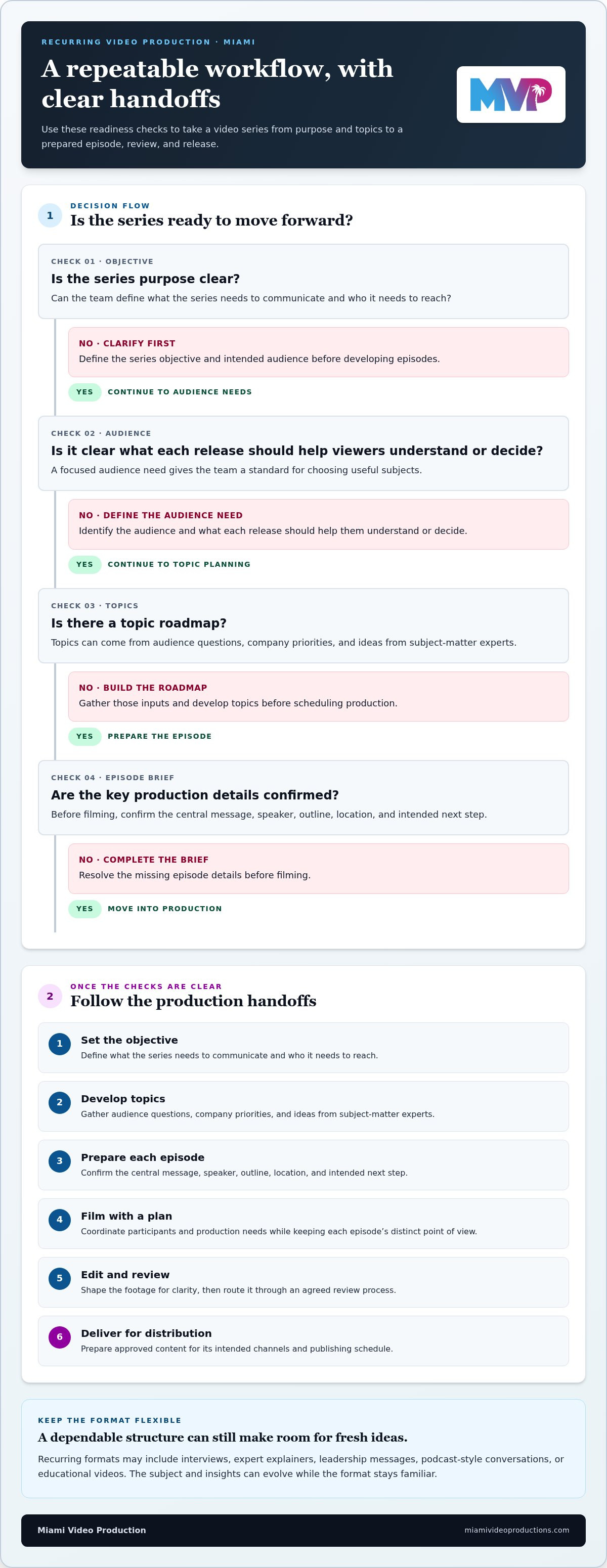
A repeatable workflow can follow this sequence:
- Set the objective. Define what the series needs to communicate and who it needs to reach.
- Develop topics. Gather audience questions, company priorities, and ideas from subject-matter experts.
- Prepare each episode. Confirm the central message, speaker, outline, location, and intended next step.
- Film with a plan. Coordinate participants and production needs while keeping each episode’s distinct point of view.
- Edit and review. Shape the footage for clarity, then route it through an agreed review process.
- Deliver for distribution. Prepare the approved content for its intended channels and publishing schedule.
This sequence doesn’t require every episode to be identical. It gives the team a dependable structure, while leaving room to adjust the subject, guest, or creative approach to suit the story. A thoughtful content strategy can provide additional context for thinking about video as an ongoing practice rather than a collection of isolated deliverables.
Plan episodes before scheduling production
Start with a topic roadmap, then give each planned episode a brief that identifies its goal, audience, key message, and intended next step. A practical review process also names who contributes expertise, who approves the message, and when feedback is due. Resolving these editorial questions before filming helps participants arrive prepared and keeps late changes from redirecting the episode.
Advance planning also makes it easier to group related production needs. If several episodes draw on the same team or subject area, their preparation can be coordinated together. The schedule should still allow each video enough attention to develop its own point and maintain editorial quality. A video growth strategy consulting roadmap can help connect topic selection and production priorities to a broader business strategy.
Make production and distribution repeatable
Clear roles reduce avoidable coordination: contributors know what to prepare, reviewers understand their part, and production planning can account for local participants and locations. Editing and approvals should be considered alongside the planned release, not left as an afterthought. That way, the finished video is shaped for where and how the organization intends to use it.
Recurring production works best as one connected workflow, from editorial planning through filming, review, and distribution. If your team is shaping an ongoing series, a conversation with Miami Video Production can help map a content-series roadmap around your organization’s goals and production needs.
Choosing recurring video formats and cadence for your Miami business
The right format is the one your audience will value and your organization can support consistently. A polished concept can still become hard to sustain if every episode requires a new location, several contributors, or extensive preparation. For recurring video content production miami, weigh the communication goal alongside the people, review time, and distribution channels available to the team.
Consider how common formats serve different needs:
- Interviews bring expertise and stakeholder perspectives into the conversation. They work well when the subject benefits from dialogue, though coordinating guests and schedules adds planning needs.
- Expert explainers let a knowledgeable speaker clarify a focused question. They suit audience education and can be organized around related topics, provided each episode has a distinct message.
- Podcast-style episodes create room for a continuing conversation among hosts or guests. They fit subjects that unfold through discussion; a podcast marketing strategy for Miami can help connect that format to its audience and distribution purpose.
- Training content supports repeatable instruction for employees or customers. Clear sequencing and consistent terminology matter, especially when viewers need to follow a process.
- Leadership updates give executives a direct format for communicating priorities, organizational changes, or perspective. A defined editorial focus helps keep updates useful rather than overly broad.
These formats aren’t mutually exclusive, but a series should have a clear organizing idea. A company might choose expert explainers as its central format, for instance, and occasionally include an interview when a topic benefits from another perspective. The choice should reflect audience expectations, internal expertise, production complexity, and where viewers will encounter the videos.
Which recurring video format fits your communication goal?
Begin with the job each episode needs to do. If it should convey several viewpoints, an interview may feel natural. If the priority is clarity, an explainer or training video can keep attention on one idea or instruction. If the subject benefits from an ongoing exchange, a podcast-style episode can provide conversational depth. Leadership updates are most effective when the audience needs a direct organizational perspective. Let the communication need guide the format, not the other way around.
How often should a business publish a video series?
There’s no universal publishing frequency that suits every organization. Choose a rhythm your team can maintain across topic development, participant availability, filming, review, and distribution. A cadence that looks ambitious on paper may falter if subject-matter experts have limited time or approvals routinely compete with other priorities.
Before setting the schedule, consider how often the audience needs useful information, who can contribute, how much review each episode requires, and what the distribution plan can support. Then choose a practical starting rhythm and assess whether the process remains manageable as the series develops. Consistency earns trust when it pairs a dependable release pattern with content worth returning for.
Building a sustainable recurring video plan across South Florida
A content calendar should connect business priorities to a production plan your team can actually maintain. Start with a small set of themes tied to what the organization needs to communicate, then map potential episodes against those themes. Leave room for timely updates, so a useful new development doesn’t have to wait for the next fixed topic cycle.
For each planned episode, record its working topic, intended audience, subject-matter contributor, approval owner, and publishing status. These details make handoffs clearer and reveal practical constraints early. A calendar for recurring video content production miami should be more than a list of release dates: it should show who needs to contribute, what decisions are pending, and how each episode supports the broader communication plan.
Create a content calendar your team can maintain
Group related ideas into themes, but don’t lock every episode before the series begins. A customer-education series, for example, might cover core questions while leaving space for a new service update or a recurring question from the audience. Assign responsibility for subject-matter input, message approval, and publishing, and set clear review points so feedback doesn’t arrive from multiple stakeholders without an owner.
Revisit the calendar regularly. Remove topics that no longer serve the audience, add emerging priorities, and flag episodes that depend on a particular leader or specialist. This keeps the plan useful rather than turning it into a rigid production checklist.
Adapt production planning to South Florida logistics
Local coordination starts with the practical details of each episode. A Miami office interview, a leadership message at another South Florida location, and a training video may involve different participants, spaces, and production requirements. Consider location access, travel between sites, participant schedules, and the intended use of the finished video while shaping the plan. Specific arrangements should follow the needs of the project, rather than an assumed one-size-fits-all setup.
Keep stakeholders and production partners aligned on schedule expectations, responsibilities, and review windows. If several episodes involve the same contributors or location, coordinate those needs where it makes sense, while preserving the preparation and attention each episode requires. Build flexibility into the calendar for business priorities that shift or participants whose availability changes.
Measurement can help refine the series. Choose indicators that reflect its purpose, such as whether viewers complete an episode, how they engage with it, whether employees use training content, or whether qualified inquiries reference the material. Interpret those signals in context, then use them to guide future topics, formats, or distribution choices. They can inform better decisions, but they don’t guarantee a particular business result.
For a plan that connects your priorities, calendar, and South Florida production needs, discuss a content-series roadmap with Miami Video Production.
Partner with Miami Video Production for recurring video content
A recurring series needs more than production capacity. It needs a partner who can help connect the editorial idea to the organization’s goals, shape a workable format, and carry the plan through production and distribution. Miami Video Production works with South Florida organizations on content series and video growth strategy, bringing strategic planning and professional production into the same conversation.
That partnership begins by understanding what the organization needs its videos to do. A series may be designed to explain a complex service, share leadership perspectives, support employee learning, or create a continuing conversation with customers. The audience, message, format, production needs, and intended channels all influence the roadmap. Aligning these decisions early helps the team build a series around its real communication priorities rather than defaulting to a generic package or an arbitrary release schedule.
A recurring series can also sit alongside other brand storytelling. If the organization needs a larger narrative to introduce its mission, identity, or point of view, cinematic corporate brand films may complement the ongoing episodes. The two forms serve different roles: one can establish a broader brand story, while the series continues to address specific audience interests over time.
What to bring to a recurring video planning conversation
You don’t need a finished creative brief to start. Bring a clear sense of who the organization wants to reach, what it needs to communicate, and which questions or themes could sustain a series. It also helps to identify internal experts, existing channels, and the people who will review and approve episodes.
Consider how each video should be used after production. The intended audience and distribution channels can shape the format and editorial approach. Sharing these priorities gives the planning conversation a practical foundation, even if the series concept is still taking shape.
Turn the series idea into a clear next step
The first planning decisions are straightforward: clarify the purpose, define the audience, select a suitable format, establish a sustainable cadence, and identify where each episode will be distributed. From there, production needs and review responsibilities can be shaped around the organization’s team and goals. The result should be a tailored roadmap, not a one-size-fits-all package.
For organizations exploring recurring video content production miami, a strategic partnership can connect those decisions into one manageable plan. Discuss a recurring video content plan with Miami Video Production and start shaping a series around your audience, communication goals, and production needs.
Give your next video series a clear starting point
The next step isn’t committing to an endless stream of videos. It’s choosing one meaningful audience need and shaping a series direction your organization can sustain. That first decision can help turn recurring video content production miami from an open-ended ambition into a purposeful communication initiative, with room to refine the approach as your priorities evolve.
Bring your ideas, questions, and business objectives into a planning conversation. Together, you can clarify what the series should accomplish and define a path that fits your organization, rather than forcing your goals into a predetermined formula. A thoughtful roadmap gives your team a practical foundation for moving from concept to production with confidence.
Discuss a recurring video content plan with Miami Video Production and take the first step toward a series built around your organization’s purpose. Your next conversation can be the beginning of a more intentional way to share your story.
Frequently Asked Questions
What is recurring video content production?
Recurring video content production is the planned development of related videos that return to a shared subject or communication goal over time. For example, a company could create a series that answers different questions about a new service, with each episode addressing one specific concern. A useful planning tool is an editorial record that tracks topics already covered, approved messages, and questions still to address, helping the series stay fresh and coherent.
How often should a business publish recurring video content?
Publish at a pace your organization can maintain without rushing preparation or review. If key experts are only available at certain times, build the release plan around their schedules and prepare topics ahead of production. After the first releases, compare the actual workload with the original plan: note where approvals slowed, contributors needed more preparation, or publishing felt rushed. Adjust the cadence to protect quality and keep the series useful.
Can one video shoot create content for multiple channels?
One production session can be planned with several intended uses in mind, but each deliverable should be scoped around its message and destination. A leadership conversation, for instance, might be designed for a company website and an internal update, with different edits serving each audience. Decide those uses before filming so the creative approach accounts for framing, context, and any details that should remain specific to one channel.
What types of recurring videos work well for businesses?
Effective formats include expert conversations, customer-question explainers, leadership messages, podcast discussions, and instructional videos. Rather than choosing by trend, consider the viewer’s task: someone preparing for a purchase may need clear answers, while an employee learning a process may need a carefully sequenced explanation. A format is easier to sustain when the organization has access to credible contributors and enough distinct subject matter to keep future episodes valuable.
How do you measure whether a recurring video series is working?
Measure the series against its intended purpose, not views alone. For a customer-education series, review whether viewers complete episodes and whether customer-facing teams find the videos useful in conversations. For internal learning, consider whether employees use the material as intended and where they still need guidance. Compare patterns across releases, and gather feedback from relevant teams. These signals can inform future editorial choices, but they don’t prove video alone caused an outcome.
Is a recurring video series only for social media?
No. A video series can also support a company website, sales conversations, employee learning, or leadership communication. For example, a sales team might use an approved explainer to introduce a complex topic before a meeting, while an internal team uses training content to reinforce a process. Decide who will use each episode and in what context, then shape its message and distribution accordingly. Social channels are one possible destination, not the only one.
How can Miami Video Production support a recurring video series?
Miami Video Production can support organizations with podcast and content series production and video growth strategy consulting. Planning can connect the series concept to the audience, communication goal, and production approach. The company serves organizations in Miami, Broward, West Palm Beach, Fort Lauderdale, North Miami, Fort Myers, and Naples. For recurring video content production miami, a discussion can help your team outline a content-series roadmap tailored to its priorities and intended use.
