
South Florida Thought Leadership Video Series: A Strategic Buying Guide
An executive interview isn’t a thought leadership strategy. A successful South Florida thought leadership video series is an editorial system: each episode offers a useful perspective, builds on the last, and gives your audience a reason to return. That distinction matters when executive time is limited and each production needs to support a business goal.
Start by identifying whose questions the series will answer and what those viewers should understand after watching. Then choose a format your experts can sustain, such as a focused interview, a host-led explanation, or a roundtable when several perspectives add real value. A clear plan also helps you coordinate busy schedules, prepare speakers, and make review more efficient. This guide walks through how to shape the concept, assess production needs, and plan episodes that work together. From Miami and Broward to Fort Lauderdale, West Palm Beach, North Miami, Fort Myers, and Naples, the goal is a polished, consistent business asset, not simply a collection of videos.
Key Takeaways
- Set a clear audience promise so each episode contributes to an editorial series, not just a collection of executive interviews.
- Use a buyer checklist that weighs strategic planning, production consistency, and distribution readiness alongside visual quality.
- Compare interview, host-led, roundtable, and event-derived formats to find the right balance of expertise, preparation, and repeatability.
- Build your south florida thought leadership video series around audience questions, focused editorial pillars, and a review process that keeps future episodes relevant.
- Use collaborative planning, filming, and editing to turn your series direction into a polished, consistent communication asset.
What a South Florida Thought Leadership Video Series Should Accomplish
A south florida thought leadership video series is recurring, video-first programming built around expert insight and a consistent promise to a defined audience. Each episode answers a relevant question or explores a useful idea, while the series as a whole gives viewers a clear reason to return. For background on the concept behind the format, see What is a Thought Leader?
The distinction is editorial, not just technical. A keynote is a single presentation; an event recording captures a particular occasion; and a corporate brand film typically introduces an organization, its purpose, or its work. A series, by contrast, is planned as repeatable programming. Its episodes connect through a shared audience, subject area, and point of view, even when each installment addresses a different question.
That structure lets an organization put expertise to work across several communication goals:
- Customer education: Explain complex topics, answer recurring questions, and give customers a clearer basis for decisions. For example, an episode can take one frequently asked question and explain the decision factors in plain language.
- Reputation: Demonstrate the organization’s perspective through useful, well-supported commentary rather than relying only on claims about its expertise.
- Internal communication: Share leadership context, specialist knowledge, or strategic priorities with employees in a format that can be revisited.
The strongest concept starts with what the audience needs to understand, not with a list of executives available to appear on camera. Write the audience promise in one sentence, then test each proposed episode against it: does the topic answer a real question, and does the speaker have relevant experience? That simple filter helps each episode earn its place and keeps the content aligned with the organization’s communication priorities.
How a video series differs from a thought leader event
A thought leader event brings people together for a moment; a video series turns expertise into planned, repeatable programming. The University of South Florida’s speaker-series example illustrates the value of gathering an audience to hear prominent business figures share practical insights. A corporate series has a different job: translate that kind of expertise into episodes shaped for a defined audience and an ongoing editorial purpose.
Event footage can still complement the series. A strong audience question, panel exchange, or keynote excerpt may provide context or a useful supporting clip. But event coverage shouldn’t have to carry the full editorial burden. Purpose-built episodes let the organization focus on a specific question, build a coherent explanation, and shape the conversation for its intended viewers.
Who should lead a corporate series?
Choose the voice that best matches the audience’s questions and the organization’s goals. An executive host can connect topics to strategy and leadership perspective. An internal subject-matter expert can offer depth on technical or operational issues. An invited industry voice can broaden the discussion with an outside perspective. The right choice may vary by episode, provided the series retains a clear editorial identity.
A confident host can make the format feel natural without scripting every insight. Prepare a concise brief with the episode’s purpose, key questions, essential context, and the takeaway viewers should remember. Then leave room for the speaker’s judgment and experience. This balance supports a focused conversation that sounds informed, not over-rehearsed.
How to Evaluate a South Florida Thought Leadership Video Series Partner
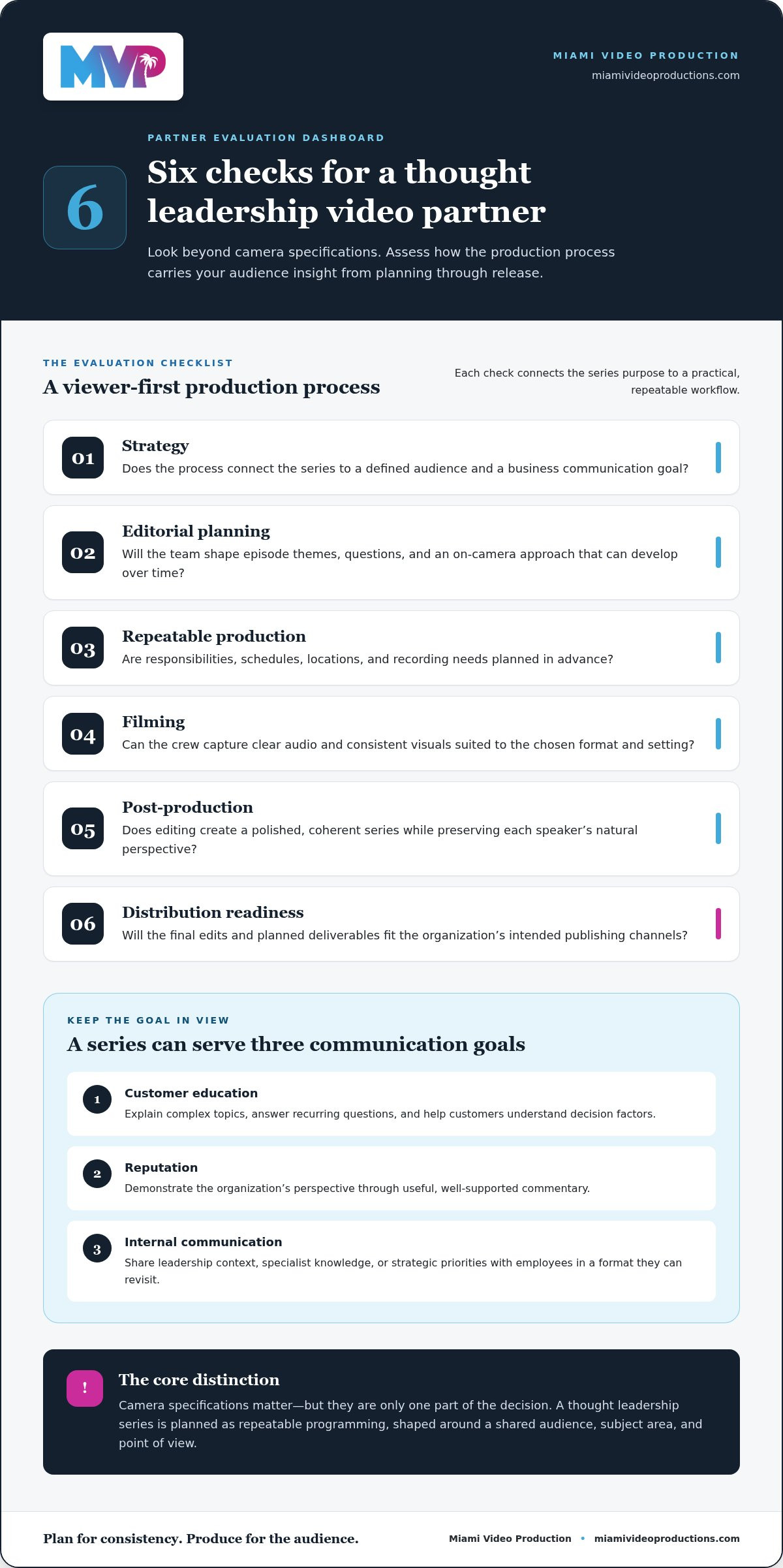
A production partner should help make a series clear in purpose, coherent in style, and practical to sustain. Camera specifications matter, but they’re only one part of the decision. For a south florida thought leadership video series, assess how the production process connects audience insight to editorial planning, filming, post-production, and the way finished episodes will be prepared for release.
Use this checklist to guide your evaluation:
- Strategy: Does the process connect the series to a defined audience and business communication goal?
- Editorial planning: Will the team help shape episode themes, questions, and an on-camera approach that can develop over time?
- Repeatable production: Are responsibilities, schedules, locations, and recording needs planned in advance?
- Filming: Can the crew capture clear audio and consistent visuals suited to the chosen format and setting?
- Post-production: Does editing support a polished, coherent series while preserving each speaker’s natural perspective?
- Distribution readiness: Will the final edits and planned deliverables fit the organization’s intended publishing channels?
This framework keeps attention on the viewer’s experience and the production workflow, not just equipment lists. For a broader view of what to consider in a production relationship, consult this Miami video production hiring guide.
What a production partner should contribute before filming
Strong pre-production begins by clarifying the series purpose, audience, episode themes, and the best on-camera approach. From there, planning can establish who provides subject expertise, who shapes the questions, how executive availability is coordinated, and what each recording requires. Ask how the team will prepare speakers and organize review, too. These decisions reduce uncertainty before filming and give internal stakeholders a shared understanding of the work.
A defined creative direction creates continuity without making every episode feel interchangeable. The series might share a visual style and conversational rhythm while allowing a Miami executive interview to feel different from a Broward-based expert discussion. The goal is a recognizable editorial identity, with enough flexibility for the subject and speaker to lead.
How to assess production quality and workflow
Listen closely to sample work: voices should be easy to understand, visuals should feel considered, and edits should make ideas flow without flattening a speaker’s personality. Ask how filming is planned and how post-production turns recorded conversations into finished episodes. Miami Video Production brings pre-production planning, professional filming crews, and editing together, supporting the series from its initial direction through the polished final cut.
Before moving forward, make sure the workflow gives your team clarity on preparation, recording, review, and release. If you’re shaping a series and want production support aligned with its goals, explore video production support.
Which Thought Leadership Video Format Fits Your Goals?
The right format makes expert insight easier to understand and practical to produce repeatedly. A focused interview may be easier to sustain than a roundtable with several busy contributors, while a host-led explainer may better serve audiences who need a complex idea unpacked step by step. Choose based on the question each episode should answer, who can answer it well, and what your team can consistently support. If the format is difficult to repeat with available speakers and schedules, simplify it before building the calendar. A broader video growth strategy roadmap can help connect format decisions to a wider content plan.
| Format | Expertise showcased | Preparation needs | Audience interaction | Repeatability |
|---|---|---|---|---|
| Interview | A guest’s experience or a focused exchange between experts | Guest research, thoughtful questions, and a clear episode angle | Indirect, shaped by the conversation and viewer questions | Strong when the guest pipeline and interview structure are manageable |
| Host-led explainer | An internal expert’s ability to clarify a subject | Topic outline, key points, and a host comfortable explaining on camera | Mostly indirect, with audience questions informing future topics | Strong when the organization has recurring questions and accessible experts |
| Roundtable | Complementary viewpoints across specialists or industry voices | Participant coordination, a shared topic, and a moderator’s questions | Conversational, with differing perspectives creating engagement | Moderate, since several schedules and viewpoints must align |
| Event-derived episode | Speakers or ideas drawn from a conference or live session | Event coordination plus editorial planning for later viewing | Live audience participation may inform the recorded material | Depends on event cadence and the ability to shape footage into episodes |
A sustainable series doesn’t need to rotate through every format. A south florida thought leadership video series can begin with one repeatable approach, then introduce another when it serves a distinct audience need. For example, use interviews for individual expertise and reserve a roundtable for a topic that genuinely benefits from contrasting views. Keep the production commitment tied to a clear editorial purpose rather than adding complexity for variety’s sake.
Interview, host-led, and roundtable episodes
Use an interview when a guest’s specific experience or a focused exchange carries the story. Choose a host-led explainer when your experts need to make a complex process or idea clear for customers. A roundtable earns its place when several perspectives genuinely deepen the answer, rather than simply adding more speakers. In each format, preparation should clarify the central question while leaving room for natural expertise.
When a live event can support the series
A conference session can introduce a speaker or surface questions that inspire later, purpose-built episodes. It doesn’t automatically deliver the planned pacing, framing, or audience focus of a standalone series. Treat event livestreaming and series production as related but distinct needs: livestreaming serves a live occasion, while series production shapes material for a deliberate viewing experience. For event capture, this broadcast-quality livestreaming guide offers relevant planning context.
Plan a Repeatable Video Series from Editorial Brief to Release
A reliable series workflow turns audience needs and organizational expertise into episodes your team can plan, produce, and publish without reinventing the process each time. For a south florida thought leadership video series, the schedule and production scope should reflect executive availability as well as the content priorities the series is meant to serve.
A repeatable video-series workflow defines the audience, establishes editorial pillars, maps episodes, produces the content, and reviews each release to guide what comes next. Use these five steps to create a practical path from brief to publication:
- Define the audience. Identify who the series should serve and what they need to understand, decide, or do. Use customer questions, sales conversations, and internal expertise to make the audience specific.
- Set editorial pillars. Choose a small set of connected themes that reflect the organization’s knowledge and audience priorities. Each pillar should support multiple useful discussions, not just one episode.
- Map episodes. Give every proposed episode a distinct audience question, a suitable speaker, and a clear intended takeaway. Order topics so the series develops naturally rather than repeating the same point.
- Produce. Confirm speakers, preparation materials, recording needs, and review responsibilities. Match the production plan to realistic executive schedules and the scope of the content.
- Review. Gather input after release, noting which questions remain unanswered, which themes deserve another perspective, and what adjustments could make the next episode clearer.
Build an editorial plan executives can sustain
Start with questions people are already asking, then match each one to the leader or specialist best equipped to answer it. An editorial calendar can record the pillar, audience question, speaker, takeaway, and current status for each episode. Add a planned review owner and note any preparation needed. This structure helps teams spot gaps, coordinate work, and avoid booking executives for topics that don’t support the series priorities.
Plan recording around actual availability rather than an idealized publishing rhythm. A focused set of prepared episodes may fit a demanding leadership calendar better than frequent sessions. The right cadence is the one your organization can sustain while preserving enough time for useful preparation and thoughtful review.
Create a consistent production and distribution workflow
Assign ownership for speaker preparation, recording coordination, editing, review, and release. Clear responsibilities help prevent avoidable delays, especially when executives, communications teams, and subject experts all contribute. Editing should preserve the substance of each conversation while giving the series a consistent finish, and review should include a clear process for consolidating feedback. A single reviewer who collects comments can help keep edits focused and avoid conflicting notes.
Consider how each finished episode will serve relevant owned and social channels. Adapt the presentation and supporting copy to the channel while keeping the central message intact. For related guidance on planning and producing recurring content, explore this video content series production guide.
With strategy, planning, filming, and editing aligned, each release can contribute to a cohesive body of communication. Develop your video series with Miami Video Production.
Develop Your South Florida Thought Leadership Video Series with Miami Video Production
A strong series needs more than a promising topic and a camera. It needs a clear connection between what your audience wants to know, what your organization can credibly explain, and how each episode will be brought to life. Miami Video Production works with organizations across South Florida to shape that direction and carry it through planning, filming, and editing.
For a south florida thought leadership video series, begin with the communication goal. Is the series intended to educate customers, share leadership perspective, or make internal expertise more accessible? Clarifying the goal helps guide the audience, editorial focus, episode approach, and production needs. Video strategy consulting can align these choices with broader business and marketing objectives, so the series has a defined role beyond simply filling a publishing calendar.
What a collaborative production engagement can cover
Pre-production connects the strategy to a workable recording plan. Together, the team can clarify the intended audience, develop the series direction, identify episode themes, and determine which speakers are best placed to address them. Planning also helps coordinate preparation, responsibilities, schedules, and recording requirements before filming begins.
Professional filming crews and post-production editing then carry the concept through to finished episodes. These stages work together: thoughtful preparation gives filming a clear purpose, while attentive editing helps each episode feel polished and connected to the larger series. Miami Video Production’s podcast and content series services support recurring, speaker-led programming where consistency matters across multiple releases.
The approach can be tailored to organizations in Miami, Broward, Fort Lauderdale, West Palm Beach, North Miami, Fort Myers, and Naples. A series might feature an executive discussing a business priority, a specialist answering a customer question, or several voices exploring a topic from distinct perspectives. The central consideration is that the creative direction and production plan support the series’ goals and the people contributing to it.
Prepare to move from idea to production conversation
You don’t need a finished concept or a complete episode calendar to begin. A few practical inputs can make the first discussion more focused and productive:
- Audience needs: Who should the series serve, and what questions or challenges should it address?
- Business priorities: What should the series contribute to your marketing or communications?
- Potential speakers: Which executives or subject-matter experts have useful experience to share?
- Early topic ideas: What themes could support several distinct episodes?
- Distribution preferences: Which owned or social channels are relevant to your organization?
These starting points give the conversation direction while leaving room to refine the format, editorial plan, and production scope together. If you’re ready to explore an idea or discuss next steps, start a conversation about your video series.
Turn Your First Series Idea into a Clear Next Step
Your next move doesn’t need to be a full production calendar. Start with one audience question your organization is equipped to answer, then decide what a viewer should take away and which voice can make that insight clear. That first episode can help bring the larger direction of your south florida thought leadership video series into focus.
Miami Video Production can help develop that starting point into a series concept shaped around your communication priorities. A conversation can explore the audience, potential speakers, creative direction, and practical next steps, giving your team a clearer path from expertise to meaningful content.
Bring the idea as it stands, whether it’s a single topic, a recurring customer question, or a broader ambition to share your organization’s perspective. You don’t need every detail resolved to begin. Discuss your video series concept and take the next step toward making it real.
Frequently Asked Questions
How do you start a thought leadership video series for a business?
Start by identifying one audience and a question your organization can answer credibly. Then choose a speaker, decide what viewers should take away, and test the concept with a focused pilot before committing to a larger slate. For a south florida thought leadership video series, consider whether the subject matters to customers, employees, or partners across communities such as Miami, Broward, and West Palm Beach. A clear initial focus makes planning more manageable.
What is the difference between a thought leadership video series and a podcast?
A thought leadership video series is defined by its editorial purpose, while a podcast is generally organized around an audio listening experience. The two can overlap: an interview recorded on video may also work as a podcast episode if the conversation is clear without visuals. Consider how the audience will consume each piece. Demonstrations, visual examples, or on-screen context may favor video; an audio-first conversation should remain understandable without them.
How long should a thought leadership video episode be?
There’s no single ideal runtime. Let the question determine the length: a focused answer may need little setup, while a nuanced discussion may require more context. During editing, remove repeated points and background viewers don’t need, but keep enough explanation to make the insight useful. Review audience retention alongside comments and feedback after release. If viewers regularly leave before the key takeaway, consider tightening the structure or moving the main point earlier.
How many episodes should a business plan for its first video series?
Plan enough episodes to test whether the concept, format, and speaker commitment are workable, but avoid setting a large season target before the workflow is proven. A short pilot slate can cover distinct questions within the same subject area and reveal where planning or approvals slow down. Before scheduling, confirm the speakers’ availability and the team’s capacity to edit and release each episode. Use what you learn to shape the next phase.
Can executives record a thought leadership series remotely?
Yes, remote recording can work for interviews or explainers if the setting and technical setup are planned carefully. Choose a quiet room, use a stable internet connection, position the camera at eye level, and check lighting and audio before recording. For multiple speakers, agree on the platform and recording process in advance. Remote capture can simplify scheduling across South Florida, including teams based in Fort Lauderdale, North Miami, Fort Myers, or Naples.
How can a business measure whether its thought leadership video series is working?
Choose measures that reflect the series’ purpose, then review them consistently. For customer education, look at viewing behavior and questions that arise after an episode. For reputation or marketing goals, track relevant engagement, visits to related pages, and inquiries, while recognizing that a video alone may not explain a business outcome. Compare episodes by topic and audience response, and use the pattern to decide what to clarify, develop, or change next.
What should executives do to prepare for an on-camera interview?
Executives should understand the audience, the episode’s central question, and the key points they want viewers to remember. Prepare a few concise examples or supporting details, but don’t memorize full answers; a conversation usually feels more natural when the speaker responds in their own words. Set aside time to review the topic and settle into the recording environment. During the interview, pause between thoughts and ask for a question to be repeated if needed.
