
Reliable Event Streaming in Fort Lauderdale: A Buyer’s Guide
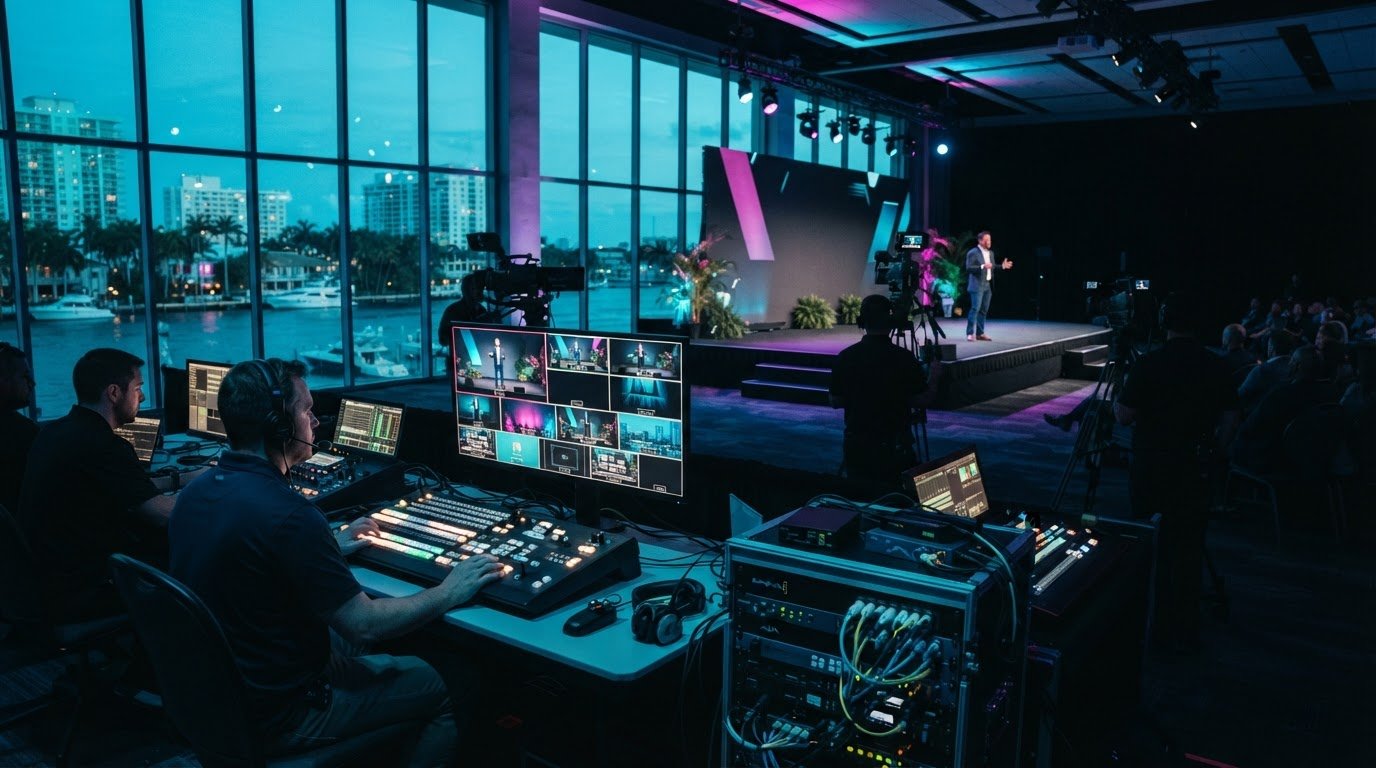
A live event can be meticulously planned and still lose momentum if the broadcast falters. A search for reliable event streaming fort lauderdale should lead to more than a camera count: it should reveal how the production team plans for the venue, coordinates the program, and manages technical risks before the audience goes live.
That concern is reasonable. Venue connectivity, production requirements, and remote viewers’ needs can be difficult to assess, especially when an important corporate event is at stake. Professional support brings technical direction, multi-camera switching, and real-time encoding together in a coordinated workflow designed around the event.
This guide explains how to evaluate livestream reliability, plan for common technical risks, and assess the production approach that fits your venue and audience. You’ll learn what a well-coordinated broadcast plan should cover, so you can make a confident choice and protect the live experience from planning through execution.
Key Takeaways
- Assess reliable event streaming fort lauderdale by looking beyond camera count to planning, technical direction, camera switching, encoding, and venue coordination.
- Match the production plan to the run of show, event format, speakers, room layout, and needs of your in-person and remote audiences.
- Share the event agenda, venue details, and audience requirements early so production decisions can be shaped around the actual event.
- Understand how coordinated production roles help manage cues and maintain a polished broadcast throughout the program.
What Makes Event Streaming Reliable in Fort Lauderdale?
A dependable livestream is the result of coordinated production decisions, not simply a camera connected to the internet. Reliable event streaming is a planned live production that delivers consistent audio and video, a controlled program, and an accessible viewing experience for its intended audience. For a foundational overview of what live streaming is, it helps to distinguish transmitting video from planning a polished event.
A corporate broadcast may need to move between speakers, presentation slides, and audience moments while keeping remote viewers oriented. A one-camera setup may suit a straightforward talk, but it can be limiting when the event includes multiple speakers, a panel discussion, or a detailed run of show. Production choices should reflect what viewers need to see and hear, and how the program is expected to unfold.
Internet speed matters, but it isn’t the whole measure of reliability. Clear audio, camera coverage, coordinated cues, encoding, and a usable viewing destination all contribute to the experience. A strong connection cannot compensate for unclear sound or missed transitions. Likewise, polished camera work won’t reach viewers if signal delivery is unstable.
What should a dependable event stream deliver?
Viewers should be able to follow the program without avoidable audio distractions, confusing camera changes, or difficulty accessing the stream. That takes coordination among the event plan, production team, and technical setup. Reliability is not an absolute promise that no disruption can occur. It means risks are considered in advance and the live program is actively managed.
- Consistent presentation: Audio and video support the speakers and content.
- Controlled direction: Camera changes and program cues follow the event flow.
- Audience access: The viewing experience is planned for the people expected to watch.
Why does Fort Lauderdale venue planning matter?
Every venue has its own room layout, access arrangements, schedule, and connectivity conditions. Those details affect camera positions, cable routes, setup timing, and the streaming workflow. Assess them for the specific event rather than assuming another location will offer the same conditions. Early coordination helps align venue access and technical requirements before event day, when changes can put pressure on the production schedule.
For reliable event streaming fort lauderdale, share the room plan, event schedule, and audience needs during production planning. Include practical details such as where the speakers and screens will be, when the production team can enter the room, and what is known about the venue’s internet connection. This gives the team a clearer basis for shaping camera coverage, technical direction, and signal delivery around the actual venue and program.
How Professional Event Streaming Protects the Live Experience
A live broadcast is shaped before the first camera goes on. Pre-production turns the event’s run of show into practical decisions: which moments need close coverage, how speakers and presentations will be heard and seen, and how the program will reach its online audience. For a panel, for example, the plan may account for speaker changes and audience questions. A keynote may call for a different sequence of shots and presentation cues.
This planning gives the production team a shared blueprint and helps surface dependencies early. A speaker may need to be ready for a camera change, or the show flow may include a video or slide transition. Miami Video Production builds event streaming around the client’s program, with technical direction, multi-camera switching, and real-time encoding working as parts of one production approach.
How do technical direction and switching work together?
Technical direction coordinates the live program. The director follows the run of show, communicates cues, and guides the timing of camera changes as speakers and segments progress. Camera switching selects which camera feed viewers see, such as moving from a wide view of a panel to a speaker’s close-up. Multiple cameras add options, but clear cues and purposeful choices are what make the coverage feel coherent rather than distracting.
That coordination matters during transitions. If a speaker takes the floor unexpectedly or a segment runs differently than planned, the production team needs to respond while maintaining the program’s flow. A thoughtful approach keeps attention on the event, not on the mechanics of the broadcast.
What role do encoding and signal checks play?
Encoding prepares the live video signal for delivery online, translating the production feed into a format a viewing platform can carry. Before the broadcast begins, reviewing the signal path and stream helps the team assess whether the picture and sound are reaching the intended destination as expected. These checks connect the production setup to the audience experience, rather than treating the camera feed as the finished product.
Encoding prepares the picture for online delivery, while signal checks help review the path from production to viewer before the program goes live. No process can remove every possible disruption, but advance planning and active technical direction give the team a clear basis for managing the broadcast. For a broader look at planning high-stakes productions, explore this broadcast-quality livestreaming strategic guide.
A plan for reliable event streaming fort lauderdale should connect production choices to the specific event, not rely on equipment alone. To learn more about event streaming production, review how Miami Video Production brings planning and live execution together.
How to Compare Event Streaming Support in Fort Lauderdale
A professional livestream is more than placing a camera in the room and pressing broadcast. To compare production approaches, look at how the work is planned and coordinated, and whether it serves your event goals and audience. A list of equipment alone won’t show how speakers, presentations, venue needs, and the viewing experience fit together.
Use these criteria to assess the production plan. Miami Video Production’s event streaming brings production planning, technical direction, multi-camera switching, and real-time encoding together, shaped around the client’s event.
| Capability | What it supports | What to look for in the plan |
|---|---|---|
| Production planning | Aligns coverage with event goals and program flow. | Camera, audio, and stream decisions reflect the run of show. |
| Technical direction | Coordinates cues and live program transitions. | Speakers, segments, and production cues have a coordinated flow. |
| Camera switching | Guides viewers through the event visually. | Camera changes serve the moment, such as shifting focus from a panel to the active speaker. |
| Real-time encoding | Prepares the live production signal for online delivery. | The encoding process is part of the production workflow, not an afterthought. |
| Venue coordination | Connects production decisions to the event location. | The plan accounts for the room, access, schedule, and venue-specific requirements. |
Which production capabilities should matter most?
Prioritize the capabilities that address your event’s demands. A keynote with slides calls for a plan that keeps both the speaker and presentation legible to remote viewers. A panel needs deliberate camera coverage and direction that follows the conversation. Miami Video Production’s coordinated approach connects these needs to switching and encoding, rather than treating each technical element as a separate checklist item. When reviewing a plan, check that it explains how the run of show informs camera, audio, and streaming decisions.
How should the plan fit your audience and format?
Consider who is in the room, who will watch remotely, and what each group needs from the program. An in-room audience experiences the event directly, while remote viewers rely on camera framing, clear program flow, and access to the stream. A hybrid format has to account for both. Speaker transitions, presentations, audience interaction, and the intended viewing platform all influence production decisions. For conference-specific considerations, see this conference livestreaming reliability checklist.
For reliable event streaming fort lauderdale, compare how the complete plan supports your venue, event format, and audience, not simply how many cameras are included. Explore event streaming production to see how Miami Video Production approaches coordinated live coverage.
How to Prepare a Fort Lauderdale Venue for a Dependable Livestream
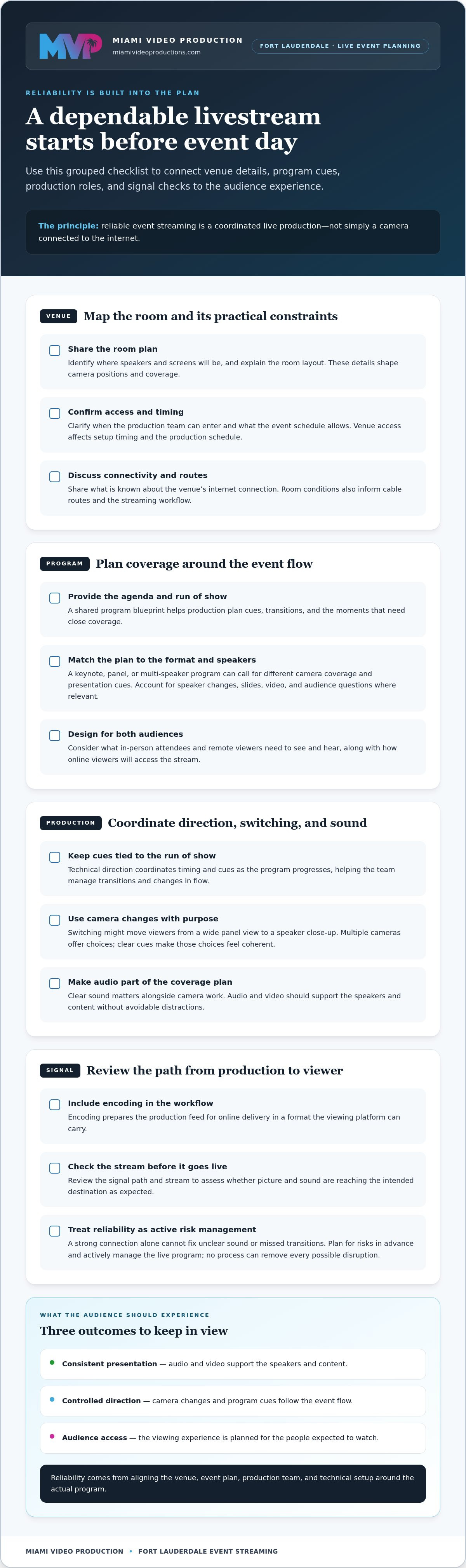
Venue readiness starts with the event plan, not with equipment arriving on site. Early coordination gives the production team time to understand the room, schedule, speakers, and online audience, then shape technical decisions around those needs. For Fort Lauderdale and Broward events, discuss venue access and connectivity as event-specific requirements rather than assuming the conditions.
What information should event organizers share?
Start with the details that explain how the event should look and flow. A complete brief helps align production roles with the venue and the intended viewing experience. Share:
- Event agenda and run of show: Include segment order, transitions, presentations, and planned audience interaction.
- Venue information: Provide the room layout, event location, access arrangements, and available details about connectivity.
- Speaker sequence: Identify speakers, panelists, and any planned changes in who is presenting.
- Audience format: Explain whether the program serves an in-room audience, remote viewers, or both, and how people will access the stream.
These details help determine camera positions, audio needs, technical cues, and production timing. They also support practical coordination with the venue before event day. Connectivity and access conditions can differ by location, so planning should be based on the specific Fort Lauderdale venue instead of a general assumption. For further insight into how production roles and cues work together, read this technical direction for live events guide.
What happens during pre-event checks?
Pre-event checks put the planned workflow into practice. The team reviews the production setup, camera views, audio, encoding, and the viewer-facing stream. The run of show guides the review of cues, including speaker changes and planned transitions, so production decisions align with the program. Venue access and the intended signal path are considered as part of preparing the event, not left as day-of assumptions.
A pre-event technical check aligns the production setup with the run of show and reviews the path from live program to viewer before broadcast. It helps the team identify issues while there is still an opportunity to address them and gives everyone a shared reference for execution.
For reliable event streaming fort lauderdale, prepare the event brief, venue details, and audience requirements early. Plan your Fort Lauderdale event stream with production decisions shaped around your venue and program.
Plan Your Fort Lauderdale Event Stream With Miami Video Production
A successful event stream starts with a production approach built around the event, not a one-size-fits-all package. Miami Video Production creates broadcast-quality livestreams for events in South Florida, including Fort Lauderdale and Broward. Production planning, technical direction, multi-camera switching, and real-time encoding are coordinated to support the program and the people watching it.
That means decisions connect to your event’s goals: what remote viewers need to see, how speakers and presentations fit into the program, and how production will work within the venue. Sharing the essentials early makes it easier to shape a plan that reflects the live experience you want to deliver.
What should you have ready for a production conversation?
You don’t need every technical detail resolved before starting a discussion. A clear outline of the event gives the production team a useful foundation. Gather what you can about:
- Event date and location: Identify the Fort Lauderdale or Broward venue and share relevant access or room details.
- Program outline: Note the schedule, key segments, speaker order, and planned transitions.
- Speaker and presentation needs: Flag panels, slides, videos, or other moments that will shape camera coverage and cues.
- Audience and viewing format: Describe who will attend in person, who will watch remotely, and how viewers are expected to access the stream.
These details help connect creative goals to production roles and venue logistics. They also give the team context to plan around the event’s flow rather than make assumptions about the room or program.
What does a collaborative production process look like?
Planning brings event objectives, venue considerations, technical requirements, and the run of show into one coordinated conversation. From there, the production approach can account for who is directing cues, how camera switching supports each segment, and how encoding prepares the live program for delivery. As the event plan develops, the production team and organizers can align on responsibilities and key transitions.
For a high-stakes corporate broadcast, reliable event streaming fort lauderdale depends on coordination between event planning and live production. The aim is a well-organized experience for both the room and remote viewers, with decisions tailored to the event rather than equipment alone.
Planning a Fort Lauderdale or Broward event livestream? Discuss your event streaming needs with Miami Video Production and start shaping a production plan around your goals, venue, schedule, and audience.
Build a Live Production Plan Around Your Event
A dependable stream begins with decisions tailored to the program, venue, and audience. Assess more than equipment: coordinated planning, clear production cues, and attention to how viewers will experience the event all contribute to a polished broadcast. For reliable event streaming fort lauderdale, advance preparation helps the team anticipate production needs while keeping the live experience at the center.
Miami Video Production creates broadcast-quality livestreams for South Florida events, including those in Fort Lauderdale and Broward. Its production approach brings planning, technical direction, multi-camera switching, and real-time encoding together to support each event’s program and viewing goals. The same event-planning considerations apply across South Florida, including Miami, North Miami, West Palm Beach, Fort Myers, and Naples.
Whether you’re organizing a corporate presentation, conference, or hybrid event, start with the essentials: your objectives, format, venue, schedule, and audience. Plan your Fort Lauderdale event livestream with Miami Video Production and shape a production approach around what your event needs. With the right preparation and a coordinated team, you can move forward with greater confidence in the live experience.
Frequently Asked Questions
What makes event streaming reliable?
Reliable event streaming combines advance planning, clear audio and video, coordinated direction, and a viewing experience suited to the audience. For reliable event streaming fort lauderdale, the production plan should reflect the specific program and venue rather than rely on equipment alone. Technical checks and real-time encoding help prepare the live signal for online delivery, while active direction keeps cues and transitions aligned with the event as it unfolds.
How do I choose an event streaming company in Fort Lauderdale?
Look for an event-specific approach that connects planning with live execution. Miami Video Production creates broadcast-quality livestreams for South Florida events, including Fort Lauderdale and Broward, with technical direction, multi-camera switching, and real-time encoding. Consider how those capabilities will support your run of show, venue, and intended audience. A clear production plan should explain how the key parts of your event translate into camera, audio, and streaming decisions.
Can event streaming work at any Fort Lauderdale venue?
Venue conditions vary, so a livestream plan should be shaped around the specific location rather than assume every space has the same access or connectivity. Room layout, setup access, event timing, and available network details can all affect production decisions. Share venue information early so these factors can be considered in the plan. Reviewing the particular setup helps align production requirements with the event space before broadcast day.
What does a professional event streaming production include?
A professional production can include planning shaped around the event, technical direction, multi-camera switching, and real-time encoding. Together, these elements support program flow, camera coverage, and preparation of the live signal for online delivery. The approach should account for the run of show, speakers, presentations, venue, and intended viewers. Miami Video Production brings these production capabilities together for broadcast-quality livestreams at South Florida events.
Why use multiple cameras for an event livestream?
Multiple cameras give the production team different views to use as the program changes. During a panel, for example, switching between a wider view and the current speaker can help remote viewers follow the discussion. Camera count alone doesn’t determine quality; purposeful switching and coordination with the run of show matter too. The camera plan should suit the speakers, presentations, and key moments audiences need to see.
What should I provide before planning an event livestream?
Share the event date and location, program outline, room layout, speaker sequence, and audience format. Note whether viewers will attend in person, watch remotely, or do both, and describe any presentations, audience interaction, or remote-viewing needs. These details give the production team context to shape camera coverage, technical cues, venue coordination, and streaming decisions around the event rather than begin with assumptions.
Does professional event streaming guarantee there will be no interruptions?
No production plan can guarantee that interruptions will never occur. Professional planning helps identify event-specific requirements, coordinate the production workflow, and review the signal and viewing experience before going live. Technical direction supports active management of the program, while encoding prepares the feed for online delivery. These steps help the team prepare for the live experience, but reliability should be understood as planned and managed, not an absolute promise.
